
WeDigBio 2017
The Notes from Nature team is really excited to be involved in the WeDigBio event that is taking place this week! There has been a flurry of activity at Notes from Nature as we gear up for the event. We currently have over 20 expeditions running. A number of new Expeditions have joined for the 3-day WeDigBio event.
WeDigBio stands for Worldwide Engagement for Digitizing Biocollections. It is a global event that focuses on digitizing of natural history museum specimens, which is something we care very deeply about.
The focus of the WeDigBio event is on onsite digitization gatherings that will take place around the world over the next few days. Many of these events will include fun activities and tours of the museums. Notes from Nature has been primarily a distributed group of people working towards a common goal. We are excited to see how bringing people together in one place will go and we certainly hope it will be an engaging and fun experience.
Even though most of the events are onsite, you can still participate from wherever they are! You can track the progress on the very cool dashboard on the WeDigBio site. We will also be using the hashtag #WeDigBio on Twitter and Facebook, along with some blog updates during the event, which runs from Oct. 19th to the 22th.
Join along on Journeys to the “Botanical Fountain of Youth”: Expeditions of John K. Small (1869-1939)

The William and Lynda Steere Herbarium is excited to launch our newest expedition featuring historic collections by NYBG’s first Curator of Museums, Dr. John Kunkel Small. Destined to be an explorer since his first forays in the mountains of western North Carolina as a college student, Dr. Small would go on to collect over 60,000 specimens of flowering plants, ferns, mosses, hepatics, and fungi–and discover thousands of species new to science.
While documenting the flora of Southeastern North America, Small also witnessed major changes to our country’s natural landscape. His many expeditions to subtropical Florida (more than 35 in as many years) revealed huge destructive impacts of canal building and agricultural expansion on native wetlands and other pristine habitats. These revelations launched Dr. Small’s life-long quest to promote conservation action in Florida, an endeavor that culminated with the successful formation of the Everglades National Park (established in 1934).
Over the past 80 years, Small’s Florida has been further transformed by its ever-increasing human population. Miami–a town of 2,000 residents in 1901–now houses nearly 500,000; and the whole state is estimated at over 20 million. Agriculture and industry have largely prevailed against lands once classified as “terra incognita”. Fittingly, it is thanks to Small–and the generations of herbarium curators who followed him–that we can still examine and investigate organisms that lived and thrived decades before human development had exacted its toll.
By helping us transcribe Dr. Small’s collection of preserved herbarium specimens, you will be making unprecedented new data available that helps scientists reconstruct the primordial natural history of Florida and the Southeastern United States. Get ready to travel back through time and get lost in a land that “had drunk in her own rejuvenating waters”- John K. Small (1922).
To find out more: @NewYorkBotanicalGarden (Zooniverse ID)
WeDig Tropical Ferns!
We are thrilled to join folks all over the world participating in WeDigBio by sharing these spectacular photos of African and Australasian ferns. The plant diversity in these parts of the world are stunning, but their existence is threatened with habitat destruction. Aside from us admiring their beauty, we love transcribing labels for these plants because it’s fun to imagine what these ecosystems are or used to be like.
Our new expedition is called Fantastic Ferns! Unlock Tropical Diversity from Africa and Australasia. Please join us in the exploration!
American Museum Specimens Join the Swarm of Swallowtails
As WeDigBio rapidly approaches, we have one last batch of Swallowtail butterflies ready for transcription — these from the American Museum of Natural History. By now you (and I) may have seen quite a few of these large, colorful butterflies. Do we really need more?
Yes! I’m working toward understanding variations in wing shape across the full geographic range and diversity of the group. Some museums have particular strengths in certain parts of the world, and more established museums like the American Museum and the Smithsonian (remember that batch from last month?) have specimens that are particularly rare and historic. This is valuable to me because I want to examine specimens from all species of New World Swallowtails, and this trip to the American Museum completed my collection of digital images.
I was particularly excited to come across several specimens of the Esperanza Swallowtail, Pterourus esperanza. These were the first I had seen in visits to three other major museums and searching through thousands of specimens. Esperanza Swallowtails are found only in the cloud forests of the Northern Sierra in Oaxaca, Mexico, and weren’t even described until 1975. A 2013 study estimated the population size to be 286 individuals. The precious few specimens at the American Museum can help give us insight into the evolutionary context for this rare and enigmatic species. That understanding can hopefully help better conserve this and other swallowtail species.

Sierra Juarez, Oaxaca, Mexico https://flic.kr/p/5nWotU
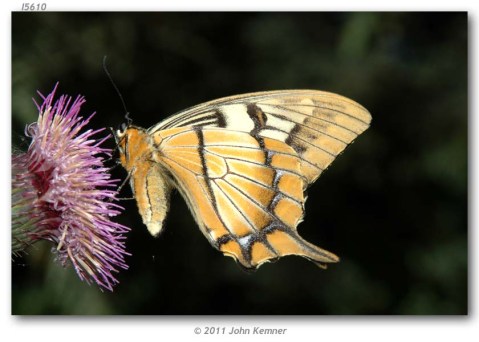
Papilio esperanza, Oaxaca, Mexico
Keep an eye out for these neat oddities as you transcribe. They’re a treat!
— Hannah Owens, Postdoctoral Associate, Florida Museum of Natural History
PhenoMuse Update
As mentioned in an earlier post, we currently have a special museum kiosk expedition being used at the Florida Museum of Natural History. It seems to be going well with lots of users interacting with the kiosks.
Below are some pictures from earlier today. A special thanks to Stacey Huber (Digitization Coordinator at the McGuire Center for Lepidoptera & Biodiversity), for sending these along! I will be in Gainesville, Florida next month and look forward to seeing it for myself.


Feel free to take a peek at the expedition on the Notes from Nature site, but realize that this expedition is designed to be used as part of a special onsite exhibition.
— Michael and the Notes from Nature team
Fixating on Figworts
The figworts (Scrophulariaceae in the broad sense) are a group of flowering plants that often have gorgeous, bilaterally symmetric (left and right sides mirror each other) flowers. They employ a variety of life history and ecological strategies — my favorite is the role of parasitism in these plants! The humble beechdrops (Epifagus virginiana) gets its name from its proximity to beech trees. This proximity stems from beech drops parasitizing the roots of beech (Fagus grandifolia) trees! And few would suspect that the brilliantly colored, delicate Indian paintbrush is a parasite! They are partial parasites (“hemiparasites”) on nearby grasses and forbs.
These plants have undergone a lot of taxonomic upheaval (many name changes) in the past few years. These name changes have mostly been at the family level but some generic and species names have been modified as well. This was spurred by DNA-based research on the evolution of these species and the expert recommendations of the Angiosperm Phylogeny Group.
So this expedition offers two opportunities to you. The first is a chance to learn to recognize the scrophs of Virginia, U.S.A. And the second is the chance to stay on top of some of those troublesome taxonomic name changes!
— Jordan Metzgar, Virginia Polytechnic Institute and State University
New Expedition Studying Impact of Climate Change on Orange Sulfur Butterflies
Because of human fossil fuel use, the world has gotten considerably warmer over the last 60 years, and even if we stopped all carbon dioxide emission today, this warming would continue for several more decades. Climate change has cascading effects on many aspects of the environment, from sea level to how early now melts to rainfall patterns, but there is one thing it can’t change: photoperiod (how much time it is light for each day). This is, in fact, a problem because daylength is used by many plants and animals to determine what time of year it is and thus predict the weather they will encounter. Photoperiod influences decisions ranging from when to produce leaves and flowers in plants to when to migrate and lay eggs for birds. But, now that any particular time of year is warmer without any change in photoperiod, animals and plants aren’t encountering the same conditions as they expected.
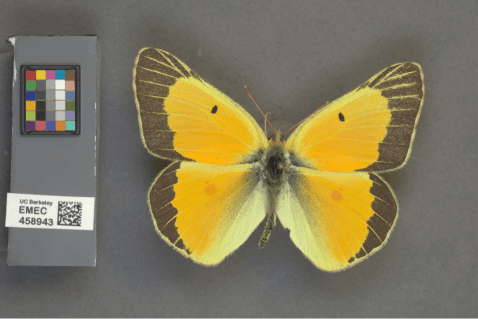
Colias eurytheme summer form
The Orange Sulfur Butterfly (Colias eurytheme) is one of the species encountering this problem. This butterfly is found throughout the US, and comes in two seasonal forms: in the summer, the dorsal (top) side of the wings is bright orange and the ventral (under) side is pale yellow, but in spring and fall, the dorsal side is yellow with a small orange patch, and the ventral side becomes darker. This darkening helps the butterflies warm themselves faster when bask in sunlight on cold days. These forms, however, are not determined by temperature but instead by the photoperiod. Thus, these butterflies are likely suffering from the mismatch between temperature and photoperiod created by climate change. What we want to know is if these butterflies have evolved to compensate for this mismatch, such as starting to produce the summer form at shorter photoperiods (earlier in the spring and later in the fall). To do so, we’re photographing thousands of these butterflies in museum collections from across the past 6+ decades.
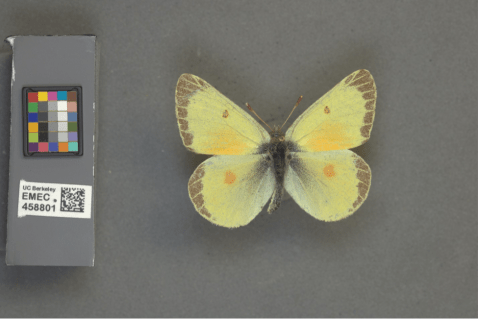
Colias eurytheme spring/fall form
To use these specimens, however, we need to know when they were collected (among other details). This is where you and Notes from Nature come in. Date of collection is right there, recorded on the labels, but we need it digitized in order to work with it in our studies. You can help us access this data by transcribing it. By combining this label data with data we’re collecting about the butterfly’s wing patterns, we will be able to figure out what time of year the butterflies changed between color patterns in different years. We can then, in turn, determine if this color change has evolved in response to climate change, or if the butterflies are falling behind. Our images and the data you enter will also be contributed to LepNet, so future scientists can also make use of it.
This is the first of what will be multiple expeditions featuring these butterflies, this time using specimens from several collections, including the California Academy of Sciences, the Essig Museum at UC Davis, and the Smithsonian National Museum of Natural History. This will give us an initial dataset covering a variety of geographic areas. Thank you all for your help!
— Matthew Nielsen, University of North Carolina at Chapel Hill
Nothing’s BETter than BETULACEAE!
The University of North Carolina at Chapel Hill Herbarium (NCU) once again seeks the aid of Citizen Scientists! We’d like you to join us for an expedition through the Betulaceae (birch) family!
The Betulaceae has six genera and 167 species within its family. The combined production of edible nuts and the tough bark that denotes this family makes Betulaceae a tough nut to crack! However, we trust that you all will handle it with ease!
It’s always an incentive to lend a hand to the family that gave us hazelnuts! From coffee additives to chocolate bars, what is not to like?! Please help us map these trees across the Southeastern United States, and thank you for your company on our expedition.
PhenoMuse: 100 Years @FloridaMuseum
We are excited to announce a collaboration with the Florida Museum for their 100th Anniversary. This is a special museum kiosk expedition being used for their special exhibition. Feel free to take a peek, but realize that this expedition is designed to be used as part of a special onsite exhibition.
The expedition will continue with our recent phenology theme, but it will only consist of one question. The idea is to prioritize specimens for future scoring expeditions and to give visitors a sense of how citizen science projects work in a museum context. There is also interpretive material that goes along with the kiosks. In addition, we hope that these onsite visitors will be motivated to check out some of our more extensive expeditions on Notes from Nature.
— The Notes from Nature team
Thank you! Skipperlings Complete!
Thank you, citizen scientists, for helping complete the Poweshiek skipperling expedition! During this expedition, you saw and transcribed the 155 specimens from the McGuire Center for Lepidoptera and Biodiversity collection. This data will be compiled with other records of Oarisma poweshiek from other institutions so researchers can begin to look for the potential drivers for the sharp decline of populations.
Be on the lookout for another expedition of specimens from the McGuire Center for Lepidoptera and Biodiversity at the Florida Museum of Natural History. And thank you for taking the time to help!
— Stacey L. Huber, Digitization Coordinator, McGuire Center for Lepidoptera & Biodiversity

