
WeDigFLPlants’ Comfort Food Relatives in Florida

Potatoes, sweet potatoes, and yams are starchy staples in many holiday meals at this time of year. We’ve wrapped together the plant families responsible for these comfort foods, Solanaceae, Convolvulaceae, and Dioscoreaceae (respectively), along with the family responsible for the Andean starch Oca (Oxalidaceae), in this new expedition. The flora of Florida contains 60 native and naturalized species from the potato family, 69 from the sweet potato family, 6 from the yam family, and 8 from the oca family. We encourage you to think about which of the four families you are seeing as you transcribe, insofar as it is easy to do so. Florida members of the yam family are all vines with heart-shaped leaves (as seen in the tile for this expedition). Florida members of the oca family are all short herbs with clover-like leaves (photo). The other two families are each other’s closest relatives and quite diverse in appearance, so there isn’t an easy way to differentiate between the two. You can watch for the most diverse Florida genera from these families though. From the potato family, you might come across Solanum (the genus that gives us potato and tomato), Physalis (the genus that gives us tomatillo), and Nicotiana (the genus that gives us tobacco). From the sweet potato family, you might come across Ipomoea (the genus that gives us sweet potato; these are the morning glories) and Cuscuta (the parasitic dodders, which look a lot like silly string). This expedition combines specimens from the herbaria at the University of West Florida, Florida State University, University of Central Florida, and University of Florida. For more info on WeDigFLPlants, visit https://biospex.org/project/wedigflplants.
Thank you for participating!
Austin Mast
Director, Florida State University’s Robert K. Godfrey Herbarium
How to Handle the Cotton Relative Specimens from the Experimental Station

WeDigFLPlants’ Cotton Relatives in the Florida Panhandle

Wetland Specialist Plants of Virginia

Introducing a new ecologically-themed expedition from Plants of Virginia: Wetland Specialist Plants of Virginia! These species share an absolute intolerance for dry, upland conditions and, unless one is a fan of muddy hikes or kayaking, they are not easily encountered. Species restricted to these wetland communities – which range from shaded ravines and forested seeps, to sunny bogs and ponds, to coastal salt-marshes – comprise a flora that is worth getting to know, if only for the critical ecosystem services that they provide. In this edition, over 400 species of wetland-restricted lycopods, quillworts, ferns and flowering plants are assembled for your viewing, no hip-waders required.
— Andrea Weeks
Director Ted R. Bradley Herbarium,George Mason University
Appreciation for the continued effort
We have continued to see some great activity on Notes from Nature the past few weeks, so we wanted to give some general appreciation. We are now over 400,000 transcriptions from over 4,000 volunteers for Notes from Nature 2.0!
Since the beginning of November four more expeditions have been finished. These included Orange Sulfur butterflies, herbarium specimens from Kentucky, microbe mutualists from Virginia and plants from northeastern U.S. forests. In addition, we have several expeditions that are over 90% complete. In particular it would be great to complete Mississippi Coastal Plant diversity which is now 93% complete. This one has been going for a while, so if everyone who reads this post could contribute a few transcriptions it could be done in no time.
All the best from the NfN Team.
Talking about Talk
We are excited to see all the effort on Notes From Nature in terms of transcription effort, but one thing we’ve mentioned less is just how active everyone has been on Talk. But the numbers are insane, in the good way. Today was a record breaking day (we are currently at 203 talk items as of 5pm), and to just get a sense of activity change, below is the talk items per day chart for the past few months (from June 23-November 1).

To what do we attribute all the talking, especially the big change in the last few weeks? We aren’t sure, but whatever it is, its great to see. We love the talking, and we appreciate all your help and willingness to share thoughts, concerns and expertise on the talk channels.
Too many eyes and legs!
We have a new expedition up on SPIDERS just in time for Halloween. Spiders often get a bad rap. They are seen as scary and creepy, especially around Halloween when people decorate their houses and shrubs with fake webs and giant black widows. But spend a few minutes watching them and you will realize spiders are some of the most fascinating and talented animals in your neighborhood. The most conspicuous spiders are the orb weavers that spin webs of concentric circles, like in Charlotte’s Web – though don’t expect to see any advertisements written in these webs. Many of these spiders eat their webs each day, recycling the materials, and rebuild them for the next night’s catch, which they skillfully wrap in silk to snack on later.
 picture credit San Diego Zoo
Many spider species do not build webs at all. Jumping spiders and wolf spiders are active, visual predators with two, large, forward-facing eyes, to go with their lateral eyes. They capture their prey by pouncing on them. Jumping spiders in particular are very inquisitive and often will investigate objects you set in front of them. Many are brightly colored and have very elaborate courtship displays in which they wave their front legs and thump their abdomens (try a search for “peacock spiders”).
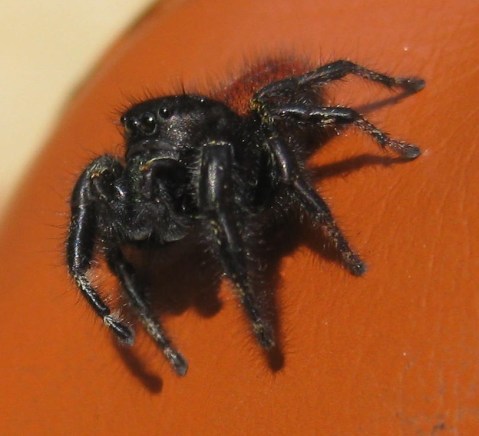 picture credit Susan Kennedy
Spiders also are unfairly accused of bites and crawling into people’s mouths at night. It is not clear where these urban myths came from, but there is no evidence that spiders infiltrate us while we slumber. As far as bites, it is extremely rare that someone actually finds the suspected spider on, or anywhere near them after a bite. Unless a spider feels trapped with no recourse, it very rarely bites. Even when left with the choice of fighting back or losing a leg, many will choose to lose a leg and run away on seven.
So why the bad rap? Probably because we walk into their sticky webs and find them lurking in the corners of our buildings. And also because they look so incredibly different from us with too many legs and too many eyes.
Finally, thanks for your help with our newest CalBug expedition, although maybe in this case we should call it SpiderCal or ArachniCal for this one instead?
Peter Oboyski, with slight embellishment by Rob Guralnick
Another fantastic WeDigBio
Many, many thanks to all that participated in WeDigBio 2017. We had a variety of very successful onsite events as well as lots of volunteers contributing remotely.
NfN had over 20 expeditions active during the event with a total of over 19,000 transcriptions completed over the four-day event! This included two record setting days, one with over 8,000 transcriptions in a single day.
We hope that many of you will come back to NfN again. There are still several great expeditions running that could use your help.
As a reminder, there is lots of information always available on our Statistics page if you want to explore around. You can also review some of the conversations and observations that went on by searching for #WeDigBio
— The Notes from Nature team
Another fantastic day (WeDigBio day 3)
It was another fantastic day at Notes from Nature. We accumulated 2,729 transcriptions. With one more day left we are over 15,000 transcriptions for the event so far.
There are currently 3 expeditions that are over 90% complete. If you are contributing remotely today please feel free to help bring these to completion.
— The NfN Team
Another record setting day!
The second day of WeDigBio was even better than the first! We smashed yesterdays recording breaking day by accumulating over 8,000 transcriptions! This brings us to over 12,000 transcriptions for WeDigBio so far.
A few highlights were the events in Arkansas and Florida, U.S.A. completing over 2,000 transcriptions each on their respective expeditions.
We are excited to see how the last two days unfold. Track the numbers throughout the day on our Statistics page and see lots of fun activity on Twitter.

