
New World Swallowtail Butterflies from the Field Museum of Natural History
The New World Swallowtail Butterfly project has a new expedition up! As you may remember, I am collecting images of swallowtail butterfly specimens to understand how morphological diversity varies across the New World. Museum specimens provide an excellent record of diversity through time and across geography, and the new expedition is no exception.
These butterflies were imaged during my recent trip to the Field Museum of Natural History. The Field Museum Division of Insects houses over 12 million specimens; their Butterfly and Moth collection has a geographic and taxonomic breadth that complements the previous expedition nicely. In addition to helping with my research, the data you transcribe will be sent back to the Field Museum to incorporate into their specimen database for other researchers to use in the future.
As with the previous Swallowtail expedition, remember that there are two images for each specimen—a front and a back. This is important, because in some cases, the labels in the image have different data written on each side. Thanks for your help, and look closely—some of these specimens provide a unique historical record of biodiversity that has since been lost!
Hannah L. Owens, Ph.D.
Postdoctoral Associate, Florida Museum of Natural History
Plants have all the anthers!
A new expedition has been launched on Notes from Nature from the herbarium at Appalachian State University. This expedition contains everyone’s favorite families: Asteraceae and Asclepiadaceae! Look for the title Plants have all the anthers (Pt1) to start transcribing this wonderful collection. As you can tell by the (Pt 1) part of the title that there is more to come. Stay tuned on our herbarium Facebook page and Twitter to see when the next segment of this lovely herbarium is released!
WeDigBio 2016
Many thanks to all the participated in WeDigBio 2016. We had a suite of successful onsite events as well as lots of volunteers contributing remotely.
NFN had as many as 23 expeditions active during the event with over 11,000 transcriptions completed over the four-day event! There were NFN events held from Bangalore, India to London, U.K and several across the United States.

WeDigBio event at the FRLHT Trans-disciplinary University
We had several very productive onsite events with volunteers contributing as many 500 transcriptions in a single day. However the most productive event by far was hosted by Travis Marsico in Arkansas U.S. with over 1300 transcriptions in a single day!
As I reminder there is lots of information always available on our Statistics page if you want to explore around. You can also review some of the conversations that went on by searching for #WeDigBio
Best,
The Notes From Nature Team
Trechine Beetles complete and more Tiger Beetles
Whoops, I made an error: there are in fact only about 1250 species of Bembidion, not over 3000 as indicated in the Trechine Ground Beetle Expedition description. My apologies to all those that noticed! Much thanks to James Bergdahl for bringing it to my attention.
In any case, thanks again to everyone that has contributed to the E.H. Strickland Entomological Museum (University of Alberta Museums) ground beetle expeditions. With the completion of these 1180 specimens, our list of transcribed specimens now totals 2278 records. Only 17,839 more to go!
For our next expedition we will return to tiger beetles. Yep, that’s right, more tiger beetles! Apparently, in the scramble to get new images prepared last time around, I overlooked 1141 records.
Check out the new expedition “Tiger Beetles 3”!
Cheers,
— Bryan Brunet, PhD
Collections Management Advisor (Natural Sciences), University of Alberta Museums, Edmonton, Alberta, Canada
WeDigBio 10K
The Notes from Nature team — all of us — have been amazed by the efforts of our volunteers during the annual WeDigBio transcription blitz. We are in the waning hours, here, as the event winds down at midnight tonight.
Right now, since WeDigBio started Sunday, we have had 9488 transcriptions completed. A HUGE effort! We are hoping to make a last push to 10K before its over, and so if you have a little more to spare to get us over the hump, we’d be excited to make that mark.
We’ll post a longer summary of all the great WeDigBio events etc. during the week, after we’ve had a chance to digest them ourselves.
Thanks, again.
Your Notes from Nature Team
Goldenrods
The Asteraceae (sunflower) family contains the largest number of species world-wide. Thus, it is often broken down into tribes or sub-families in order to make more sense of it. The genus Solidago contains the goldenrods for which there are about 100 species worldwide and 25+ species occurring in Louisiana alone. These plants are a prominent feature of the fall landscape across eastern North America. Goldenrods are characterized by rows of tiny yellow disk flowers atop a green, leafy, and upright stem. Distinguishing between different species of goldenrods can be very difficult, even to a trained botanist. Thus, curated herbarium specimens are highly valuable for comparative studies.
The Director of the Shirley C. Tucker Herbarium at Louisiana State University, Lowell Urbatsch, has been working with a goldenrod specialist in Canada, John Semple, who recently discovered two species never recorded in Louisiana, namely Solidago brachyphylla and S. rigidiuscula, indicating that there is still a lot to learn about this important genus.
Goldenrods are often blamed for fall allergies when they become prominent in fields and roadsides. However, this is not likely the case since the pollen is not airborne. Instead goldenrod pollen is carried by a plethora of insects that favor visiting these bright yellow flowers. Another member of the sunflower family, ragweed, blooms at the same time and in similar habitats, is far more likely the culprit of seasonal sniffles.

Locust borer feeding on goldenrod pollen
Louisiana State University will be hosting a WeDigBio event this weekend focused on transcription of this important genus.
Irene Moon and NFN
The University of California Santa Barbara Cheadle Center for Biodiversity and Ecological Restoration Director has an alter ego. She goes by the name Irene Moon, and she came into being decades ago when Katja Seltmann first started creating science-inspired performance art. Some of the performances are artier, but many of them are specifically created to Perform Science!
This intersection of science and art opens up interesting ways to communicate about natural history collections and science in popular culture. Seltmann and her partner, Yon Visell, have a weekly radio show called “Unknown Territories”, an hour-long cultural arts program on the UCSB campus radio station, KCSB 91.9fm. The show airs on Monday 10-1100am PT and streams online at kcsb.org.
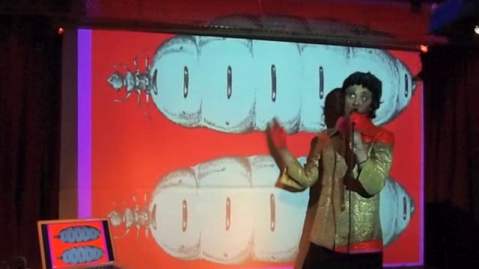
Several of her recordings of science inspired radio shows are available online. You can listen to interviews with researchers about various topics including rust, evolution and field recordings through the Let’s Talk Science series. Recent shows are archived through the Internet Archive and found on the Unknown Territories website. Just like with the collection data she puts online, all of these recordings are all released under Creative Common licenses for reuse, or put into the Public Domain.
Natural history collections work has inspired much of the music, and Irene has several pieces for radio that are specifically about natural history collections. “Curator Bill” is a fictional character that appears throughout the radio pieces, and the audio introduction to Bill.
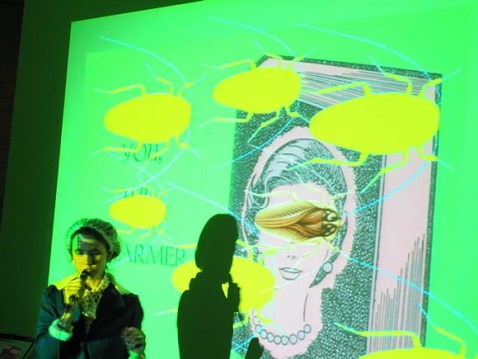
So next time you need perk up a boring lecture for that intro bio class, think about singing songs in a gold jacket, or create music about the topic. She has performed absurd Scientifically Speaking with Irene Moon musical lectures where collections are highlighted as the character of one of her personal heroes, EO Wilson. “Most of the lectures are done in late night musical venues, rock clubs, and raves. The information is factual, inspired by research, and people do learn when they least expect it.”
Find out more at begoniasociety.org
Check out some of her performances at the links below.
Editor’s Note: Katja Seltmann is one of the Curators participating in this weeks WeDigBio Events. You can check out her current expedition (California Plants) on the NFN Herbarium page.
WeDig Tropical Ferns!
We are excited to join folks all over the world participating in WeDigBio by sharing these spectacular photos of neotropical ferns. The plant diversity in the American tropics is stunning, and it is not uncommon for new species to be found, already collected, hiding in the herbarium! We love transcribing labels for these plants because the specimens are so beautiful. It’s fun to imagine what these tropical ecosystems are like. Please join us in the exploration!
WeDigBio kicks off today – help us set our Natural History collections free!
 There has been a flurry of activity at Notes from Nature these past few days, as a number of new Expeditions join us in the Plants section, and new sections for Aquatics and Fossils are launched, all in time for the 3-day WeDig Bio event that launched today!
Starting in Australia….
 It all kicked off at the Australian Museum, where the DigiVol team gathered a group of volunteers to spend the day transcribing some fascinating specimens – check out their projects here: https://www.wedigbio.org/content/digivol. You can help out with these projects at any time, or if that’s your corner of the world, why not join them on Saturday for a great chance to hang-out with others interested in Biodiversity Collections around the world?
….over to Europe – live in London at the time of writing ….
 As the planet turned, we were handed the baton here in London at the Natural History Museum, where we have a team of Visiteers joining us in our Specimen Preparation Area in the Cocoon, helping us to transcribe our ‘Killer Within’ chalcid slides. These tiny wasps are parasitoids, meaning they lay their eggs inside other insects.
When chalcid eggs hatch, the emerging larvae eat the inside of their host. They then grow and pupate until mature enough to burst out as adults, finally killing the host. These tiny creatures play a very important role as biological control agents – they are the natural enemy of a wide range of insect pests that damage our food crops, thus reducing the need for chemicals and pesticides, and saving a significant amount of money as well. You can join us too!
Primulaceae from Royal Botanic Gardens Kew
 We’re joined by our London neighbour Royal Botanic Gardens Kew, who have launched their Primulaceae Expedition in the Herbarium section.
The tropical Primulaceae form a species-rich but poorly known group. Research at Kew aims to further understand the taxonomy, evolution and diversification of the family to mirror our understanding of the temperate Primulaceae. When thinking of Primulaceae, most of us will picture the spring flowers primroses and cowslips.
These are not only charismatic wild flowers but are also important in horticulture. Traditionally, Primulaceae contained only temperate herbaceous groups and whilst known to be very closely related to Myrsinaceae, was kept separate, primarily on account of Myrsinaceae being woody and tropical. However, based on a suite of similar morphological characters and more recent DNA evidence, all species of Myrsinaceae have been placed in Primulaceae. Come take a look!
Amaranthaceae from the Botanischer Garten Berlin
 And just a short trip down to the European continent, we are joined by the Botanischer Garten und Botanisches Museum Berlin, and their newly launched Amaranthaceae Expedition in the Herbarium.
These plants represent the most species-rich lineage within the flowering plant order of Caryophyllales, and are economically important to study because they include vegetables such as spinach (Spinacia oleracea) or forms of beet (Beta vulgaris) (beetroot, chard), and ‘pseudocereals’ such as lamb’s quarters (Chenopodium berlandieri), quinoa (Chenopodium quinoa) and kañiwa (Chenopodium pallidicaule).
A number of species are popular garden ornamental plants, (such as Alternanthera, Amaranthus, Celosia, and Iresine), others are considered weeds (such as redroot pigweed (Amaranthus retroflexus) and alligatorweed (Alternanthera philoxeroides)), and many others cause pollen allergies.
Up Next: North America
Where will you visit? What projects will you join?

Now it’s your turn!
Your help transcribing these specimen labels will allow many more scientists around the world to study the mechanisms of their evolution and investigate biological diversity around the world.
It is essential to link information about organisms and specimens in the collections, to secure this data sustainably and to make it widely accessible and usable. You are helping us to make these collections accessible around the world, and this important information on biodiversity available to everyone.
If you’d like to find an event happening near you, check out the WeDigBio event listings. But you can take part in any of these digitisation projects, from anywhere in the world!
Unlocking Northeastern Forests: Nature’s Laboratories for Global Change
Though plants provide the food, shelter, and oxygen that sustain all other living beings, we are only beginning to understand how even the most familiar plant ecosystems are responding to environmental disturbances such as pollution, human land-use and global climate change. Fortunately to understand our future, we can also look to signs from the past.
Historic plant collections can provide an essential perspective for studying long-term changes in these environments because they chronicle distinct species–and whole communities of organisms–that have lived in particular places and at different points in time. Right now, the New York Botanical Garden is partnering with 14 other research institutions to develop a groundbreaking new dataset for all specimens of vascular plants collected from the Northeast US*.
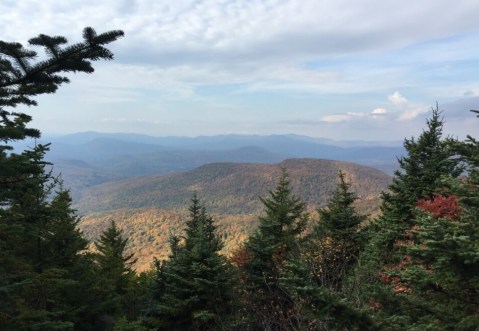
By connecting this network of researchers to the data captured by 1.3 million preserved specimens, participants in this citizen science expedition will help to illuminate subtle variations in species richness and forest composition over time. With your help, understanding how changes in the environment have affected the forests of yesterday will help us to predict how current human behavior will shape the forests of tomorrow!
*This project is funded by an award from the National Science Foundation (EF-1503583)
Charles Zimmerman, Herbarium Collections & Outreach Administrator, The New York Botanical Garden
 Notes from Nature