
Visionary Violets
Spring ephemerals are nature’s reward for surviving winter. These springtime sweeties emerge during the transition from winter to spring. They are an indicator that spring is (finally) on its way. Spring ephemeral plants thrive under unusual conditions. They only have access to sunlight for a brief period of time – they get shaded out by tree leaves once spring is in full swing. The Southeastern United States is home to several species of spring ephemerals. Help us show appreciation for these phenomenal plants while supplementing our database of herbarium specimens.
In an effort to transcribe our spring ephemerals, we wanted to start with a beloved spring star. Violets are a staple spring ephemeral plant. Violets are edible, medicinal, and beautiful – what’s not to love? Their emerald green leaves bring color back to the landscape. Violet flowers – although commonly purple – can be other colors as well! Despite the fickle spring transition we’re having in the Southeast, we’re trying to stay inspired and excited for warmer weather! Remind yourself the winter will eventually end by helping us transcribe these valiant violets!
— Alexandra Touloupas, North Carolina State University
New 5000 badge!

We have recently added a new herbarium badge. This brings our count of herbarium badges to 7. The new “mature grove” badge is earned after completing 5,000 transcriptions on herbarium expeditions. There is something special about this particular badge. It was created by our own longtime Notes from Nature volunteer Mr. Kevvy!
Thanks to Mr. Kevvy for the contribution and congratulations for reaching this milestone!
Another Swallowtail Butterfly Expedition!
It’s about time—the New World Swallowtail Butterfly project has another expedition up. This is the last batch of McGuire Center specimen images I am collecting for a study on the relationships between morphological variation and geography. This collection provides an excellent record of morphological variation across the distributions of these species.
You may also come across some specimens that look different from the other McGuire Center specimens—their backgrounds are white foam with a white ruler for scale. These images were generously provided from the private collections of dedicated amateur lepidopterists. The specimens come from a hybrid zone between two species—Papilio canadensis, Canadian tiger swallowtail, and Papilio glaucus, Eastern tiger swallowtail. We are interested in understanding whether the hybrid species looks more or less like one of its parent species, an amalgamation of the two, or if it has begun to display morphological characteristics that are completely unique.
As with the previous Swallowtail expedition, remember that there are two images for each specimen—a front and a back. This is important, because in some cases, the labels in the image have different data written on each side. Thanks for your help, and look closely—some of these specimens provide a unique historical record of biodiversity that has since been lost!
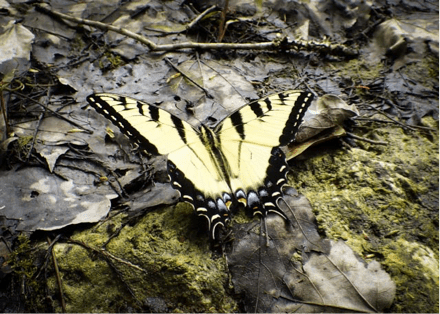
Photo: Hannah Owens
Check back when the expedition is complete—we’ll have some exciting preliminary data for you!
Hannah Owens, Post-doctoral Fellow, University of Florida
Fungus Among Us
Fungus Among Us considers the 19th-Century fungi collected in South Carolina by Henry William Ravenel
It’s not ‘your-celia’, it’s mycelia. Fungus Among Us asks volunteers to consider the myriad of mycelia that invade the earth, leaves, tree-bark and other substrates in their backyards. That’s exactly what Henry William Ravenel did back in the late 1840’s – except his backyard was either the malarial swamps of the lower Santee River or the diverse set of habitats found in and around Aiken, South Carolina. His exhaustive work culminated in the publication of the Fungi Caroliniani Exsiccati published between 1852-1856. The work consisted of five bound volumes called ‘Centuries’. Each Century contains 100 specimens of dried fungi that were painstakingly glued to the pages along with a descriptive label. In all, 30 copies of the five Centuries were produced for a grand total of 15,000 individual specimens that were carefully selected by Ravenel. Recognizing that his work was the first major effort to document the Fungi of North America since Lewis David von Schweinitz (1780-1834), Ravenel sent a copy to the Smithsonian Institution. Later that copy formed the nucleus of what is now the National Fungus Collection. The specimens presented here are from a copy that Ravenel presented to his Alma Mater – South Carolina College (now the University of South Carolina).
We encourage professionals, students, and citizen scientists from a variety of backgrounds (history, botany, mycology, etc.) to explore the world of 19th-Century Mycology and to help us by entering the label data visible on the image for each specimen. There is an interesting twist to this new expedition. Ravenel write his habitat information in latin. We don’t expect you to translate this text into to english, but some might find it interesting to research the meanings. Have FUN transcribing for . Among Us! Your hard work will eventually be displayed on the Mycology Collections data Portal, and will help update the entry for the Fungi Caroliniani Exsiccati.
To learn more about Henry William Ravenel and his contributions to science during the 19th Century please visit Plants & Planter.
Carabid beetle genome #seqthebeetle
This seemed fitting given our current bombardier beetle expedition. In addition, our very own CalBug data provider and NfN founder member Kip Will is a principal investigator on the project.
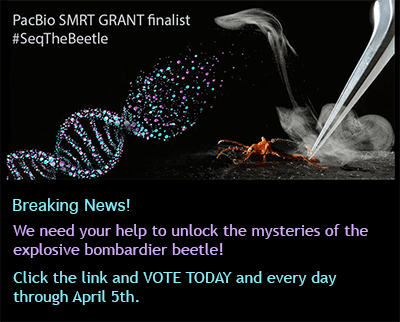
Help get a genome for the amazing Bombardier beetle #seqthebeetle
Vote daily from now until 5 April here https://tinyurl.com/gn84mu8
Leafcutter bees: building the perfect home
Many people have heard of leafcutter ants carrying bits of leaves around the forest like little parasols. Ants are all in the family Formicidae, in the order Hymenoptera, which includes bees, wasps, and ants. Leafcutter ants do not eat the leaves, but rather compost them to feed their fungus gardens. They only eat a particular species of fungus, removing all other species, and constantly tend their gardens to keep them clean.

Photo: Peter Oboyski
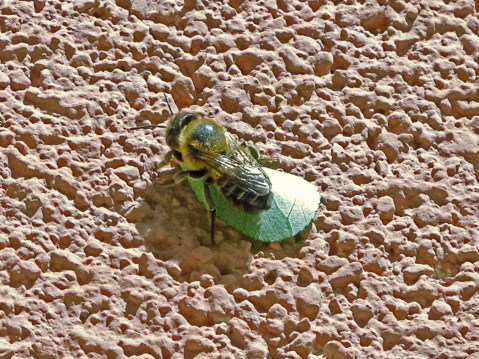
Photo: jacinta lluch valero https://flic.kr/p/ne1WHh

New Bombardier beetle expedition
Thanks to everyone who contributed to the Trechine Ground Beetles 2 expedition. With its completion, we have also finished off our remaining specimens from this ground beetle subfamily, and brought our total number of ground beetle specimens digitized to 4391. That’s a little less than 25% of the total number of specimens we had when we started this project back in July, 2016.
For our next expedition we’ll be focusing on the Bombardier beetles (subfamily Brachininae). The University of Alberta’s E.H. Strickland Entomological Museum has a large number of Bombardier beetle specimens, with 860 already digitized and publicly available from GBIF, and another ~4300 with images remaining to be transcribed as part of this effort. Most of these belong to just one genus, Brachinus, though there are about a dozen genera known in the subfamily. Bombardier beetles are found in temperate and subtropical regions around the world. They get their name from their ability to spray boiling hot chemicals from their abdomen, a characteristic whose mechanical/biological basis eluded explanation until a couple of years ago (a must see article and video here).
You’ll notice that our expedition image has changed from what use to be a photo of a specimen drawer to something a little more lively. We now feature an in situ photograph of a Brachinus specimen courtesy of PhD student and carabidologist, Wesley Hunting. Thanks Wes!
Make sure to check out our Bombardier beetle expedition!
Cheers,
–Bryan Brunet, PhD
Collections Management Advisor (Natural Sciences), University of Alberta Museums, Edmonton, Alberta, Canada
We thought the timing was good for a phenology expedition
It’s tantalizing close to Spring here in North America, and some of you may have noticed hints of it, not just the nicer weather, but maybe moreso the first blooms of redbud, apple and plum and cherry trees, dogwoods, citrus. These harbingers of Spring have been part of not only the natural season cycle, but also human cultural history, for millennia.
People have been recording phenology for thousands of years. In Japan, records were kept of cherry blossoms back starting in 812AD. Yeah, not 1812, but 812. These have become part of national festivals around the world, with famous festivals in Tokyo and Washington DC. The date at which plants first flower, or have peak flowering, are often directly linked to climate conditions. The same is true of first appearance of new leaves, or new fruits. In Fall, leaf senescence, with first changes in leaf color, is also tied to temperature, as well as day length.
How do we know historical patterns of phenology? In some cases, we can refer to diaries and other written records, such as the case in historical record-keeping in Japan. In the last decade, we have a lot more tools at our disposal, including remote sensing – yes, imaging devices on satellites can tell when our planet gets more green! But for phenology records going back the last century, one powerful resource are natural history collections. A lot of the specimens collected and stored in museums tell us about phenology. But in order to use those data effectively for science, we need to actually report phenological stages and traits from those specimens. And that is where you come in!
Our newest expedition is a different beast than ones we have run in the past. In this expedition, you’ll help us determine if specimens from oak trees have flowers or fruits. These specimens already had their labels transcribed as part of an earlier expedition, and now we’ll annotate phenology information as well, and have that information associated with the specimen label data. These data can be used to look at historical patterns of phenology, and linked to past climate data records, to determine relationships, ultimately across many different species.
We are interested in your feedback on this first try at Notes from Nature with reporting phenology. In later expeditions, we may ask for more detailed information such as how many flowers are visible on a specimen, or fruits (in the case of oaks, we call the fruits “acorns”). For now, thanks for the help with enhancing the ability to use specimens for new kinds of science. We’ll share more about the science we are hoping to enable in later blog posts.
Finally, we are also launching our first mini-course with this expedition. This mini-course is about phenology, and how and why it is studied. What is a mini-course? Every 5 or so transcriptions, you’ll get some more information on phenology. We have 11 total “slides” in our mini-course, so you can see them all if you do 55 transcriptions. We haven’t tried a mini-course before, and we hope it proves interesting and not distracting. Let us know!
Introducing NFN Labs
We have always wanted to make Notes from Nature a place where our amazing volunteers can try out new activities, as long as they have high scientific value. In order to try out some of those activities, and find out what you think about them, we are excited to launch a new section of Notes from Nature called “NFN Labs”. The “Labs” idea lets us be experimental, while we remain committed to our core mission of helping to unlock natural history data, one record at a time.
NFN Labs is a place to try new kinds of expeditions. For example, we might have a labs expedition where instead of transcribing most of specimen label, we might have just one field that is needed. Or maybe we ask for help getting latitude and longitude information based on textual descriptions of localities where a specimen was collected. Or, as in the case of our first NFN Labs expedition, we might ask you to answer a question or two about the specimen itself, such as whether it has flowers or fruits. We also want to use the NFN Labs idea to test new features and get feedback. In the first Labs expedition, we are also launching our first mini-course. Mini-courses provide extra content on a topic that shows up after performing a certain number of transcriptions – in this case after 5 transcription. The topic of the first mini-course covers why phenology is important to study.
After we have tested out some labs ideas, they may move into more full “rotation” as part of Notes from Nature. We really hope some of these new experiments are cool and fun to do, while also keeping the same high bar of having immediate value for scientific use. We always appreciate (and crave) feedback. What do you think of our first NFN Lab?

