
Why do we need so many collections of the same plant?!
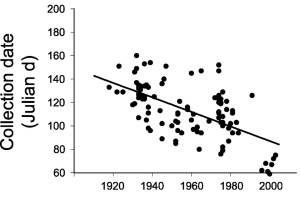
Figure from a paper by C. Lavoie and D. Lachance showing a shift toward earlier flowering time for coltsfoot (Tussilago farfara). Image used by permission of the Botanical Society of America.
When people first get a look inside of a herbarium cabinet they often ask: “why do you need so many specimens of the same plant species?” Well there are a few reasons for this. People who study plants don’t just want to see one example of a species. They may want to see multiple collections so that they can understand the variation in characters for the species. For example, the leaf shape may be highly variable so we would need to see different specimens to understand this. It may also be important to get an idea of all the places where a certain plant can be found. We would need several specimens from different locations to understand the geography. We may also want to know how characteristics of a plant, or its geographic distribution, might be changing over time. In this case, we would need collections from multiple years.
The change in when plants bloom (aka phenological shift) has received a lot of attention over the past few years. It is now well established that changes in the climate have caused many species to shift the timing of when the leaves emerge in the spring (leaf out) and when the flowers open. This shift has major implications. One example is that a plant might bloom before its pollinators are available. If pollination does not occur, this could result in the plant not being able to produce fruits and seeds, which are important for the future success of the species.
Herbarium specimens can be used in a relatively simple way to study phenological shifts.
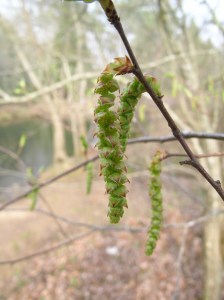
American Hornbeam (Carpinus caroliniana) flowering in March 2007.
Using the date information provided on the specimen label, we can record the day of the year that different plant collections were made (e.g., collections showing flowers in bloom) and graph these values against the year. What is commonly found is that plants are blooming earlier as a response to a warmer climate. For example, the graphic at the right shows how a plant is blooming earlier. The collections made in the year 2000 bloomed several days earlier than the ones collected in 1920. The full article can be read here.
I am interested in knowing the date that plants were collected for a different reason.
For exotic species, or species that are relatively newly introduced into an area, it is valuable to know when they first arrived in a new place and how fast they are spreading. If we can locate the earliest museum records of a species in the United States for example, we can then trace its expansion to new areas over time using additional museum records (subsequent collections). We can then examine where the exotic species has spread and how fast. There are many factors that influence the spread of exotic species, but describing the basic aspects of their spread in space and time is a first important step in our efforts to understand this process.
The Notes From Nature projects asks citizen scientists to transcribe specimen labels in order to help record this kind of information that is important in ecological research. The date is a simple but extremely important piece of information. Phenological shifts and the spread of exotic species are two important issues that can be addressed using this information.
-Michael Denslow
What is an herbarium?
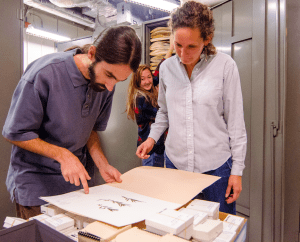
Researchers working in the herbarium at Appalachian State University
An herbarium is a place that houses plant specimens. Many people expect that an herbarium will be filled with living plants. However, these plant specimens are pressed, dried and glued to sheets of paper. They are dead. The sheets of paper are typically stored inside of cabinets for safekeeping and organizational purposes. An herbarium is similar to a library in that both house artifacts (specimens or books) in a safe and organized way that allows them to be found and used by researchers. If plant specimens are stored properly they will last hundreds of years with little sign of degradation.
If you think about it, it makes sense to store plant specimens in this way (as dead samples). Logistically you can fit and care for many more pressed specimens than living plants in the collection. In addition, an herbarium often contains plants from all over the world including plants from diverse habitats such as deserts and alpine tundra. It would be tough to grow all of these different plants in one place.
Herbaria are sometimes part of natural history museums, associated with botanic gardens or academic institutions. The largest herbarium collections in the world are housed in Paris and New York. These large collections contain millions of specimens. However most herbarium collections are much smaller. There are more than 3500 herbaria scattered across the world. In fact, you likely have a local herbarium that contains specimens of the plants that occur in your area. To learn more about the herbaria in your area you can search Index Herbariorum, a global directory of herbaria.
-Michael Denslow
Introduction to Notes From Nature
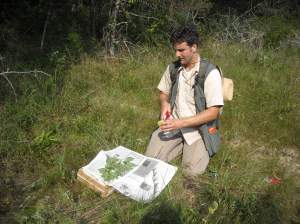
Michael Denslow collecting plants in central Tennessee, USA.
Humans have been collecting specimens from the natural world for centuries. These specimens include samples of rocks, minerals, plants, fungi and animals. In fact, a lot of the knowledge that we have about the earth’s plants and animals is based on specimens that were collected in nature. These specimens are now housed in natural history museums. The world’s great exploration expeditions often included teams of scientists that documented the things that they saw along the way. For example, Lewis and Clark’s expedition of the western United States resulted in the discovery of hundreds of plants and animals that were new to science.
Today, there are an estimated 2 billion specimens housed in natural history collections around the world. This incredible resource provides us with baseline information about the biodiversity of the earth. In addition, the data resulting from these specimens has been used to address a wide range of society’s pressing issues such as public health and environmental change.
However, for this resource to be used to it full potential there must be better digital access to the collections. Most natural history collections are housed in museum cabinets, where they are not easily available to citizens and researchers. It is estimated that only about 1/3 of all natural history specimens are available digitally over the Internet! In effect, the other 2/3 of this biodiversity information is locked away from view. This is despite the fact that the natural history museum community is committed to providing access to this data.
The Notes from Nature project is about digitally unlocking this treasure trove of biodiversity data. Contributions from the public or informally trained people have always played an important role in the field of natural history. These citizen scientists, as they are now called, have made many important contributions, including collecting specimens and even describe new species. Today’s technology provides us with new ways for people to engage with natural history collections, and to help promote access to this biodiversity resource.
The Notes from Nature project has built a tool that enables citizen scientists to make a scientifically relevant contribution though the transcription of specimen label information. Please consider helping us unlock this important information by taking some notes from nature. Every transcription that is completed brings us closer to the goal of providing access to this critical resource.
Take Notes From Nature!

