
See no-see-ums Hawaii Expedition
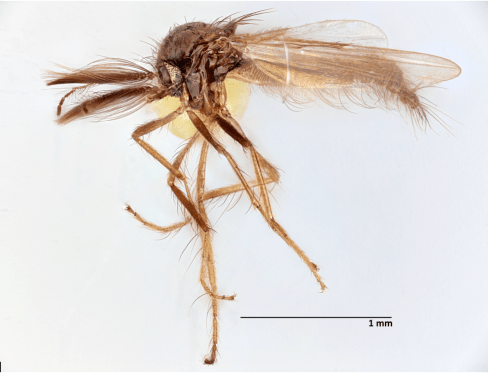
Calling all nature and science lovers. We need your help. If you enjoy learning about insects and museum collections, you can help researchers studying the biodiversity of parasites by transcribing specimens in the Bishop Museum Entomology Collection.
We are launching a new expedition to digitize our U.S. parasite collection starting with no-see-ums from Hawaii. No-see-ums or “punkies” are tiny midges usually less than 3 mm wingspan. They are barely bigger than nothing, but their painful bite feels like a burning piece of ash. Hawaii has 8 native species in two genera: Dasyhelea and Forcipomyia. One native species of Forcipomyia rarely bites humans and other animals, but adults of most native species feed on pollen and nectar and are important pollinators, including some crop plants like cacao.
Eight alien species have been introduced into Hawaii by human trade. One recently established species, Culicoides jamaicensis belongs to a group of important human and veterinary pests and may become problematic in Hawaii.
Because of their small size, these midges are usually glued on paper points mounted on insect pins. Specimens in the Hawaiian insect collection include hundreds of important historic pinned specimens. They represent an important reference collection documenting the biting midge fauna of Hawaii.
Your participation in this expedition will not only be helping the Bishop Museum but will be assisting a larger community involving 22 museums and institutions that are working together to digitizing over a million parasite specimens. The Terrestrial Parasite Tracker project goals are to synthesize thousands of important arthropod records so that the specimens, and their associated data, will be available to help understand and predict the spread of human and wildlife disease.
Please join our virtual ohana of citizen scientists and help unlock valuable information about the diversity and distribution of these parasites making these data available to scientists across many disciplines.
You can find the new See no-see-ums Hawaii expedition in the Terrestrial Parasite Tracker Project.
— Jim Boone, Bishop Museum, Honolulu, Hawai‘i
WeDigBio Lite Day 1 Summary
WeDigBio Lite got off to an amazing start! NfN received 5,119 transcriptions on day 1. We’d love to hear about everyone’s experiences participating online. Feel free to check in on NfN Talk with any thoughts or impressions you would like to share.
We’d also like to send a special shout out to the volunteers and project team from Notes from Nature – Plants of Arkansas. That project contributed 1,540 transcriptions, which is 30% of yesterday’s total.
We are so grateful to each and every person who participated no matter which project or how many transcriptions you completed!
— The Notes from Nature Team
NYBG Globe Spotter

Every year, tens of thousands of new botanical collections make their way into the William and Lynda Steere Herbarium from every corner of the globe. Often arriving pressed between sheets of newspaper from their country of origin, these precious biological samples document everything from enormous rainforest trees to tiny wildflowers. When made accessible quickly to researchers online, these incoming collections represent a vital flow of new information about the state of the world’s plants and fungi.
Through our latest virtual expedition series, “NYBG Globe Spotter”, Notes from Nature participants can help rapidly connect scientists to biodiversity collections worldwide which are relevant to their field of interest. If you’ve participated before in our US State Spotter projects, you will recognize this streamlined workflow focusing on each subject’s geographic origin. In these new series of expeditions, you will travel virtually to nearly every continent on the planet as you search specimen labels for clues to identify the COUNTRY (or US State) where each organism was collected from its environment.
In response to mounting global crises, from public health to biodiversity loss, it is more important than ever to understand the multitude of connections that hold our living Earth together. Fortunately, by helping to uncover the latest botanical observations from around the world, you can directly support scientific research to investigate these planetary threads.
To get started, follow the link to our latest “NYBG Globe Spotter” expedition on the Notes from Nature-NYBG project page.
— Charles Zimmerman, New York Botanical Garden, William and Lynda Steere Herbarium
Zooniverse username: @czimmerman
Hop to it! With the new MI-Bug grasshopper expeditions
We are launching a new series of expeditions exploring the specimens located in the University of Michigan Museum of Zoology Insect Collection. First up, grasshoppers! Grasshoppers are found around the world and some species can be found as close as your backyard. Grasshoppers are often called ‘locusts’ and are an important part of the environment providing food for both animals and people alike. In some areas certain species can even be agricultural pests, as they like to eat the same plants we do. By rubbing their hind legs against their forewings, many male grasshoppers will also ‘sing’ to try and attract a mate – isn’t that sweet?
The grasshoppers you will be looking at as part of our MI-Bug project could be recently collected specimens, or they could be over a 100 years old as our collection started back in 1913 with some things collected even before then. They could also be from places as close by as Michigan or Wisconsin, or from more exotic places like the Amazon Rainforest or African savanna. With your help, these are some of the things we’re hoping to find out.
So, as we’re all cooped up in our houses for now, consider becoming a citizen scientist on MI-Bug project on the Notes from Nature website and help us discover more about the insects in our collection.
Thank you for your help!
— Erika Tucker, UMMZ Insect Collection Manager & Assistant Research Scientist
Help Study Parasite Biodiversity from Home
If you are sitting at home watching wildlife from your kitchen window, you are witnessing several levels of biodiversity that cannot be seen through binoculars. Birds and mammals are hosts to many different parasites that live amongst their fur and feathers such as: lice, fleas, flies, ticks and mites. Most of these parasites are restricted to a single host, but some of these parasitic arthropods can vector pathogens that affect humans (for example, prairie dog fleas transmit the pathogen that causes plague). Yet, data about parasitic arthropods are underrepresented among digitized museum specimens, which makes them hard to find and study. To solve this void, 22 museums and institutions in North America have teamed up to digitize data for over 1.2 million parasite specimens in the next three years, including Dr. Sarah Bush, in the School of Biological Sciences.
“We have a collection with over 80,000 parasites from around the world,” Bush says. “There are slides from extinct birds, new species, and new genera hidden in our collection, we just need help determining what we have.” To digitize specimens, Bush and colleagues have turned to a citizen science platform called Notes from Nature, where anyone, anywhere can go online and help transcribe data from historic microscope slides. “Our goal is to better understand the distribution and evolution of parasite diversity” explains Bush. “By digitizing data from existing specimens, we are hoping to understand where these parasites occur? What hosts these parasites infest? Which parasites are most likely to vector pathogens to humans, and whether their distribution has changed over time?”
Citizen scientists involved in this project get to peek through the parasite collection. “You never know what you’re going to find”, says Bush, “the slides you see may be new species of parasites from your backyard, or they might be a parasite collected 100+ years ago in the far reaches of New Guinea.” We may be stuck at home, but this is a way to explore new levels of biodiversity that can be shared and studied by new generations of biologists.
If you are interested in helping with this citizen science project visit the “Terrestrial Parasite Tracker” project on the Notes from Nature website.
— The Terrestrial Parasite Tracker Team
Gray Matter: North American Geometrid Moths
We are launching a series of Expeditions called Gray Matter: North American Geometrid Moths! In this new expedition you will see multiple species and genera of North American Geometridae. This collection was curated by one of the North American experts, Dr. Charlie Covell.
The name Geometridae is derived from the Greek words “geo” (earth) and “metron” (measure). The caterpillar appears to ‘measure the ground’ as it moves, like a tiny walking tape measure, one inch at a time hence the name “inchworm”. Although the adult moths are often gray, and less colorful than their butterfly counterparts, they are widespread moths that are ecologically and economically important. Some Geometridae, such as cankerworms, are destructive pests of hardwood trees. Biston betularia moths (included in this expedition), have light and dark wing phenotypes, which have been used to study effects of industrial pollution. Their caterpillars also have multiple phenotypes; they can mimic different colors of twigs in order to more effectively camouflage on their host plants.
It is important to remember that you will be looking at two images per moth, dorsal and ventral. The reason for this is because there sometimes is critical information on the back of labels. So be sure to check both images! While checking both images, look at the amazing shapes and minute coloration of the moth. Thank you so much for your help!
— Laurel Kaminsky
Digitalization Coordinator, McGuire Center for Lepidoptera & Biodiversity
Presentations from some of our Scientists for WeDigBio Lite
We are excited to offer two presentations from our Notes from Nature scientists during WeDigBio Lite. WeDigBio Lite is taking place April 16th – 19th. On Thursday the 16th and Friday the 17th at 11am eastern we will offer presentations that are open to the community. More information and registration information can be found below.
Thursday April 16th 11am Eastern
Finding Wallace: Insect expeditions in the Malay Archipelago
Dr. Peter Oboyski, Essig Museum of Entomology
Our modern understanding of plant and animal distribution patterns (biogeography) date back to Alfred Russel Wallace, who collected insects and other organisms in Malaysia and Indonesia in the 1850’s. His discoveries and observations challenged the scientific community and inspired generations of biologists. Researchers at UC Berkeley are following in Wallace’s footsteps to conduct a biotic survey of the insects, spiders, birds, small mammals, reptiles, and amphibians of the island of Sulawesi, Indonesia. Part of this five year project is to discover insect species new to science and document how their diversity changes over an elevation gradient on nine mountains scattered across the island. In this presentation, find out what it is like to spend 3-4 weeks living in a tent in the jungles of Indonesia to collect night-flying insects.
Register in advance for this meeting: https://appstate.zoom.us/meeting/register/vpcpdu6gpj0u9U4iGnlrqJiFstzpJita_Q
After registering, you will receive a confirmation email containing information about joining the meeting. Note that we will not save your email and it will only be used for the purposes of this meeting.
Friday April 17th 11am Eastern
Comparing phenology annotation by in-person and Notes from Nature volunteers
Dr. Laura M. Brenskelle, University of Florida
In June and July 2019, the Notes from Nature community helped us complete two phenology annotation expeditions for Prunus (cherry) and Acer (maple) herbarium specimen images. These annotations for the presence or absence of fruits, flowers, and unfolded leaves were analyzed for accuracy and compared to in-person volunteers who performed a similar task on the same specimen images. Our findings include recommendations for how to maximize human effort in image annotation projects and demonstrate the advantages and disadvantages to in-person and Notes from Nature annotation approaches.
Register in advance for this meeting: https://appstate.zoom.us/meeting/register/tJEkc-CtrjMjYFbJVgGVFWVWUTkpuzW1tg
After registering, you will receive a confirmation email containing information about joining the meeting. Note that we will not save your email and it will only be used for the purposes of this meeting.
Hope to see you there,
The Notes from Nature Team
WeDigBio Lite
Please join Notes from Nature for WeDigBio Lite coming April 16-19, 2020. WeDigBio is a global data campaign that mobilizes participants to create digital data about biodiversity specimens. This special WeDigBio event is “lite” because it will be online only (no onsite events).

Notes from Nature has been getting lots of interest from educators for use by students away from the classroom, from employees working remotely, and from people just looking for something fun and productive to do from home. As a result, we have lots of content on the site from butterflies and beetles to lice and of course lots of plants! We will also be adding more expeditions as we get closer to the event.
Educators can find resources on the WeDigBio education site. We are also planning some events over video conference so stay tuned for those as well.
If you are one of the fortunate ones who is safe at home, well stocked, connected online and has some extra time on your hands please spread the word and join us. We have a Facebook event that you can share with your friends and feel free to share your own ideas on the Notes from Nature Talk forum.
— The Notes from Nature Team
Introducing the The Terrestrial Parasite Tracker Project (TPT)
Let’s take a break from talking about the spread of coronavirus and turn our attention to other important vectors of diseases. Parasitic arthropods inflict an enormous burden on human society. They afflict humans and the animals on which we depend. Fleas transmitted bubonic plague, mosquitoes vector malaria and dengue, and ticks transmit the bacteria that causes Lyme disease. Arthropods have vectored the parasites and pathogens that cause disease to hundreds of millions of people. Yet, this is not just the stuff of history, we are faced with similar issues today. In fact, vector borne diseases are increasing as the climate and ecosystems change. The Center for Disease Control (aka CDC) estimates “illnesses from mosquito, tick, and flea bites have tripled in the U.S., with more than 640,000 cases reported during the 13 years from 2004 through 2016.” Human movement, land use, and rapidly changing environments have contributed to both range expansion or distribution changes in many arthropod vector species and the recent surges in the diseases they transmit. Arthropod-borne pathogens can also have a significant impact on our livestock, which poses a serious threat to agriculture and food security globally. Our ability to understand and model the potential risk of parasites is hampered by a lack of baseline information.

Data about parasitic arthropods are underrepresented among digitized specimens. This is because people tend to focus on charismatic animals (like big vertebrates). Although parasitism is one of the most common lifestyles on the planet, parasite data are not readily accessible. Parasite specimens exist, however, the collections can be difficult to find. Specimens of parasitic arthropods are often stored separately from invertebrate collections; they are kept in collections with their hosts, or in smaller collections held by specialist researchers around the country. These hidden collections tend to be data-rich collections that represent irreplaceable knowledge about past organismal habitats, distributions, and parasite-host associations.
The goal of the Terrestrial Parasite Tracker (TPT) project is to mobilize and digitally capture these parasite collections to help understand the host-associations, evolution, distribution, and the ecological interactions of these important vectors. These data will assist scientists, educators, land managers, and policy makers. We will focus on lice, fleas, ticks and mites, biting true bugs and biting flies. We have teamed up with 22 collections and institutions with the goal of digitizing over 1.2 million specimens over the next 3 years and we are excited to work with our Notes from Nature community to help make this project a success!
Check out our first expedition in the new TPT Project!
— Julie Allen University of Nevada, Reno
Field Book Update
As many of you are already aware, we have recently encountered some glitches with one of the Notes from Nature features called the Field Book. The Field Book is the place where Notes from Nature users can look at their personal statistics and the badges they have earned. We are very sorry about this glitch, but the good news is that we have a solution that deals with this problem!
Now each Notes from Nature Project will have a dedicated Field Book. The Field Book will collect information about your work and it will be organized by specific Projects, such as Southeastern U.S. Biodiversity or CalBug.
Your Field Book can be accessed using the link at the lower right of each Project’s landing page. The Field Book contains things like recent classifications, links to your Favorites and weekly statistics. The badge section not only contains the badges that you have earned, but you can also see your remaining badges (which are ones you are still working towards) and your progress towards them.
Your Field Book will show general statistics that reflect previous effort. However, the Field Book will be collecting information for things like time or decade badges starting now. While we acknowledge that this solution is not perfect, this is the best we are able to do right now. We still have the goal of a Notes from Nature wide Field Book that reflects all effort across our many Projects, but this capability will have to wait until we have additional developer resources.
We greatly appreciate everyone’s efforts on all of the Notes from Nature Projects. Thank you very much for all that you do!
The Notes from Nature Team
 Notes from Nature