
Talking about Talk
We are excited to see all the effort on Notes From Nature in terms of transcription effort, but one thing we’ve mentioned less is just how active everyone has been on Talk. But the numbers are insane, in the good way. Today was a record breaking day (we are currently at 203 talk items as of 5pm), and to just get a sense of activity change, below is the talk items per day chart for the past few months (from June 23-November 1).

To what do we attribute all the talking, especially the big change in the last few weeks? We aren’t sure, but whatever it is, its great to see. We love the talking, and we appreciate all your help and willingness to share thoughts, concerns and expertise on the talk channels.
Too many eyes and legs!
We have a new expedition up on SPIDERS just in time for Halloween. Spiders often get a bad rap. They are seen as scary and creepy, especially around Halloween when people decorate their houses and shrubs with fake webs and giant black widows. But spend a few minutes watching them and you will realize spiders are some of the most fascinating and talented animals in your neighborhood. The most conspicuous spiders are the orb weavers that spin webs of concentric circles, like in Charlotte’s Web – though don’t expect to see any advertisements written in these webs. Many of these spiders eat their webs each day, recycling the materials, and rebuild them for the next night’s catch, which they skillfully wrap in silk to snack on later.
 picture credit San Diego Zoo
Many spider species do not build webs at all. Jumping spiders and wolf spiders are active, visual predators with two, large, forward-facing eyes, to go with their lateral eyes. They capture their prey by pouncing on them. Jumping spiders in particular are very inquisitive and often will investigate objects you set in front of them. Many are brightly colored and have very elaborate courtship displays in which they wave their front legs and thump their abdomens (try a search for “peacock spiders”).
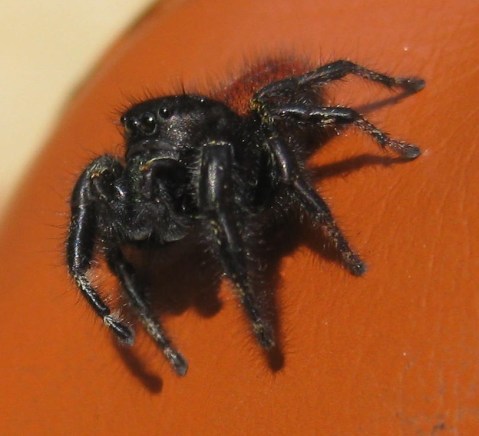 picture credit Susan Kennedy
Spiders also are unfairly accused of bites and crawling into people’s mouths at night. It is not clear where these urban myths came from, but there is no evidence that spiders infiltrate us while we slumber. As far as bites, it is extremely rare that someone actually finds the suspected spider on, or anywhere near them after a bite. Unless a spider feels trapped with no recourse, it very rarely bites. Even when left with the choice of fighting back or losing a leg, many will choose to lose a leg and run away on seven.
So why the bad rap? Probably because we walk into their sticky webs and find them lurking in the corners of our buildings. And also because they look so incredibly different from us with too many legs and too many eyes.
Finally, thanks for your help with our newest CalBug expedition, although maybe in this case we should call it SpiderCal or ArachniCal for this one instead?
Peter Oboyski, with slight embellishment by Rob Guralnick
Another fantastic WeDigBio
Many, many thanks to all that participated in WeDigBio 2017. We had a variety of very successful onsite events as well as lots of volunteers contributing remotely.
NfN had over 20 expeditions active during the event with a total of over 19,000 transcriptions completed over the four-day event! This included two record setting days, one with over 8,000 transcriptions in a single day.
We hope that many of you will come back to NfN again. There are still several great expeditions running that could use your help.
As a reminder, there is lots of information always available on our Statistics page if you want to explore around. You can also review some of the conversations and observations that went on by searching for #WeDigBio
— The Notes from Nature team
Another fantastic day (WeDigBio day 3)
It was another fantastic day at Notes from Nature. We accumulated 2,729 transcriptions. With one more day left we are over 15,000 transcriptions for the event so far.
There are currently 3 expeditions that are over 90% complete. If you are contributing remotely today please feel free to help bring these to completion.
— The NfN Team
Another record setting day!
The second day of WeDigBio was even better than the first! We smashed yesterdays recording breaking day by accumulating over 8,000 transcriptions! This brings us to over 12,000 transcriptions for WeDigBio so far.
A few highlights were the events in Arkansas and Florida, U.S.A. completing over 2,000 transcriptions each on their respective expeditions.
We are excited to see how the last two days unfold. Track the numbers throughout the day on our Statistics page and see lots of fun activity on Twitter.
A new record!
The first day of WeDigBio 2017 was a huge success. On Notes from Nature we had over 4,000 transcriptions on the first day (4,209 to be exact!). This bests our previous record of 3,354.
We can’t wait to see what day 2 will have in store. Remember that you can look at lots of interesting numbers on our Statistics page. If you are participating in an onsite event, please come over to Talk and tell us about your event. We’d love to hear from you.
— The NfN Team
WeDigBio 2017

The Notes from Nature team is really excited to be involved in the WeDigBio event that is taking place this week! There has been a flurry of activity at Notes from Nature as we gear up for the event. We currently have over 20 expeditions running. A number of new Expeditions have joined for the 3-day WeDigBio event.
WeDigBio stands for Worldwide Engagement for Digitizing Biocollections. It is a global event that focuses on digitizing of natural history museum specimens, which is something we care very deeply about.
The focus of the WeDigBio event is on onsite digitization gatherings that will take place around the world over the next few days. Many of these events will include fun activities and tours of the museums. Notes from Nature has been primarily a distributed group of people working towards a common goal. We are excited to see how bringing people together in one place will go and we certainly hope it will be an engaging and fun experience.
Even though most of the events are onsite, you can still participate from wherever they are! You can track the progress on the very cool dashboard on the WeDigBio site. We will also be using the hashtag #WeDigBio on Twitter and Facebook, along with some blog updates during the event, which runs from Oct. 19th to the 22th.
Join along on Journeys to the “Botanical Fountain of Youth”: Expeditions of John K. Small (1869-1939)

The William and Lynda Steere Herbarium is excited to launch our newest expedition featuring historic collections by NYBG’s first Curator of Museums, Dr. John Kunkel Small. Destined to be an explorer since his first forays in the mountains of western North Carolina as a college student, Dr. Small would go on to collect over 60,000 specimens of flowering plants, ferns, mosses, hepatics, and fungi–and discover thousands of species new to science.
While documenting the flora of Southeastern North America, Small also witnessed major changes to our country’s natural landscape. His many expeditions to subtropical Florida (more than 35 in as many years) revealed huge destructive impacts of canal building and agricultural expansion on native wetlands and other pristine habitats. These revelations launched Dr. Small’s life-long quest to promote conservation action in Florida, an endeavor that culminated with the successful formation of the Everglades National Park (established in 1934).
Over the past 80 years, Small’s Florida has been further transformed by its ever-increasing human population. Miami–a town of 2,000 residents in 1901–now houses nearly 500,000; and the whole state is estimated at over 20 million. Agriculture and industry have largely prevailed against lands once classified as “terra incognita”. Fittingly, it is thanks to Small–and the generations of herbarium curators who followed him–that we can still examine and investigate organisms that lived and thrived decades before human development had exacted its toll.
By helping us transcribe Dr. Small’s collection of preserved herbarium specimens, you will be making unprecedented new data available that helps scientists reconstruct the primordial natural history of Florida and the Southeastern United States. Get ready to travel back through time and get lost in a land that “had drunk in her own rejuvenating waters”- John K. Small (1922).
To find out more: @NewYorkBotanicalGarden (Zooniverse ID)
WeDig Tropical Ferns!
We are thrilled to join folks all over the world participating in WeDigBio by sharing these spectacular photos of African and Australasian ferns. The plant diversity in these parts of the world are stunning, but their existence is threatened with habitat destruction. Aside from us admiring their beauty, we love transcribing labels for these plants because it’s fun to imagine what these ecosystems are or used to be like.
Our new expedition is called Fantastic Ferns! Unlock Tropical Diversity from Africa and Australasia. Please join us in the exploration!
American Museum Specimens Join the Swarm of Swallowtails
As WeDigBio rapidly approaches, we have one last batch of Swallowtail butterflies ready for transcription — these from the American Museum of Natural History. By now you (and I) may have seen quite a few of these large, colorful butterflies. Do we really need more?
Yes! I’m working toward understanding variations in wing shape across the full geographic range and diversity of the group. Some museums have particular strengths in certain parts of the world, and more established museums like the American Museum and the Smithsonian (remember that batch from last month?) have specimens that are particularly rare and historic. This is valuable to me because I want to examine specimens from all species of New World Swallowtails, and this trip to the American Museum completed my collection of digital images.
I was particularly excited to come across several specimens of the Esperanza Swallowtail, Pterourus esperanza. These were the first I had seen in visits to three other major museums and searching through thousands of specimens. Esperanza Swallowtails are found only in the cloud forests of the Northern Sierra in Oaxaca, Mexico, and weren’t even described until 1975. A 2013 study estimated the population size to be 286 individuals. The precious few specimens at the American Museum can help give us insight into the evolutionary context for this rare and enigmatic species. That understanding can hopefully help better conserve this and other swallowtail species.

Sierra Juarez, Oaxaca, Mexico https://flic.kr/p/5nWotU
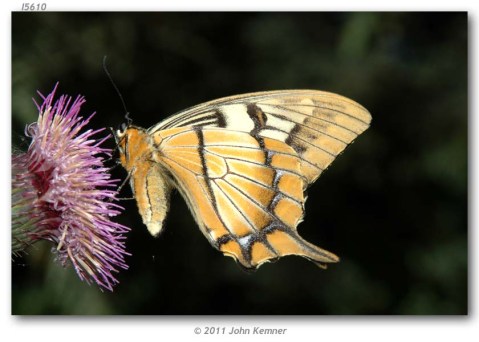
Papilio esperanza, Oaxaca, Mexico
Keep an eye out for these neat oddities as you transcribe. They’re a treat!
— Hannah Owens, Postdoctoral Associate, Florida Museum of Natural History
 Notes from Nature