
What to do about too much information?
If you’ve been working on transcribing labels in Notes from Nature, you may have run across some labels that have more information than you’d expect, or possibly what appears to be conflicting information. Sometimes, this is the product of an original collector’s identification being reanalyzed and “determined” by a later collector or curator. Take a look at this Notes from Nature discussion to see how you might deal with such discrepancies: http://talk.notesfromnature.org/#/boards/BNN0000005/discussions/DNN00000j1

Notes from Nature Team Member: Aly Seeberger
Name: Aly Seeberger
Title: Graduate Student in Museum & Field Studies
Where do you work primarily? As a graduate assistant in the Zoology collections for the University of Colorado Museum of Natural History.
What you do in your day job? Anything and everything, from skinning and prepping specimens to cataloging and data entry. Once I carried a taxidermied egret across campus and someone asked me if it was alive.
What’s your role with NfN and what do you hope to gain from it? If relevant, how will your research benefit? My role with NfN is primarily “interested party”, but I have helped with some of the text development and beta testing for the program. I hope to integrate NfN and its users into my master’s thesis, with deals with citizen science participants’ motivations. This research will benefit the citizen science community at large by making it easier for institutions to identify and fulfill the needs of participating citizen scientists, and by satisfying these users so that their work with citizen science projects is as rewarding as it can be.
What’s the most exciting aspect of citizen science work from your point-of-view? There is essentially nothing about citizen science that I don’t find exciting, but I think for me the best part of these projects is the potential for exposure to “real science” in a way that few people get, especially those who don’t work in scientific disciplines. There is something about seeing a scan of a museum ledger, a piece of ancient papyrus or a ship’s log, that makes this data real in a way that I think really makes it meaningful. For us, museum records themselves may not be so thrilling, but even those are a glimpse into a behind-the-scenes part of the field that few people have access to, and that is a huge draw as well as a really interesting and rewarding experience.
Profile of Notes from Nature Citizen Scientist: “El_Lion”
Name (or userid if you prefer to remain more private): Eliane Escher (userid: El_Lion and I have no idea how my friend came up with that!)
Country of residence: Switzerland. Born and bred. 🙂 Sorry in advance for my English!
What sort of science background or interest do you have? I’m a lab technician at a molecular biology lab at the university. The span of species I worked with range from woody plants to fruit flies. I was always interested in sciences. Probably, I’m curious (no, I didn’t say nosy!) and interested in the “how” and “why” of stuff going on out there.
What do you find most exciting about Notes from Nature? There’s so much arduous work done by so many people to collect all those species. I know how it is to work in the field. It can be fun sometimes but often enough you get to the point where you ask yourself “what am I doing here??”. Especially, when you’re cold, wet, and feel miserable. And then you need this certain persistence to meticulously investigate and determine the species. I think it’s great that Notes from Nature honors this work by preserving the data and making them available in a digital form, easier to use for nowadays (and future) scientists.
What’s the most exciting aspect of citizen science work from your point-of-view? The “swarm technology” (can I call it that?). I like to compare it to an ant which alone doesn’t get very far but together with thousands of others can build an ant hill. It’s exciting to be part of such a “swarm”. Maybe one day I can proudly say “I contributed to those new results”.
What other citizen science projects (including beyond Zooniverse) have you participated in? I participated only in the ones from Zooniverse. I got to know about Zooniverse through a TV docu in the BBC. However, the Mars project they had portrayed seemed a bit boring to me, so I tried out other ones. So far, I participated in the Serengeti picture project (which turned out to be a bit addictive :-)), in the Seafloor Explorer project and in the Cancer Cell Slides project.
Profile of Notes from Nature Team Member: Mike Denslow
Name: Mike Denslow
 Title: Assistant Director for Scientific Research Collections
Where do you work primarily? The National Ecological Observatory Network (NEON)
What you do in your day job? I am responsible for the archiving of biological samples collected as part of NEON’s field activities. Archiving is the act of safely saving and making available samples for use in research. NEON is an ecological observatory that will have 60 field sites across the Unites States (including Alaska, Hawaii and Puerto Rico) where ecological information will be collected for at least the next 30 years. These samples represent a range of organisms from mammals and plants to soils and zooplankton, just to name a few. Now-a-days archiving not only deals with physical specimens and their safe keeping but also the digital information that goes along with them. For this reason, I am also concerned with capturing information about these sample in a digital format and making sure that it accessible on the internet for interested people to find and easily utilize.
What’s your role with NfN and what do you hope to gain from it? If relevant, how will your research benefit? My primary role at Notes From Nature is to bring in photographs of plant collections from various plant museums (called herbaria). I am also responsible for providing feedback on the design of the web interface for the project. I am interested in developing new ways to make more information from museum specimens available for people to discover and use. My hope is that people will also appreciate the importance of museums in the process. There is a wealth of existing information about biodiversity that is not currently available in easily usable formats. It is critical that new ways of getting this information are developed and Notes From Nature is one exciting way that this is being done.
What’s the most exciting aspect of citizen science work from your point-of-view? I really enjoy seeing the things that people notice about museum specimens and the questions that get generated from these observations. The contributors to Notes From Nature find all kinds of interesting things both on the labels and the specimens themselves. I am really enjoying interacting with people on the Talk page and it is helping me see museum specimens in a whole new way.
Video from CalBug
Like the CalBug portion of Notes from Nature? Take a few minutes and view this video that they produced about the need for entomological museum collections and some of the challenges that they face. It’s all part of the strategy for understanding global change. See video here: Global Change and CalBug
Shapely beetles on Notes from Nature
Are you curious about how Notes from Nature is actually making an impact on real scientific research? One of our collaborators, Kip Will, a scientist with the CalBug team at the University of California – Berkeley’s Essig Museum of Entomology, offers some detail in a post on another blog. Kip talks about how he uses the data afterwards, how one of his undergraduate assistants has been involved, and some of their preliminary results. It’s great to know that all this citizen science work makes a difference! – Andrew Sallans
See full post here: Shapely beetles on Notes from Nature
Profile of Notes from Nature Team Member: Kip Will
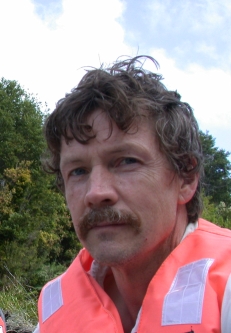
Kip on expedition in Chile.
Name: Kip Will
Title: Associate Director of the Essig Museum of Entomology and Associate Professor in the Dept. of Environmental Science, Policy, and Management.
Where do you work primarily? My research is on the systematics, taxonomy and evolution of a major, world-wide group of beetles (Carabidae). As a field biologist I travel to many parts of the world to sample them. Most of my time is split between the Southern Hemisphere (for example Australia or Chile) and the California region.
What you do in your day job? When classes are in session I teach the wonderful students of UC, Berkeley about insects, evolution, ecology, and behavior. I advise undergraduate and graduate students on projects that range from DNA sequencing to biological-illustration to observations of beetle behavior. I also take time to study the morphology and genetics of beetles in the laboratory and in the museum collection.
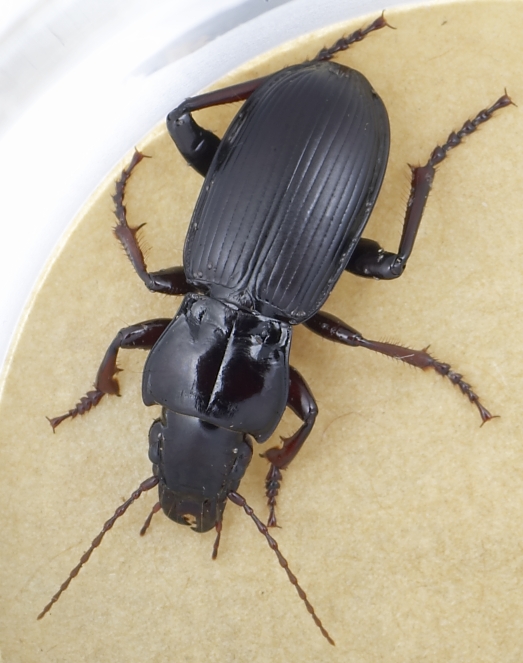
Photo of a Californian beetle, Pterostichus morionides. By Kip Will.
What’s your role with NfN and what do you hope to gain from it? If relevant, how will your research benefit? As one of the CalBug science team members, I will help to manage the specimen imaging and the flow of data back from the Citizen Science Volunteers. My research is entirely specimen-based and so having the valuable data from specimens in our collections digitally available for analysis will be a huge benefit to my research. One beetle group I am currently working on has about 125 species that are only found in western North America and most of these only in California. We have tens of thousands of specimens of these beetles to study. Once label data has been transcribed from these beetles I will be able to analyze the spatial relationships among these species at high resolution and look for trends in patterns over long (evolutionary) and short (ecological) timescales.
What’s the most exciting aspect of citizen science work from your point-of-view? Being able to share the thrill of discovery and passion for science with such a broad audience is amazing for me. Also, with the help of volunteers, I now see a task I thought at best would take most of my lifetime could possibly be done in months. This is something of a dream come true.
Profile of Notes from Nature Citizen Scientist: “SandersClan”
Name: Maggie (my userid is SandersClan).
Country of residence: I live in the good ol’ U.S. of A.
What sort of science background or interest do you have? I really don’t have a science background to speak of. I have always been fascinated by repeating patterns in nature, though. My family and I are fortunate to be surrounded by wonderful hiking areas, so we spend as much time outside as we can. We spend lots of time looking for and collecting fossils and interesting things.
What do you find most exciting about Notes from Nature? I am so excited by Notes from Nature mainly because it’s not really repetitive. Each sample is unique, as is the description of where it was found and when. While I type, it’s easy to picture the area I’m transcribing, and it’s never the same as the one before.
What’s the most exciting aspect of citizen science work from your point-of-view? I love citizen science because it’s an easy way to feel involved in something outside of my home and regular life, something ‘bigger’, if you will. I’m a homemaker, which means things feel the same from day to day. With citizen science I can participate in these projects at my leisure. I can invest as much time as I want, when I want, and my children can see that I have eclectic interests.
What other citizen science projects (including beyond Zooniverse) have you participated in? I’ve participated mainly in Sea Floor Explorer, Ancient Lives, SETI Live and Cell Slider, but have dabbled in a few other projects as well. I have to say that I would love to see Zooniverse create kid-friendly projects, especially with summer coming! Thanks for the opportunity to share!
What to do about insufficient information?
Today’s post is going to highlight a recent conversation amongst Notes from Nature citizen scientists regarding what to do when a specimen doesn’t seem to have most of the necessary information. Is it best to just leave fields blank? Is it better to just skip it? Is it a “Top Secret” specimen? These are great questions, and ones which will likely come up over and over again throughout the life of Notes from Nature. Here’s the conversation. How would you deal with this?

Started 4 days ago by carolely
-
 by carolely
 The label has only the scientific name and a question about that. Should I create a record and leave all the other fields blank?
-
by SandersClan
I vote yes.
-
by ghewson
Yes, then it’ll be flagged as needing more information.
-
by carolely
Thanks for the help. It seems I lost this page when I started this discussion so I never got to enter it. However, I’ll know what to do next time.
-
by nosenabook
I’m glad to know what to do as well, when I saw one like this, I passed on to the next specimen.
-
by nosenabook in response to ghewson’s comment
Responding to ghewson, it sounds like it is better to leave a field blank than enter “none given” say, for the reference. I started doing that because it was easier than arguing with the form – YES skip this field – and because R. K. Godfrey rarely gives a reference.
I’ll leave that field blank from here on out, unless or until I hear different.
-
by xairbusdriver
I seem to have found a “Top Secret” specimen, twice! 😉 If you come across Image ANN000039x, you’ll see what I mean. The ‘Location’ info seems to te a test site for White Out(r)! “…N side of _ Creek Road (S of Rte _), ca. air mi ESE of _. __________ of Sec ” I sure hope L. C. Anderson didn’t get into any trouble finding that specimen! 8) LOL!
-
by ghewson in response to
Ah yes, I had that, and tagged it #redaction. But if you search for that tag, there are 0 results! Spookyyyyyyyyyyyyyyy!
-
I can’t decide whether this is a Roswell, thing, the MIB, or what!
Imaging the University of Virginia’s Mountain Lake Biological Station Herbarium
Notes from Nature has been a significant undertaking with many people involved, but the transcription work being completed through the project is only a slice of the entire process of increasing access to and use of research collections. This guest post comes from Christina Deane, Head of Digitization Services in the University of Virginia Library. Christina was intricately involved with the imaging of the University of Virginia’s Mountain Lake Biological Station Herbarium, which is one of the current featured collections. Through this post, we hope you’ll gain an understanding of how all of the images in this collection were produced. If you are interested in seeing more about the University of Virginia Library’s Digitization Services, see this video: http://www.youtube.com/watch?v=7CRHyj-6syM (look to 3:24 for a photo of a herbarium sheet!). This story is one of many ways, and we will likely touch on other imaging processes in the future. – Andrew Sallans
We began a discussion of how this project would be carried out in late summer of 2005. The conversations included biologists, librarians, and technologists, to make sure that we were covering our bases on 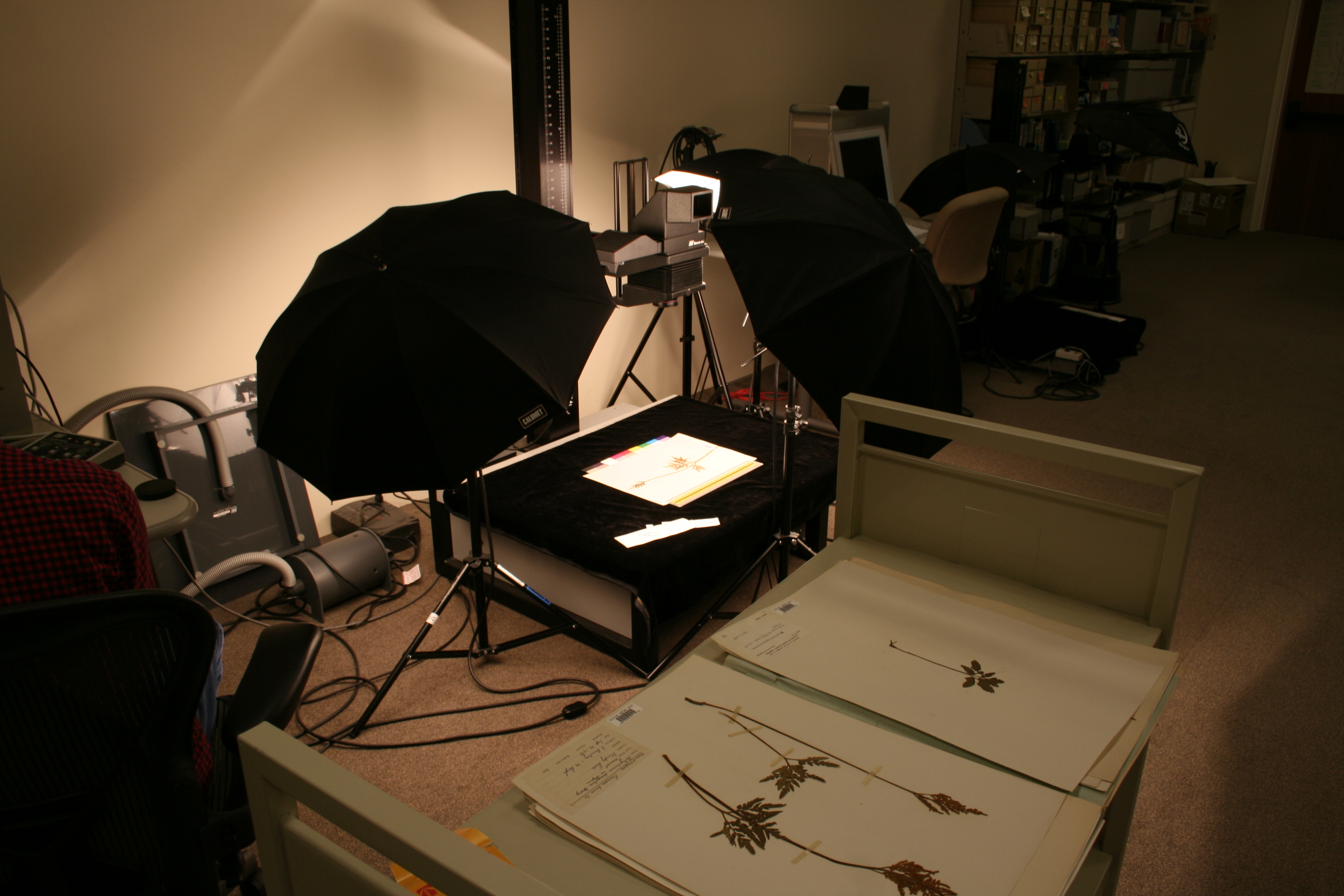 technique, metadata, and consistency so we would only have to do this once! Once we had ironed out some of the metadata issues, we were able to modify our scanning workflow to accommodate the different requirements for the herbarium specimen. We agreed that we would create archival tiffs and deliverable jpegs at 300 dpi following UVa’s digitization guidelines, and our digital library workflows were already in place to programmatically extract technical metadata from the images.
We hired a student in the spring of 2006 to begin scanning images using our overhead, Hasselblad cameras with PhaseOne P45 Plus digital scan back cameras (capturing at 39 megapixels!). These cameras are typically used for our rare print materials, including all varieties of rare books, Jefferson letters, and even copies for the Declaration of Independence. We established a set way to position the ruler and color bar so we could achieve a consistent look for the images, and this was likely influenced by other herbarium digitization projects going on at the time. It was definitely a different way to work than what we were doing for books and manuscripts. When we began this work, we didn’t really know how many specimen there were to scan, as the estimates we were provided with were in the thousands.
Our workflow was to barcode the images before scanning them, create a folder name based on the folder the items were housed in, and name each image based on the barcode. Our cameras and digital backs were very slow back in 2006, and imaging took a lot longer then than it does now. Once through the basic quality assurance steps (QA) we were to send jpegs to the librarians in charge of the project so they could facilitate the metadata creation with the team they had assembled to work on this part of the project. We utilized multiple rounds of QA so at least 3 or 4 people examined each image.
Scanning continued from the spring of 2006 through the spring of 2007, at which point the student working on the project graduated. Scanning resumed in the spring of 2008. Over the course of the next year, DS digitized thousands more images. This  process went faster because DS had acquired new camera systems with autofocus lenses and faster digital backs for almost instantaneous capture of the images. During 2008 we continued scanning specimen as they were delivered to us. We made a big push in January of 2009 to finish the rest of the collection (over 4000 pieces), and we completed the project that month. Full-time staff involved in the project included Andrew Curley, Kristy Haney, Jeanne Pardee, and Christina Deane. John Ruscher was the primary student worker in the early part of the project, and many student employees were involved in the second phase of scanning from 2008 to early 2009. Over the course of the project, we scanned 8,935 images in all.
-Christina Deane, Head of Digitization Services, University of Virginia Library
 Notes from Nature