
Field Book Update
As many of you are already aware, we have recently encountered some glitches with one of the Notes from Nature features called the Field Book. The Field Book is the place where Notes from Nature users can look at their personal statistics and the badges they have earned. We are very sorry about this glitch, but the good news is that we have a solution that deals with this problem!
Now each Notes from Nature Project will have a dedicated Field Book. The Field Book will collect information about your work and it will be organized by specific Projects, such as Southeastern U.S. Biodiversity or CalBug.
Your Field Book can be accessed using the link at the lower right of each Project’s landing page. The Field Book contains things like recent classifications, links to your Favorites and weekly statistics. The badge section not only contains the badges that you have earned, but you can also see your remaining badges (which are ones you are still working towards) and your progress towards them.
Your Field Book will show general statistics that reflect previous effort. However, the Field Book will be collecting information for things like time or decade badges starting now. While we acknowledge that this solution is not perfect, this is the best we are able to do right now. We still have the goal of a Notes from Nature wide Field Book that reflects all effort across our many Projects, but this capability will have to wait until we have additional developer resources.
We greatly appreciate everyone’s efforts on all of the Notes from Nature Projects. Thank you very much for all that you do!
The Notes from Nature Team
Kalmia, Lyonia and Chimaphila!
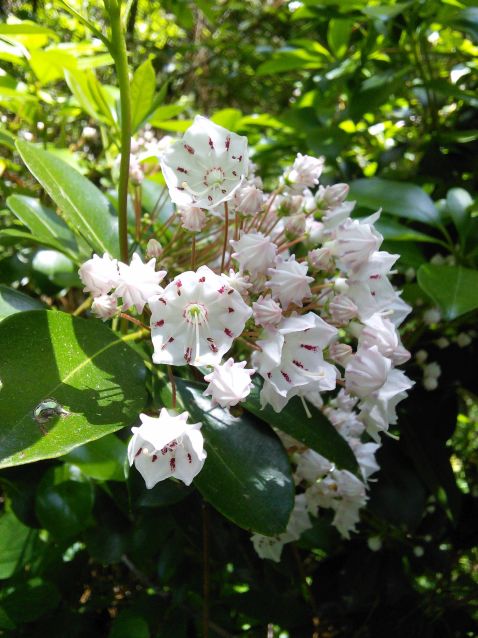
We are embarking upon this expedition not just because of Kalmia, Chimaphila, and Lyonia’s beauty, but also to enable work study students to work remotely during a time of college classes moving online. However, one does not have to be a work study student to work on this project. If you just love databasing, love pretty flowers, and/or are partial to North Carolina plants…this is the expedition for you!
All three of these plants are in the blueberry and heath family. They differ noticeably in size from one another. From the wee Chimaphila at 5 inches tall…to the waist high Lyonia….and all the way up to the sub-canopy Kalmia. Enjoy these plants while databasing and, sometime, take a hike in the wilds of North Carolina and visit these plants. Chimaphila blooms in June. Lyonia blooms midsummer. Kalmia is usually in full bloom on Mothers’ day, so go looking for them and take your mum! We thank you for taking the time to database these specimens with us and take a walk on the pretty side. The data from these plants help researchers from around the world view our specimens! Cheers!
You can find this new expedition the Southeastern U.S. Biodiversity Project on Notes from Nature.
— Shanna Oberreiter, University of North Carolina at Chapel Hill
Notes from Nature Update
Dear NfN Community,
It’s a difficult and uncertain time for many people around the world. We hope that this message finds everyone safe and healthy. We’ve been getting a lot of questions about the status of the platform during this time for use by students away from the classroom, for employees working remotely and so on. If you are one of the fortunate ones who is safe at home, well stocked, connected online and has some extra time on your hands, know that NfN is always open.
We have lots of expeditions to work on. There are currently 15 active expeditions in 6 different projects at this time. We even have a new and exciting project coming related to terrestrial parasites.
As always please feel free to ask questions or simply introduce yourself on Talk.
The Notes from Nature Team
Year end updates
You may notice some changes to the Notes from Nature webpage rolling out this week. The main Notes from Nature page is called the Organization landing page and takes users to all the Projects that are hosted on the Notes from Nature site. The updates related to the Organization model were outlined in a post back in May.
You can now see Active, Paused and Finished Projects. In addition, you can hide and show the details of those sections.
At Notes from Nature, we are particularly excited about another update that the Zooniverse is working on. It is a new page that will let you dive even deeper into an Organization’s statistics which will again show us statistics across all Notes from Nature Projects and expeditions. That page will be rolled out in early 2020.
If you have comment about the changes we encourage you to post in the Notes from Nature Talk Chat board.
— The Notes from Nature team
WeDigBio 2019 Appreciation
WeDigBio 2019 was a major success! Notes from Nature received over 27,000 transcriptions during the four day event period. We even had two days with over 9,000 transcriptions and broke our previous daily record.
We want to thank the WeDigBio organizers, all the event hosts and most of all the volunteers that participated onsite or online. A special mention goes out to Notes from Nature volunteer am.zooni who is always willing to help in so many ways. We also want to thank the Zooniverse team for always keeping things running smoothly during times with such heavy site traffic.
We finished 5 expeditions during the event, but we still have lots of great expeditions that need attention including plants, butterflies and bees.
You can learn more about the WeDigBio event by checking out a paper published last year.
— The Notes from Nature Team
WeDigBio 2019 Day 4 summary
We closed out WeDigBio day 4 with 2,967 transcriptions! That put us at 27,060 transcriptions for the entire event. This surpassed all of our previous years for this event!
There are still many great expeditions to work on! Two are currently above 90% and could use some effort to help bring them to completion. Those are WeDigFLPlants’ Buckeyes, Sumacs, and Citrus of Florida and Fresno State Herbarium (Part 1).
Thanks to all for making this another huge success.
— The Notes from Nature Team
WeDigBio 2019 Day 3 summary
WeDigBio 2019 day 3 was another very big day at Notes from Nature. Notes from Nature received 5,123 transcriptions. So far we are over 24,000 transcriptions for the entire event! To put that in perspective, our most productive WeDigBio so far was in 2017 with over 19,000 transcriptions.
Here is a fun news clip from our wonderful partners at the Field Museum in Chicago. If you look closely you can see our colleague Matt von Konrat’s shirt reads “FinleyDigsBio” a reference to Finley Middle School, a local school that participated in the event.
Remember to check #WeDigBio Twitter through out the event for more exciting developments!
— The Notes from Nature Team
WeDigBio 2019 Day 2 summary
WeDigBio day 2 was another huge success! NfN received over 9,000 transcriptions (9,105 to be exact). That is our second most productive day ever. We are excited to see how the next two days unfold.
It’s not all about the numbers though. We’d love to hear about everyone’s experience at at an onsite event or participating online. Feel free to check in on NfN Talk.
We are so grateful to each and everyone who participated. Remember to check #WeDigBio on Twitter through out the event for more exciting developments!
— The Notes from Nature Team
How Weird is That?
Specimen collectors often have deep experience with the natural world, and occasionally they notice things that aren’t as they expected. In a recent survey of over 220 collectors from across taxonomic disciplines (botanists, ornithologists, entomologists, etc.), over half (59%) reported documenting the anomalies that they observe on their specimen labels, which is great. However, there is a huge diversity of ways in which they do this, which makes it hard to find their observations. When asked to provide words that they use in those descriptions, survey respondents gave 170 unique words and phrases. Most of these words and phrases can be used in ways that might not communicate an anomaly. For example, “early” is a frequently cited word to describe a phenological anomaly (i.e., an anomaly related to the timing of life history events). “Flowering early” is an observation of an anomaly; “specimen collected in early morning” is not. Even words that might be thought straightforward, like “Strange”, appear in ways that are not documenting an anomaly (e.g., “Strange Road” as a place name).
With this new project, “How Weird is That?”, we are seeking help to classify specimen records as including an observation of an anomaly or not. These classifications will then be used to train machines to differentiate between the two cases. To ensure that some of the records being considered include observations of anomalies, we’ve searched the 120 million specimen records at iDigBio for each of 25 terms cited by collectors as useful in describing them. In the project’s first Notes from Nature Expedition, we included all of the records that have images associated with them and that contain the terms “early”, “earlier”, or “earliest”. The second expedition includes records that use the terms “late”, “later”, or “latest”. After that, we will do a second late-later-latest set of specimens, then move on to other terms like “weird”, “abnormal”, and “odd”. The further classification of statements of anomalies as being about phenology, distribution, or other things will be used in to refine the machine learning step. Once the machines have been taught to flag assertions of an anomaly, it can be a much faster hand-off of that information to those who could use the information, such as those studying invasive species or mismatches in the arrival of migratory birds and emergence of the insects that they eat.
Finally, a few things to note. We have the expectation that most images that are associated with specimen records will contain the specimen labels, but that is not always the case. So as not to bias the sampling and diminish the utility of the machine learning rules that we arrive at, we have not removed any records from the datasets by acting on potentially faulty assumptions, such as “images of fossils don’t ever contain labels” or “bird images are only ever made in the field and not after specimen preparation is complete.” This leads us to an important point: specimens are preserved plants, insects, birds, fish, etc. If you think that viewing dead organisms, whether in the field (e.g., a photo of a beached whale) or after preservation (e.g., an insect on a pin), will trigger unpleasant reactions for you, we encourage you to contribute to science in a different Notes from Nature project. Also, please note that some handwriting on labels is hard to read. If that’s the case for something you see, use “Uncertain” as a response, and we will check it later. Finally, please be assured that classifications of specimen records as not containing an observation of an anomaly are as valuable to our process as finding those that do. The machines need both to learn how to differentiate.
We are tremendously grateful to participants in this activity and hope to keep things interesting throughout this data creation campaign by remaining engaged in Talk and providing occasional blog updates. Thank you and enjoy!
— Austin Mast, Florida State University
A new record and WeDigBio 2019 Day 1 summary!
WeDigBio 2019 got off to an amazing start! NfN received 9,865 transcriptions on day 1 of the 4 day event. That is our most productive day ever! This broke our previous record set back in 2017. We are beyond thrilled and can’t wait to see what happens with day 2.
Remember to check #WeDigBio on Twitter through out the event for more exciting developments!
— The Notes from Nature Team
 Notes from Nature