
New Expedition Studying Impact of Climate Change on Orange Sulfur Butterflies
Because of human fossil fuel use, the world has gotten considerably warmer over the last 60 years, and even if we stopped all carbon dioxide emission today, this warming would continue for several more decades. Climate change has cascading effects on many aspects of the environment, from sea level to how early now melts to rainfall patterns, but there is one thing it can’t change: photoperiod (how much time it is light for each day). This is, in fact, a problem because daylength is used by many plants and animals to determine what time of year it is and thus predict the weather they will encounter. Photoperiod influences decisions ranging from when to produce leaves and flowers in plants to when to migrate and lay eggs for birds. But, now that any particular time of year is warmer without any change in photoperiod, animals and plants aren’t encountering the same conditions as they expected.
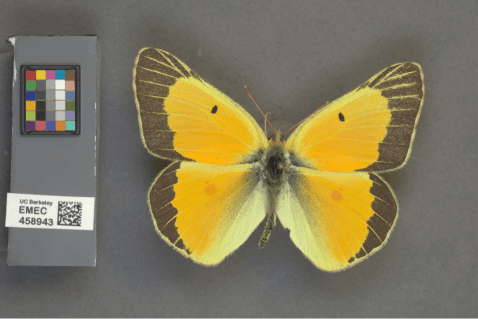
Colias eurytheme summer form
The Orange Sulfur Butterfly (Colias eurytheme) is one of the species encountering this problem. This butterfly is found throughout the US, and comes in two seasonal forms: in the summer, the dorsal (top) side of the wings is bright orange and the ventral (under) side is pale yellow, but in spring and fall, the dorsal side is yellow with a small orange patch, and the ventral side becomes darker. This darkening helps the butterflies warm themselves faster when bask in sunlight on cold days. These forms, however, are not determined by temperature but instead by the photoperiod. Thus, these butterflies are likely suffering from the mismatch between temperature and photoperiod created by climate change. What we want to know is if these butterflies have evolved to compensate for this mismatch, such as starting to produce the summer form at shorter photoperiods (earlier in the spring and later in the fall). To do so, we’re photographing thousands of these butterflies in museum collections from across the past 6+ decades.
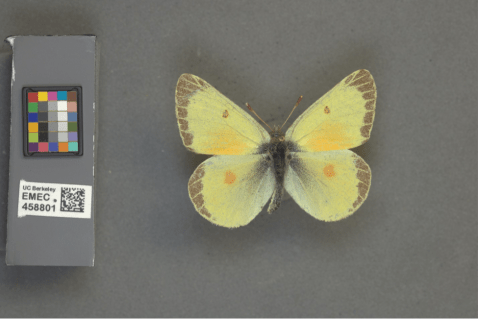
Colias eurytheme spring/fall form
To use these specimens, however, we need to know when they were collected (among other details). This is where you and Notes from Nature come in. Date of collection is right there, recorded on the labels, but we need it digitized in order to work with it in our studies. You can help us access this data by transcribing it. By combining this label data with data we’re collecting about the butterfly’s wing patterns, we will be able to figure out what time of year the butterflies changed between color patterns in different years. We can then, in turn, determine if this color change has evolved in response to climate change, or if the butterflies are falling behind. Our images and the data you enter will also be contributed to LepNet, so future scientists can also make use of it.
This is the first of what will be multiple expeditions featuring these butterflies, this time using specimens from several collections, including the California Academy of Sciences, the Essig Museum at UC Davis, and the Smithsonian National Museum of Natural History. This will give us an initial dataset covering a variety of geographic areas. Thank you all for your help!
— Matthew Nielsen, University of North Carolina at Chapel Hill
Nothing’s BETter than BETULACEAE!
The University of North Carolina at Chapel Hill Herbarium (NCU) once again seeks the aid of Citizen Scientists! We’d like you to join us for an expedition through the Betulaceae (birch) family!
The Betulaceae has six genera and 167 species within its family. The combined production of edible nuts and the tough bark that denotes this family makes Betulaceae a tough nut to crack! However, we trust that you all will handle it with ease!
It’s always an incentive to lend a hand to the family that gave us hazelnuts! From coffee additives to chocolate bars, what is not to like?! Please help us map these trees across the Southeastern United States, and thank you for your company on our expedition.
PhenoMuse: 100 Years @FloridaMuseum
We are excited to announce a collaboration with the Florida Museum for their 100th Anniversary. This is a special museum kiosk expedition being used for their special exhibition. Feel free to take a peek, but realize that this expedition is designed to be used as part of a special onsite exhibition.
The expedition will continue with our recent phenology theme, but it will only consist of one question. The idea is to prioritize specimens for future scoring expeditions and to give visitors a sense of how citizen science projects work in a museum context. There is also interpretive material that goes along with the kiosks. In addition, we hope that these onsite visitors will be motivated to check out some of our more extensive expeditions on Notes from Nature.
— The Notes from Nature team
Thank you! Skipperlings Complete!
Thank you, citizen scientists, for helping complete the Poweshiek skipperling expedition! During this expedition, you saw and transcribed the 155 specimens from the McGuire Center for Lepidoptera and Biodiversity collection. This data will be compiled with other records of Oarisma poweshiek from other institutions so researchers can begin to look for the potential drivers for the sharp decline of populations.
Be on the lookout for another expedition of specimens from the McGuire Center for Lepidoptera and Biodiversity at the Florida Museum of Natural History. And thank you for taking the time to help!
— Stacey L. Huber, Digitization Coordinator, McGuire Center for Lepidoptera & Biodiversity
An update on the WeDigFLPlants project

On August 8, 2017, leadership from some of the largest plant-focused communities in Florida met in iDigBio’s Gainesville conference space to plot the future of the WeDigFLPlants project. Attendees represented the major herbaria in Florida, as well as the Florida Native Plant Society, Florida Wildflower Foundation, Florida Master Naturalists Program, Florida Master Gardeners Program, Notes from Nature, Biospex, and iDigBio, the US NSF’s National Resource for Advancing Digitization of Biodiversity Collections.
The WeDigFLPlants project seeks to engage the public in digital data creation about the million+ plant specimens collected in Florida over the past 200 years for the benefit of science, society, and the flora. These plant specimens are each labelled with the who, what, when, and where from the collection event. About 570 WeDigFLPlants participants have produced 28,000 transcriptions of those labels at Notes from Nature to date. WeDigFLPlants organizers seek to provide a rich learning (and sometimes social) experience for participants through its dashboard, Twitter account, educational resources (e.g., http://www.cpalms.org/Public/PreviewResourcePerspectivesVideo/Preview/166547 and www.cpalms.org/Public/PreviewResourcePrespectiveVideo/Preview/166555), and onsite events during WeDigBio (e.g., https://www.eventbrite.com/e/fsus-wedigflplants-digitization-blitz-fri-tickets-37342927702).
What does the future hold? Expect to see more Notes from Nature expeditions tailored to the interests of the membership of each of Florida’s plant-focused groups. Expect to see more educational modules that incorporate Notes from Nature activities aligned to these groups’ existing education portfolios. And expect to see WeDigFLPlants-branded incentives. We are actively seeking financial sponsors—please let us know if you are interested.
Together we can build the historical baseline with which to understand the current and future diversity and distribution of Florida’s 4700+ species. Thank you, if you have contributed to a WeDigFLPlants expedition. There are currently two active expeditions on Notes from Nature: one focused on the sedges of the Florida Panhandle, and one focused on the grasses of the Florida Peninsula. Join in today!
To learn more about WeDigFLPlants, contact Austin Mast (amast@bio.fsu.edu) or Jillian Goodwin (jvgoodwin@fsu.edu).
Poweshiek Skipperling

This expedition takes a look at the endangered species Oarisma poweshiek, the Poweshiek skipperling. Habitat loss and fragmentation are to blame for its endangered species status. Its habitat consists of tallgrass prairies and prairie fens and much of the original tall grass and native prairie in the United States are gone.
The Poweshiek skipperling is a tiny butterfly with a wingspan of only 1 inch. It is dark brown with orange coloring on the wings and the head. On the underside, its veins are highlighted white, making it appear striped. The historical range for the skipperling ran from Manitoba to Iowa, with populations in Michigan and Wisconsin. According to U.S. Fish and Wildlife Services, surveys in 2014 showed that the range has drastically declined, with only a few sites in Michigan, Wisconsin, and Manitoba.
One of the steps in helping conserve the Poweshiek skipperling is research. There is limited information on the life history and habitat of this endangered species. Some researchers are looking into the causes of the species’ decline that has occurred during the past 10 to 20 years. This is where your help is needed. By transcribing museum data labels, the data can be used to generate habitat suitability models across the historic range to look for potential drivers for the sharp decline of populations. Help conserve the Poweshiek skipperling by transcribing!
For more information, please see this link: https://www.fws.gov/midwest/endangered/insects/posk/index.html
~ Stacey L. Huber
McGuire Center for Lepidoptera & Biodiversity, Florida Museum of Natural History
Hummingbird Moths Complete
Thank you citizen scientists for helping complete the expedition Hummingbird Moths as a celebration of Moth week! With this information, researchers can begin to examine their distribution changes, changes in host plants, and impact of climate change during the last century. Thank you again for taking the time to help.
Be on the lookout for another expedition from the McGuire Center of Lepidoptera and Biodiversity at the Florida Museum of Natural History coming later this week. The next expedition will feature the Oarisma poweshiek.
— Stacey L. Huber,
Digitization Coordinator, McGuire Center for Lepidoptera & Biodiversity
100,000 specimens and counting

Original Photo: Epic Fireworks https://flic.kr/p/dh7QsJ
We reached another exciting milestone this week at Notes from Nature. Over 100,000 specimens have now been completed on Notes from Nature 2.0. That is over 300,000 transcriptions by over 3,900 volunteers. It has been 14 months since we launched the new version of Notes from Nature and are thrilled with the progress. As a reminder, you can view lots of Notes from Nature statistics on our dedicated Statistics page.
Thanks again to all our dedicated volunteers!
— The Notes from Nature Team
Hummingbird Moths on Notes from Nature #mothweek
Its Moth Week! And how better to celebrate than helping us to transcribe critical information about these amazing organisms. Moths are one of the most diverse branch of the tree of life, and not only because of their colors, patterns, shapes, and sizes. It is estimated that there are between 150,000 to 500,00 species of moths — in comparison, there are only ~65,000 species of all vertebrates! And this new expedition features a particularly awesome species, Hyles lineata.
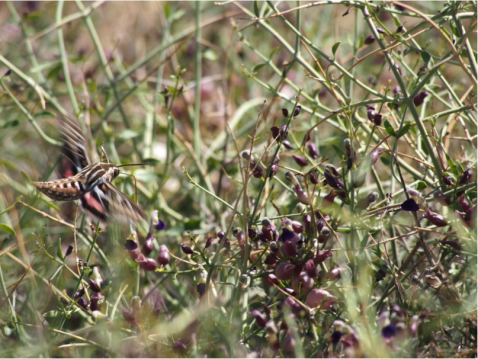
Is that a hummingbird hovering over those flowers? Oh wait, it’s a moth with a ten-inch proboscis! Hyles lineata is a moth from the Sphingidae family. This moth, and other related species, are called hummingbird moths because their flight and feeding behaviors resemble the mannerisms of hummingbirds. Hyles lineata uses its long tongue (proboscis) to feed on the nectar from a variety of flowers. Its common name, the white-lined sphinx, describes its physical appearance, with white lines across the wings and thorax. The forewing of the moth is dark brown, while the hindwing has a broad band of pink. This moth can be found across the entire continental United States, and its range extends into Canada, Mexico, and even some of the islands in the Caribbean.
In this project, you will be transcribing the numerous descriptive labels that are pinned to each hummingbird moth specimen from the Florida Museum of Natural History’s McGuire Center. One of the numerous benefits of digitizing these records is that the transcribed label data can be added to a database and made accessible to researchers that can’t afford to travel and visit the McGuire Center’s collections on a regular basis. Through this interface, you will be looking at two images of the moth, taken from the dorsal and ventral sides of the insect. Please be sure to transcribe the information from both images.
This project is part of a collaborative network of museums seeking to digitize approximately 2 million North American butterfly and moth specimens. Butterflies and moths are one of the most charismatic groups of insects, yet there is still much that we don’t know about them. Your role in transcribing the specimen data is very valuable, and provides a significant contribution to research and conservation of butterflies and moths. Thank you for your help!
A big thank you from Royal Botanic Gardens, Kew
A big thank you from Royal Botanic Gardens Kew – challenge accepted and completed.
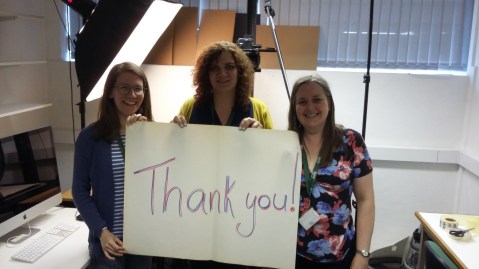
Many thanks for completing our expedition Primulaceae of the world: An amazing 3,092 specimens have now been transcribed. We appreciate that we did not begin with an easy set of specimens. They were collected from all over the world, often the labels had very difficult-to-read handwriting and even contained different languages (including Cyrillic script!). However you were up to the challenge! We are also pleased to say that we created a few George Forrest fans, one of the many prolific and famous plant collectors whose specimens are represented in the herbarium at Kew. We are now looking forward to getting our hands on the data and coming up with ideas for improvements to try and make future expeditions a bit more straightforward for you. It may take us a little bit of time to analyse the specimen records and incorporate them into our herbarium catalogue, but once we complete this stage the records will become widely available to researchers worldwide, all thanks to you. The data will also be fed into projects at Kew helping us to understand the taxonomy, evolution and diversification of the tropical Primulaceae.
Sarah, Laura and Marie-Hélène
Herbarium Royal Botanic Gardens, Kew
 Notes from Nature