
Great progress (moths)!
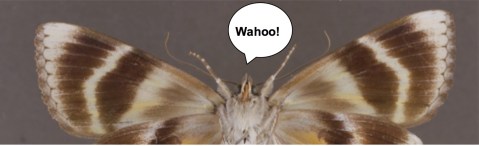
Wahoo, with your help we are at 60% completion! Keep up the good work for we are more than halfway done. Be sure to get the word out to transcribe these spectacular underwing moths. Thanks again, this important work can’t be done without you all!
-Stacey Huber (@huberlstacey)
Pollinator Plants of Virginia Complete
Thank you to all who helped complete the inaugural Pollinator Plants of Virginia expedition! Pollinators are essential for our environment’s health as well as our food supply. With the completion of this first batch of specimens, we now know just a bit more about pollinators’ favorite foods and where they could be observed feeding.
The Xerces Society (http://www.xerces.org/) is an international society dedicated to the conservation of invertebrates – a taxonomic group that includes the majority of pollinating animals in the mid-Atlantic region. We have used their online resources to assemble this Expedition, which included specimens from over 50 plant genera known to be very attractive to native pollinators. By transcribing these herbarium records, you’ve helped us refine our understanding of these plants’ locations and flowering times, which can be used by pollinator researchers to find their quarry.
Spectacular Underwing Moths on Notes from Nature
Underwing moths are one of the most strikingly patterned, beautiful moths. Their hindwings are marked with orange, yellow, pink, red, blue, or purple, and have been one of the most historically prized moths sought by collectors. Some researchers have called them the “legions of the night” because of their large size and species diversity. When at rest on tree bark, the bright hindwings are hidden by their dark, camouflaged forewings. When disturbed, the moth will flash these hindwings to scare predators. Scientists have thought that the markings resemble the eyes of a cat. Some species are known to drink beer, and collectors often use bait to collect them.
The goal for this project is to examine how these moths have shifted their distribution in light of climate change over the last 100+ years. Some species are clearly declining in number, and may possibly be critically endangered, but we still do not know how their ranges have changed because the data are limited. We cannot assess the impact of human disturbance without obtaining these data from historical museum specimens.
In this project, you will be transcribing the numerous descriptive labels that are pinned to each underwing moth specimen from the Florida Museum of Natural History’s McGuire Center. The McGuire Center has one of the largest collection of these moths in the world, but researchers cannot access the data because they remain hidden on a label under each specimen. Through this interface you will be looking at two images of the moth, taken from the dorsal and ventral sides of the insect. Please be sure to look at both images and remember your role in transcribing is valuable! And be sure to look at the amazing patterns and colors of the “underwing moth.” Can you see the resemblance to cat eyes?
This project is part of a collaborative network of museums seeking to digitize approximately 2 million North American butterfly and moth specimens. Butterflies and moths are one of the most charismatic groups of insects, yet we still don’t know much about them. Obtaining the data from these specimens is very important for research and conservation of butterflies and moths, so please help!
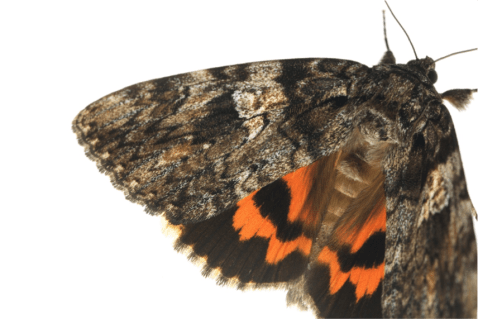
Photo by Lary Reeves
Happy New Year and thanks (Tiger Beetles 3)
Happy New Year everyone, and thanks (yet again) for the rapid turnaround on Tiger Beetles 3!
I hadn’t been paying close attention to the progress of the expedition over the holidays, but was expecting there to be a few more days left before its completion upon my return to work today. Instead, I was pleasantly surprised to see that on January 1st, you “Beat the ETC” by 6 days. Way to go! Much thanks to Rob G. for providing the impetus to see this happen.
This now completes the E.H. Strickland Entomological Museum’s Tiger Beetle holdings (for real this time), so we’ll be moving on to other ground beetle groups from here on. First, we’ll finish off the remainder of the Trechine ground beetles with our next expedition “Trechine Ground Beetles 2”, of which there are 972 specimens left to be transcribed, and then we’ll move on to the Bombardier Beetles (Brachininae).
In the meantime, I hope to start reconciling completed transcriptions and loading the data into our collections’ database soon. At the end of November we received results from the 1st Tiger Beetle expedition which I now need to comb through for data issues that I hope to discuss in future posts.
In other news, last month our Tiger Beetles 3 expedition was the focus of a teaching session on digitizing collections for 10-11 year olds put on by folks at the Natural history Museum in London. Much thanks goes to Margaret G. for coordinating this and providing valuable feedback on how it went. Here is some helpful information that might help others working on this project:
- I’ve prepared a list of URLs where you can find common abbreviations that are in use for Canadian provinces/territories1 and US states2. In addition, the Getty Thesaurus of Geographic Names3 and Canadian Geonames Database4 are useful for interpreting place names of both historical and contemporary use around the world and in Canada, respectively. These links have also been integrated into the help boxes.
1 https://www12.statcan.gc.ca/census-recensement/2011/ref/dict/table-tableau/table-tableau-8-eng.cfm
2 https://www.census.gov/geo/reference/ansi_statetables.html
3 https://www.getty.edu/research/tools/vocabularies/tgn/
4 http://www.nrcan.gc.ca/earth-sciences/geography/place-names/10786
- I’ve attached our our current list of ground beetle collecting parties (collector list), along with the earliest and latest dates of their collections. A quick perusal of the list should help determine who the collector of a specimen was if there are any label interpretation issues.
- Collectors of entomological specimens often report the month of collection in Roman numerals, and the year may appear in 2-digit or 4-digit formats. For the former, take note that our collection was founded in the early 1920s and so much of the material will be collected from the 20th-21st
- Finally, you can visit any of the following websites for more information on our collection, and the specimens and/or species it contains:
http://entomology.museums.ualberta.ca/
http://www.gbif.org/dataset/8971dfba-f762-11e1-a439-00145eb45e9a
https://www.idigbio.org/portal/recordsets/1f9209f0-ecf2-4c3e-8ec5-bfacec1e5b9c
http://symbiota4.acis.ufl.edu/scan/portal/collections/misc/collprofiles.php?collid=84
Cheers,
–Bryan Brunet, PhD
Collections Management Advisor (Natural Sciences), University of Alberta Museums, Edmonton, Alberta, Canada
Beat the ETC Finale
Thanks to everyone for all their hard work on the four expeditions near completion late last year. Quick update – we are done! All those expeditions are finished. Finito. Done. Awesome.
Here is a quick summary about how you beat the ETC (estimated time to completion)!
- Pinned Specimen_Tiger Beetles 3. That one had an 8 day ETC on Dec. 30th, and finished on January 1, beating the ETC by 6 days.
- Herbarium_Arkansas Dendrology: Part 8: Hickories and Walnuts. You beat the ETC by 3 days, also finishing on January 1.
- Aquatics Aquatic Insects of the Southeastern United States expedition had a 3-day estimated time to completion (ETC) and finished within the first day. You beat ETC by 2 days.
- Magnified_The Killer Within: Wasps, but not as you know them had a 19 day ETC and those are some challenging labels, as well. We finished that one in 15 days. So we beat the ETC by 4 days, but it was a major effort to get those last, and likely hardest ones, done.
Overall, you shaved off 19 days in total, and we couldn’t be more thrilled. Now that we have cleared out some of these older expeditions, we are looking forward to some new ones coming on board in the next few weeks. We’ll have more information on those, and some other plans for 2017, to share soon!
First fossil expedition complete
Hello NfN transcribers!
Labels associated with fossil specimens are tricky, they’ve got age and date information about how old the specimen is and the actual date that the specimen was collected. Locality information frequently is confused with geological age info (especially in Indiana because most of our rocks are Mississippian or Pennsylvanian in age!) and abbreviations aren’t always clear.
However, the champion transcribers from NfN have done remarkably well and in an unbelievable time. We’re very grateful for all of your hard work and we’re very much looking forward to seeing some familiar names on some of our upcoming transcription expeditions. A very special shout out to @maggiej is well deserved for over 500 transcriptions!!!
Thanks also to those individuals that helped to craft some of the specialized instructions for this expedition. Fossils and geologic time add a whole new dimension to our inventory of life on this planet and we’re quite pleased at how well everyone handled the extra information. Again, special thanks to @maggiej for being a tremendous help in the Talk section too!
Don’t forget that the @researchers are here for you too. We’re very interested in seeing how we can be better science communicators and your feedback is much appreciated. Feel free to contact us using our tag @researcher or me directly (@garymotz) for the fossil expeditions. Help us help you to help science!
Keep your eyes open for a new fossil label transcription expedition coming soon!
(spoiler alert: we do have some incredibly preserved soft-bodied forms from the Cambrian Burgess Shale coming up in the next expedition!)
Beat the ETC Update 2.5 – another finished expedition. How fast?
Happy first day of 2017! And a big WOW on all the effort to beat the ETC. Just now, your effort helped to get Pinned Specimen_Tiger Beetles 3 done. Finished. That one had an 8 day ETC on Dec. 30th, so you beat the ETC by 6 days!
Now there are just 2 expeditions near-complete left, Herbarium_Arkansas Dendrology: Part 8: Hickories and Walnuts (ETC 3 Days) and Magnified_The Killer Within: Wasps, but not as you know them (ETC 14 days). Both are getting done (slightly) faster than the ETCs we posted on Dec. 30th, so that is great – but lets just how much faster!
Update as 7pm Jan. 1: Herbarium_Arkansas Dendrology: Part 8: Hickories and Walnuts just FINISHED – you beat the ETC by 3 days and took it to another level with 168 transcriptions in the last 24 hours.
Beat the ETC Update 1 – You ruled on the first one to finish… but…
Quick update! In just 20 hours, you guys finished the Aquatics Aquatic Insects of the Southeastern United States expedition, which had a 3-day estimated time to completion (ETC). That is WAY ahead of schedule!
However, two others that had ETCs of 8 and 5 days (Pinned Specimen_Tiger Beetles 3 and Herbarium_Arkansas Dendrology: Part 8: Hickories and Walnuts, respectively) yesterday, now show 9 and 6 days ETC – yes, they appear to be backsliding. We bet that this change is more a hiccup in how ETC is calculated, but we’ll check back again and send in reports over the next couple days.
Thanks again for all the effort!
Beat the ETC (estimate time to completion)
Hi everyone, and Happy Almost New Year from everyone at Notes from Nature. Its been a great year for NFN (bucking, perhaps, the overall trend), with our re-launch, WeDigBio and lots of great activity on the site . And we are excited about some new features coming in 2017. In the interim, we have been trying to finish a few more expeditions off before we launch some new ones.
Below are the expeditions that are nearly finished and the ETC (estimated time to completion) — we are hoping to be able to beat those ETCs if you can help out. Lets see by how much we can beat them. We’ll report the outcome here soon (we hope!) You can check how you are doing to help get there by checking our handy-dandy and now less cluttered stats page: https://www.zooniverse.org/projects/zooniverse/notes-from-nature/stats.
Aquatics_Aquatic Insects of the Southeastern United States
ETC* 3 days
Herbarium_Arkansas Dendrology: Part 8: Hickories
ETC* 5 days
Pinned Specimen_Tiger Beetles 3
ETC* 8 days
Magnified_The Killer Within: Wasps, but not as you know them
ETC* 19 days
Another summary of WeDigBio 2016
Many of you participated in WeDigBio 2016 on the Notes from Nature platform. It is an exciting yearly event that continues to grow worldwide. The main organizers of the event just posted their own summary that we wanted to share with the Notes from Nature community.
Check it out here: https://www.idigbio.org/content/wedigbio-2016-0

