
Thank You! Meet Our (MGCL) Sack-bearer Moths, aka Poop-house Caterpillars!
Thank you for your work on the Mixed Bag of Specimens from the McGuire Center! It was amazing to see this expedition finish in a short amount of time. We have another grab bag of specimens for you to transcribe. But before transcribing read about some of the moths you will be transcribing, thanks to graduate student Ryan St. Laurent.

Throughout the Americas, but especially in the rainforests and savannahs of Latin America, live a peculiar family of moths called Mimallonidae. These moths are colloquially known as “Sack-bearers,” a name derived from their strange caterpillars which make open-ended shelters that are unlike any other constructed by butterflies and moths. These shelters are made of frass (poop), silk, and plant material; the caterpillars drag around their funny houses much like a hermit crab carries its shell. Sack-bearer caterpillars have evolved specialized bodies adapted to living inside these shelters, their heads and butts are tough and shield-like, so they can stuff either end of their bodies in either opening of their house, preventing unwanted intruders from entering. While these shelters usually appear mostly to be made of leaves and silk, the frass is interwoven into the shelter, providing structure and rigidity. The frass pellets are actually used much like little bricks. Maybe these moths are more accurately called Poop-house Caterpillars, rather than Sack-bearers? Relative to many other moth families, the Poop-house caterpillar family is not particularly diverse, with only about 300 species total. Despite the low number of species, and restricted distribution, Mimallonidae are an interesting piece of the overall evolutionary puzzle of Lepidoptera (butterflies and moths). From recent studies that examined the DNA of many families of Lepidoptera, it has become increasingly clear that Mimallonidae share a common ancestor with a globally distributed group of moths that also happens to be the most diverse in terms of number of species. Does this mean that the ancestor of most moths that are alive today was like a Poop-house caterpillar, and not like a typical caterpillar that you might find in your garden? Therefore, it seems that studying Mimallonidae will help researchers unravel the evolutionary history of butterflies and moths more broadly. This Notes from Nature expedition, which includes moths of this fascinating family, will be the first attempt to digitize and transcribe labels of an entire Mimallonidae collection, setting the stage for countless studies on Mimallonidae and Lepidoptera more broadly, by making images and data of hundreds of these specimens available to researchers around the world.
— Stacey L. Huber, Digitization Coordinator, McGuire Center for Lepidoptera & Biodiversity, Florida Museum of Natural History
Help NYBG solve history’s botanical mysteries! New Labs Expedition: “US State Spotter”

The New York Botanical Garden Herbarium is pleased to launch its latest Notes From Nature project, “US State Spotter”, designed to uncover occurrence data from some of our oldest specimens from North America. As a participant, your focused mission is to help identify the correct US State where each plant specimen was found in the wild by interpreting clues from the original collection label.
This new expedition features a simplified workflow with easy-to-follow instructions, and should be a great introduction for those who have never tried interpreting scientific specimens before. That’s not to say this expedition will be easy! We suspect even veteran transcribers will enjoy a surprising challenge, since most specimens we are targeting feature old and handwritten collection labels. This is no coincidence, since we developed “US State Spotter” specifically to address persistent gaps in the sampling of older collections by crowdsourcing projects.
In the spirit of discovery, I hope you’ll help us classify these cryptic specimens so we can connect researchers to essential biodiversity data and build even more interesting and comprehensive virtual expeditions for the citizen science community!
Click here to join expedition Part 4 “Reclusive Rosaceae” More State Spotter expeditions coming soon!
— Charles Zimmerman, New York Botanical Garden Herbarium, czimmerman@nybg.org
Nitrogen Fixers Part 3 — Missouri Botanic Garden Goodness
Swipe for Science!

Can you spare a few moments to help identify flowers on images of museum specimens? We need help with a simple task, which will assist researchers who are studying phenology (cycles of events in the natural world). All you need to do is download the Zooniverse mobile app, load up our first ever fully mobile expeditions, and swipe right if you see flowers and left if you do not. It may be simple, but it will be a huge help for science.
The species we’ll be focusing on is called evening primrose. The flowers of the evening primrose open quickly every evening, earning this plant its name. Its flowering phenology is broadly late Spring through Fall but we don’t yet know much how that varies across geography and during different years with different weather patterns.
Here are more details to help you get started:
- Download the Zooniverse app from Google Play or the App Store.

- Select Nature and scroll to Notes from Nature. You don’t need to create an account if you don’t want to.
- Select “Phenology II: Evening-primroses”
- Read through the short tutorial. Be sure to check out the directions by clicking the “?” next to the question.
- After that you will see an image of a plant specimen. Can you see flowers? If yes, swipe right, and if no, swipe left.
- You may need to zoom in to check for flowers. You can tap the image to engage the zoom feature and then use normal gestures to zoom in or out.
We know some folks have helped with this project using our web application, and that is still up and running as well.
Thanks for your time! If you enjoyed this project, then please check out notesfromnature.org.
We <3 New York Botanic Gardens (NYBG) and the first NitFix expedition finished
Back in October, we started an adventure that I am not sure has ever been tried before. We aimed to sample 15,000 species (!) of nitrogen fixing plants, with the goal of assembling one of the largest set of resources to better understand the underlying genomic innovations that led to nitrogen-fixing plants. The main resource we are using are small tissue samples (e.g. leaf and floral material) taken from already-collected samples stored in herbaria. Our first port of call was the New York Botanic Gardens, and the truly awesome staff there, especially Barbara Theirs and Charlie Zimmerman, but we owe thanks to the whole herbarium for making us feel so welcome. We ❤ NYBG!
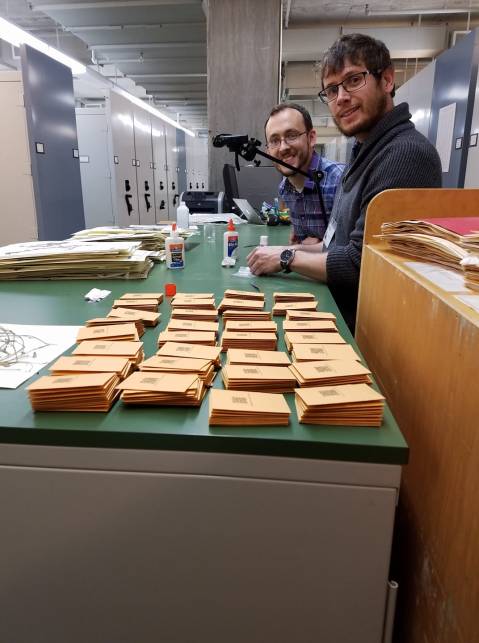
Here we are happily sampling:

We collected about 1400 samples during our first visit, and we since have also begun to extract DNA from those samples. The great news is that we are having a lot of success with extractions, thanks to the hard work of Heather Rose Kates at the Florida Museum. We will talk more about the next steps in further blog posts, but we are excited about that success. We have also visited a lot more herbaria, including ones at Harvard University, the California Academy of Sciences, the Missouri Botanic Gardens, and the Ohio State University. We also just headed back to the New York Botanic Gardens and will be sampling there for many more weeks. We anticipate hitting our half way mark this week – 7500 samples! That represents a huge amount of work!
The data we are getting from labels is really important for this work. Photo vouchers and labels link the genes to the specimen, both virtually and in a physical sense too. Label data will be used in a lot of the downstream analyses that come from this work and we are so thrilled that you helping this science happen. Nitrogen fixing is a key novel symbioses that really changed the world, we are hoping to learn how that novelty arose, and herbaria and their specimens may be an essential part of the key to telling that story. Your help is so important so a HUGE thanks for your work on the first NitFix expedition. There is already a second one up and a third one soon to follow.
A Huge Thank You with More to Come!
First off thank you so much for taking the time to help transcribe the “Banded Yellow Butterfly” expedition. This expedition was challenging, but you persisted and that shows the amount of care you have for helping natural history collections. Thank you also for providing comments and suggestions. They have been noted and where possible incorporated in to this next expedition for a smoother transcription experience. That being said, let me introduce you to our new expedition “Mixed Bag of Specimens” from the McGuire Center.
The McGuire Center for Lepidoptera and Biodiversity at the Florida Museum of Natural of History is home to one of the largest Lepidoptera collections in the world. Since the opening of the center in 2004, it is has grown rapidly and now has nearly 10 million specimens. The McGuire Center was founded by combining collections from the Allyn Museum (then located in Sarasota, Florida) and the Lepidoptera holdings of the Florida State Collection of Arthropods. While students and staff are constantly contributing to the collection, its growth is primarily due to donations from private collections.
With such big and vast collection, digitizing has taken place on all three floors of collections and with all different species. In this expedition, you will find a mixed bag of specimens to transcribe. All specimens are moths, but there are different species and various layouts. Don’t be discouraged, the information you seek is there.
As you know transcribing this data is extremely important part of the digitization effort. Thank you for taking the time to help! The information that you transcribe is essential to our ongoing research. It enhances data sets and helps answer questions about the history and behavior of these moths and butterflies. We value your contributions to the scientific community, and we thank you for devoting your time and effort to help us complete these butterfly projects.
— Stacey L. Huber, McGuire Center for Lepidoptera & Biodiversity, Florida Museum of Natural History
Tennessee Invaders
There are almost 500 non-native plants that now call Tennessee home. These plants threaten native Tennessee ecosystems. Detection and monitoring, of these species present tremendous challenges to conservation groups. As a first line of defense, organizations such as the Tennessee Invasive Plant Council (TN-IPC) work to list and rank non-native species. Up until recently, organizations such as these have relied heavily on expert opinion and experience to rank non-native species. However, with the onset of metadata technology, the ability to access large amounts of information has transformed the ways in which we might enhance our understanding of the threat non-native species pose across the landscape.
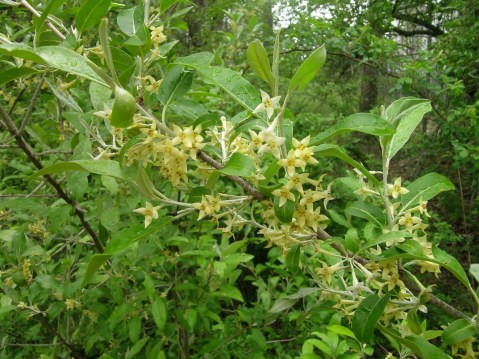
Elaeagnus umbellata (Autumn Olive) Photo by M.W. Denslow https://flic.kr/p/GFRQgA
This expedition will assist University of Tennessee at Chattanooga graduate student Courtney Alley (@Calley2012) in collecting data for her thesis research that will utilize this advancement in technology to further our understanding of non-native plant species. Ultimately, this information will be used to map the locations of these invasive plant species and eventually determine a pattern of spread throughout the state. With your help, we can use these data to develop more effective detection and monitoring techniques for non-native plants!
— The NfN Team
Phenology of evening primrose
Oenothera are the evening primroses, or sundrops, and are so named for their tendency to open cheery, long-lasting yellow flowers during the evening. There are about 145 species of evening primrose spread across the New World, where they have long be a cultivated species. One species, Oenothera biennis, is common across eastern and central North America, and has a long history of medicinal use. Much of the plant is edible and the oil for primrose has long been used a traditional medicine.
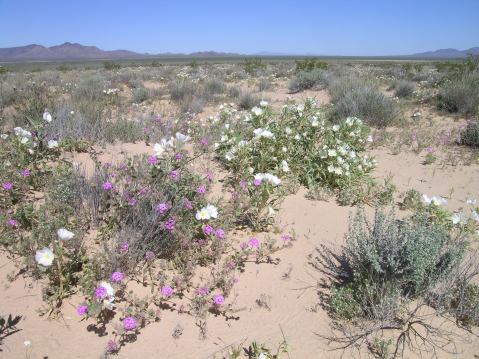
Evening primose plants (white flowers) are often dominant in sandy areas. Photo by mwdenslow
Evening primrose is pollinated by a special set of bee and moth pollinators with specialized ability to handle its more viscous pollen strands, and its seeds are eaten by birds such as finches. Evening primroses are not related to other primroses in the genus Primula, which are in a different family.
While diurnal patterns of flower opening and closing is a form of phenology, we are interested here in the seasonal patterns of evening primrose blooming, and especially if climatic changes are impacting evening primrose cycles. We are especially interested in both spring and fall timing since many in this species can have two generation of plants per year.
We are really excited to launch the Evening Primrose Phenology project as out first truly mobile-friendly Notes from Nature project. We are just looking for help with documenting flower presence, so a simple “yes it has flowers” or “no it doesn’t” suffices.
Its so easy to try one – we hope you do!
Pollinator Plants of Virginia II
Welcome to another edition of the Plants of Virginia expeditions – Pollinator Plants of Virginia II. In this project, we have assembled a range of species from predominantly animal-pollinated plant families including the Sunflower, Mint, Tomato, Blueberry, Carrot, Coffee and Apple families, all of which provide food for humans, too. Pollinator populations and their overall health have declined in recent decades. While much current research is necessarily focused on the health of non-native, domesticated honey-bees and agricultural productivity, thousands of other invertebrate pollinators such as bumble-bees, small solitary bees, butterflies and moths are in need of help, too. In order for researchers to find these small creatures in the wild to monitor their population sizes or to test them for diseases, they must first locate the food plants that are preferred by each pollinator and wait for their research subjects to appear. Many native pollinator species will consume the pollen or nectar of very few plant species; this very choosy feeding behavior is called oligolecty. It also means that these species can die out if their food plants disappear. By transcribing these herbarium records, you help us develop very fine scale maps of the plants’ locations and flowering times, which can be used by pollinator researchers to find their quarry.
Andrea Weeks, Director, Ted R. Bradley Herbarium, George Mason University, Fairfax, Virginia
NfN and the Virginia Master Naturalist Program
We wanted to share this wonderful post about how NfN is being used by the Virginia Master Naturalist program. Master Naturalists can earn volunteer service by working on NfN. The NfN Team is very excited to be part of this partnership!

