
We thought the timing was good for a phenology expedition
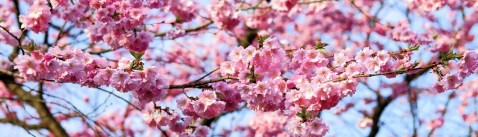
It’s tantalizing close to Spring here in North America, and some of you may have noticed hints of it, not just the nicer weather, but maybe moreso the first blooms of redbud, apple and plum and cherry trees, dogwoods, citrus. These harbingers of Spring have been part of not only the natural season cycle, but also human cultural history, for millennia.
People have been recording phenology for thousands of years. In Japan, records were kept of cherry blossoms back starting in 812AD. Yeah, not 1812, but 812. These have become part of national festivals around the world, with famous festivals in Tokyo and Washington DC. The date at which plants first flower, or have peak flowering, are often directly linked to climate conditions. The same is true of first appearance of new leaves, or new fruits. In Fall, leaf senescence, with first changes in leaf color, is also tied to temperature, as well as day length.
How do we know historical patterns of phenology? In some cases, we can refer to diaries and other written records, such as the case in historical record-keeping in Japan. In the last decade, we have a lot more tools at our disposal, including remote sensing – yes, imaging devices on satellites can tell when our planet gets more green! But for phenology records going back the last century, one powerful resource are natural history collections. A lot of the specimens collected and stored in museums tell us about phenology. But in order to use those data effectively for science, we need to actually report phenological stages and traits from those specimens. And that is where you come in!
Our newest expedition is a different beast than ones we have run in the past. In this expedition, you’ll help us determine if specimens from oak trees have flowers or fruits. These specimens already had their labels transcribed as part of an earlier expedition, and now we’ll annotate phenology information as well, and have that information associated with the specimen label data. These data can be used to look at historical patterns of phenology, and linked to past climate data records, to determine relationships, ultimately across many different species.
We are interested in your feedback on this first try at Notes from Nature with reporting phenology. In later expeditions, we may ask for more detailed information such as how many flowers are visible on a specimen, or fruits (in the case of oaks, we call the fruits “acorns”). For now, thanks for the help with enhancing the ability to use specimens for new kinds of science. We’ll share more about the science we are hoping to enable in later blog posts.
Finally, we are also launching our first mini-course with this expedition. This mini-course is about phenology, and how and why it is studied. What is a mini-course? Every 5 or so transcriptions, you’ll get some more information on phenology. We have 11 total “slides” in our mini-course, so you can see them all if you do 55 transcriptions. We haven’t tried a mini-course before, and we hope it proves interesting and not distracting. Let us know!
Introducing NFN Labs
We have always wanted to make Notes from Nature a place where our amazing volunteers can try out new activities, as long as they have high scientific value. In order to try out some of those activities, and find out what you think about them, we are excited to launch a new section of Notes from Nature called “NFN Labs”. The “Labs” idea lets us be experimental, while we remain committed to our core mission of helping to unlock natural history data, one record at a time.
NFN Labs is a place to try new kinds of expeditions. For example, we might have a labs expedition where instead of transcribing most of specimen label, we might have just one field that is needed. Or maybe we ask for help getting latitude and longitude information based on textual descriptions of localities where a specimen was collected. Or, as in the case of our first NFN Labs expedition, we might ask you to answer a question or two about the specimen itself, such as whether it has flowers or fruits. We also want to use the NFN Labs idea to test new features and get feedback. In the first Labs expedition, we are also launching our first mini-course. Mini-courses provide extra content on a topic that shows up after performing a certain number of transcriptions – in this case after 5 transcription. The topic of the first mini-course covers why phenology is important to study.
After we have tested out some labs ideas, they may move into more full “rotation” as part of Notes from Nature. We really hope some of these new experiments are cool and fun to do, while also keeping the same high bar of having immediate value for scientific use. We always appreciate (and crave) feedback. What do you think of our first NFN Lab?
Spectacular Underwing Moths III
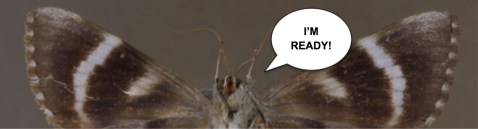
We have a new expedition of Spectacular Underwing Moths! In this new expedition you will see familiar faces (species), but you will also see new ones. While it is hard to differentiate the new species from the old, there is one that will set itself apart: The Epione Underwing. The goal of this project is to look at the distribution of underwing moths over the last 100+ years. These data are needed to understand how distributions might have changed over time, and the only way to discover this is by transcribing specimen labels that are pinned to each specimen from the Florida Museum of Natural History’s McGuire Center.
It’s important to remember that you will be looking at two images per moth, dorsal and ventral. The reason for this is because there has been important information on the back of labels. So be sure to check both images! While checking both images, look at the amazing patterns, or lack of patterns, and the colors of the moth. The Epione Underwing does not have bright stripe markings, it has a solid-color hindwing. It might seem drab, but take a closer look at the moth’s ventral side, where a pattern resides. Obtaining these data from both sides of the label is very important for research and conservation of these beautiful moths, so please help!
— Stacey Huber, University of Florida
High five!
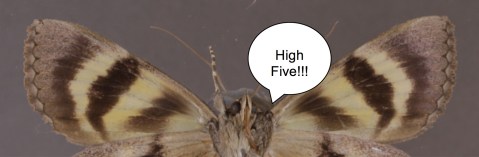
Thank you NfN citizen scientists for helping complete the second expedition digitizing the spectacular underwing moths! This expedition of 1000 images was a little tricky with some hard-to-read labels, but you all managed to power through. It is remarkable work. Thank you for taking the time to help. With this information, researchers can begin to examine the moths’ distribution changes, changes in host plants, and impact of climate change during the last century.
Be on the lookout for the next underwing moth expedition, coming very soon. The next expedition will have many new species. Maybe you will notice the differences!
WeDigFLPlants Launches Ninth Expedition
WeDigFLPlants is a collaboration between professional research botanists, amateur naturalists, gardeners, educators, and citizen scientists to build the most complete picture possible of plant distribution and diversity in Florida over the past 200 years. The group’s new expedition is focused on the plant family Euphorbiaceae (spurges) in the Florida Panhandle. This includes about 50 native and naturalized relatives of the plants that bring us natural rubber, cassava, tung oil, and castor oil. The specimens in this expedition are each curated either at the University of West Florida’s Michael I. Cousens Herbarium or Florida State University’s Robert K. Godfrey Herbarium. If you’d like to learn more about WeDigFLPlants, we encourage you to visit https://biospex.org/project/wedigflplants where you can find, among other things, a plot of transcription activity across the WeDigFLPlants expeditions through time.
Thank you for your contributions to WeDigFLPlants’ expeditions!
Austin Mast, Florida State University
Explore the world of the wasps with our Curator Gavin Broad
For all of you who have been helping us transcribe the specimen labels of the Chalcids – our slide-mounted parasitoid wasps, we thought you might enjoy learning about these fascinating creatures, and other members of the wasp family. Gavin Broad, who is Curator of Hymenoptera at the Natural History Museum did an #NHM_Live on Facebook last night (a weekly broadcast). Do watch the recording to find out why wasps are so undeserving of their bad reputation and that some even make honey.
And the winner is…
CalBug Leaf-cutter Bees! Late last week we asked which expedition would finish first Arkansas Dendrology: Part 7 or CalBug Leaf-cutter Bees 3. The Leaf-cutter Bees finished first by one day. More importantly, we beat the estimated time to completion (ETC) for both of these expeditions by over a week.
Thanks to all that helped and a special mention to @am.zooni,@maggiej, @QuantumSpaceGoat and a WordPress user named ilke for all the transcriptions and Talk participation.
The CalBug folks are working up a new expedition that will be posted very soon. For those looking for more plants from Arkansas U.S.A. we still have the Herbaceous Plants of the Ouachita Mountains expedition.
— The NfN Team
Finishing race?
We noticed today that two of our current expeditions are ~80% complete with an estimated time to completion (ETC) of 11 days. They are Arkansas Dendrology: Part 7 and CalBug Leaf-cutter Bees 3.
They aren’t directly comparable since Arkansas Dendrology: Part 7 has fewer overall images, but we wondered if our transcribers might want throw their weight behind one or the other? So which do you prefer red oaks or bees? Maybe you like them both. Try out a few and follow along on the Statistics page to see how things unfold.
Best,
The NfN Team
New expedition: Ferns and Fern Allies of Tennessee
We’re proud to introduce the maiden expedition of the larger “Digitizing the Herbarium Collections of Tennessee” project. The first expedition is a sneak peak into: the University of Tennessee and University of Tennessee at Chattanooga collections, and we’re starting with the Ferns and their allies! It is called Ferns and Fern Allies of Tennessee, Part 1.
Tennessee is centrally located in a geologically and botanically diverse region of the United States, making it critically important to understanding eastern North American biogeography and floristics. Our state spans ecologically variable environments from mountains to barrens to the Mississippi River floodplains. Due to a complicated evolutionary history, Tennessee is a botanical crossroads for floristic elements from the Gulf Coastal Plain, the eastern temperate forests, and the Midwestern prairies. We have created this expedition to begin the process of databasing ALL of Tennessee’s herbarium specimens into the modern digital arena.
Please, join us as we introduce these historic collections to the information age!
@calebadampowell and @joeyshaw, The University of Tennessee at Chattanooga
Changes to Completed Expeditions Page
We recently made some changes to the completed expedition page. We had so many expeditions on the page that it became hard to visually sort through them. We see this as a great sign of the effort and activity that has been taking place on the site!
You can now view the all completed expeditions sorted by date or select by a specific group type (e.g., Plants). We also now show the date that the expedition was completed as well the number of images and length of time that it took to complete.
We hope you like the changes and let us know what you think.
— The NfN Team
 Notes from Nature