
The Crab Shack at the Natural History Museum of Los Angeles County
We’re incredibly excited to have the opportunity to work with you through WeDigBio so that we can move forward with digitizing our crabs! And a large part of our excitement is because of you.
So what are these crabs? And who are “we”?

Immodestly, we’ll start with “we”: we’re the Marine Biodiversity Center (MBC) at the Natural History Museum of Los Angeles County (LACM). Despite the provinciality of “county” in our name, LACM has some of the world’s largest specimen collections in numerous disciplines. The MBC began its life over fifteen years ago as an initiative to sweep up many of the “orphan” subcollections that had accumulated in LACM’s marine section. Because of its intrinsically cross-taxon nature, the MBC has matured into a center for integrative biodiversity studies, sidestepping the classical taxon stovepipes of the traditional museum world.
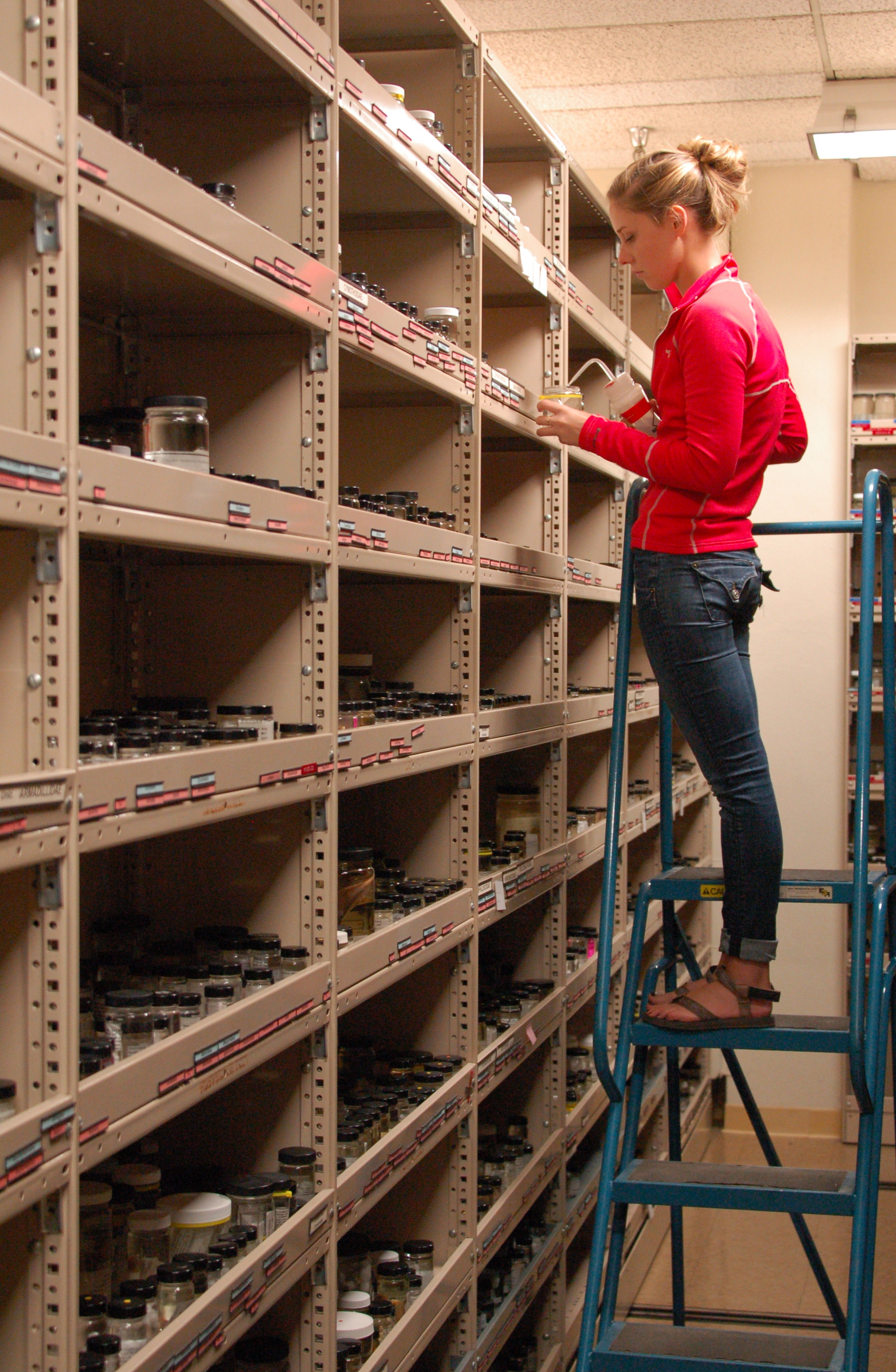
But back to the crabs. One of LACM’s largest collections is of marine Crustacea — one of the biggest in the U.S. and the world. Crustacea are a subphylum that also includes shrimp, lobsters, crayfish and barnacles to name a few. For this project, we’ve chosen to focus on crabs of the family Cancridae, of which there are thousands in the LACM collection.
Why the Cancridae? OK, let’s be honest here: they’re cute. And they taste great. (Always choose a research subject you can eat. [Of course, no one is suggesting that museum specimens are edible — particularly not ones that may have been in formalin. But I digress.].) More objectively, there are a number of reasons that make the family Cancridae a compelling target group. Our current phylogenetic understanding (e.g., evolutionary history) of the family comes mostly from fossil evidence, and it would be fascinating to explore those hypotheses with extant specimens. Extant organism are ones that are still living, while many fossils represent organisms that have gone extinct some time in the past. The Cancridae include a number of commercially important species, such as Dungeness Crab and Rock Crabs. On the west coast of the United States, different states regulate fisheries of these crabs in radically different ways: some states individually regulate the species, while some lump them all together. That’s a situation that could be better informed using museum specimen data.
LACM’s collection of Cancridae dates back to the early twentieth century. A significant proportion of the specimens came from the massive collecting efforts of Captain Allan Hancock, a Los Angeles oil magnate early in the last century, who had a deep interest in marine collections. Key qualifications for biologists on his expeditions included musical talent — Hancock was unwilling to be trapped on a ship without entertainment. With this digitization project, we will learn just how much of this subcollection is Eastern Pacific, and how much has been added from the rest of the world.
But there’s a problem: if these specimens are so important and interesting, why haven’t we digitized them already? The short answer: it’s hard.
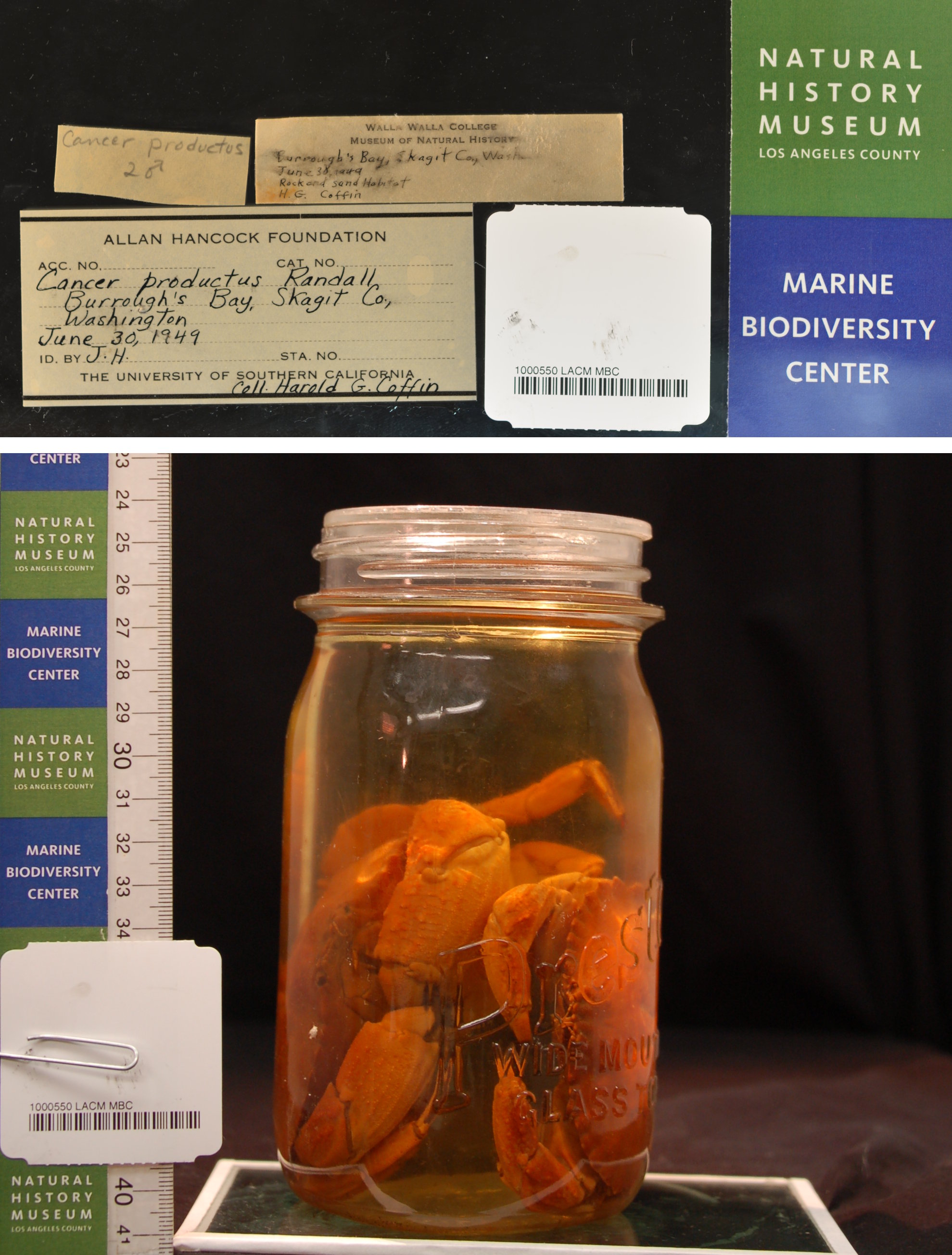
The problem is common to many “wet collections” (specimens in jars of alcohol): it’s ludicrously time-consuming to get the labels out so that the data on them can be captured. Over the years, researchers have added supplementary information to the specimens, hence many jars have multiple labels, any or all of which may be critical for understanding the importance of the specimen. Each label has to be removed, laid out, and imaged before data capture can begin.
Even after the labels have been imaged, the text that has been printed or written on them needs to be captured in machine-readable form. The combined effort needed to get the labels out of the jars, image them, and then enter the data just isn’t something we have the staff to tackle.
Enter WeDigBio.
Having the opportunity to engage a broader public gave us the incentive to get started. Over the last few months, we’ve designed and implemented a label (and specimen jar) imaging system, developed software to process the label images, and prepared ourselves for label data analysis.
Now that we know you’ll jump in to help us do the actual data capture from the labels, we’ve been able to get the preparatory work done.
That’s the magic of unfolding our institutional box to the public in a project like this: we get to give you a peek into some of life’s coolest specimens, and your help gives us the ability to achieve digitization that we wouldn’t (couldn’t!) achieve without your help.
Thank you for your work with our collection and all the other WeDigBio-associated collections — not only are you contributing to projects that are describing the scope of life on earth, you’re making those projects possible.
Many thanks to Rafe LaFrance, our Notes From Nature developer, for his help making Crab Shack come to life under a short deadline!
Notes From Nature participation in WeDigBio
The Notes From Nature team is really excited to be involved in the WeDigBio event that is taking place this week!
 WeDigBio stands for Worldwide Engagement for Digitizing Biocollections. It is a global event that focuses on digitizing of natural history museum specimens, which is something we care very deeply about. Notes From Nature is not the only transcription tool that is being used. There are others such as the DigiVol in Australia and Les herbonautes in France making this a truly global event.
The focus of the WeDigBio event is on onsite digitization gatherings that will take place around the world over the next few days. Many of these events will include fun activities and tours of the museums. Notes From Nature has been primarily a distributed group of people working towards a common goal. We are excited to see how bringing people together in one place will go and we certainly hope it will be an engaging and fun experience.
Even though most of the events are onsite, you can still participate from wherever they are! You can track the progress on the very cool dashboard on the WeDigBio site. We will also be using the hashtag #WeDigBio on Twitter and Facebook, along with some blog updates during the event, which runs from tomorrow Oct. 22 to Sunday the 25th.
CalBug Expeditions is online! Welcome to the Wood Boring Beetle Campaign.

Buprestis (Knulliobuprestis) confluenta
Quick Notes from Nature Summer Update!
An update from here at Notes from Nature Headquarters:
1) To all you devoted CalBug transcribers, we are rapidly winding down a MASSIVE (and impressive effort) that has yielded over 500,000 transcriptions and 90,000 completed imaged specimens. We have just 700 images to go! If you can help us make a push to get those done, we are busy assembling what we are calling CalBug Missions – more focused efforts on particular groups and regions (we’ll be unveiling wood-boring beetles (!) when we finish those 700 images). More on that VERY soon!
2) In the “persistence pays off category”, if you to go to the Macrofungi collections, you’ll see that we have implemented a simple PAN/ZOOM (the same used by the Herbarium interface) for locating the label, instead of the clunky old “draw a box around the label” mechanism. We think this is a big improvement and will make you all faster/better/awesomer transcribers. Let us know what you think. PROGRESS!
_W_IMG_2894.jpg) Wood boring beetles – NOT BORING
Wood boring beetles – NOT BORING
Taxonomy and Notes From Nature
A few volunteers have recently asked some questions about taxonomy in Notes From Nature. This seems to be a big question that comes up as part of the herbarium interface since this is one of the two collections where volunteers are asked to transcribe the scientific name that is present on the label.
Most of the questions and comments are about accepted versus unaccepted names. Before we get into that issue, let touch on the task that is being completed. Volunteers are asked to transcribe the scientific name (usually just genus and specific epithet) without the authorship of the name as it appears on the label. The genus and specific epithet are transcribed into the “Scientific Name” field. Here is an example:
Saccharum giganteum (Walter) Pers.
Saccharum is the genus.
giganteum is the specific epithet, sometime called species name.
(Walter) Pers. is the authorship for the name.
The authorship can be left off since this saves time and can most of the time be easily looked up automatically by querying existing databases. Another potential complication is that sometimes authorship is abbreviated and sometime not. For example, “L.” is the same as “Linnaeus.”
Databases such as ITIS list plant names as being ‘accepted’ or ‘ not accepted’. This terminology is a bit confusing for a few reasons. First, accepted names are neither static nor are they absolute; they are open to different opinions by different experts and what is accepted today may be different from what is accepted a year from now. These differences usually reflect new studies or information about the relationships among different taxa. The other issue is that one source may accept one name while another accepts a different one. Here is an example:
Saccharum giganteum is accepted by ITIS, but is not by Weakley’s Flora. Weakley considers Saccharum giganteum to be synonym of Erianthus giganteus while the opposite if true for ITIS. Both sources agree that the two names exist, but they have different opinions about which is currently accepted.

We are very excited to see folks doing some research about these names. At Notes From Nature we strongly encourage our volunteers to learn more about the work that we do and hope that everyone learns something about museums and biodiversity as part of the process. Below are a few links where volunteers can look up more information about the different taxa that they encounter, but there is no need to include that information in the transcription or Talk page. However, there are at least two exceptions to this. First would be the discovery of a misspelling or typo. Any scientific names that you discover to be misspelled should be corrected in the transcription. The other would be if you have a question, concern, noted some other oddity on the label, or just want to chat about something you have seen.
Resources:
Flora of North America: http://efloras.org/flora_page.aspx?flora_id=1
The Integrated Taxonomic Information System (ITIS): http://www.itis.gov/
Encyclopedia of Life: http://eol.org/
The PLANTS Database: http://plants.usda.gov/java/
Notes From Nature volunteer Mr Kevvy’s has generated a very useful set of custom dictionaries. They can be found here: http://www.baldurdash.org/Herbarium&MacrofungiWordListDictionary5.1.zip
Grow your piece of the patchwork! Every little bit helps.
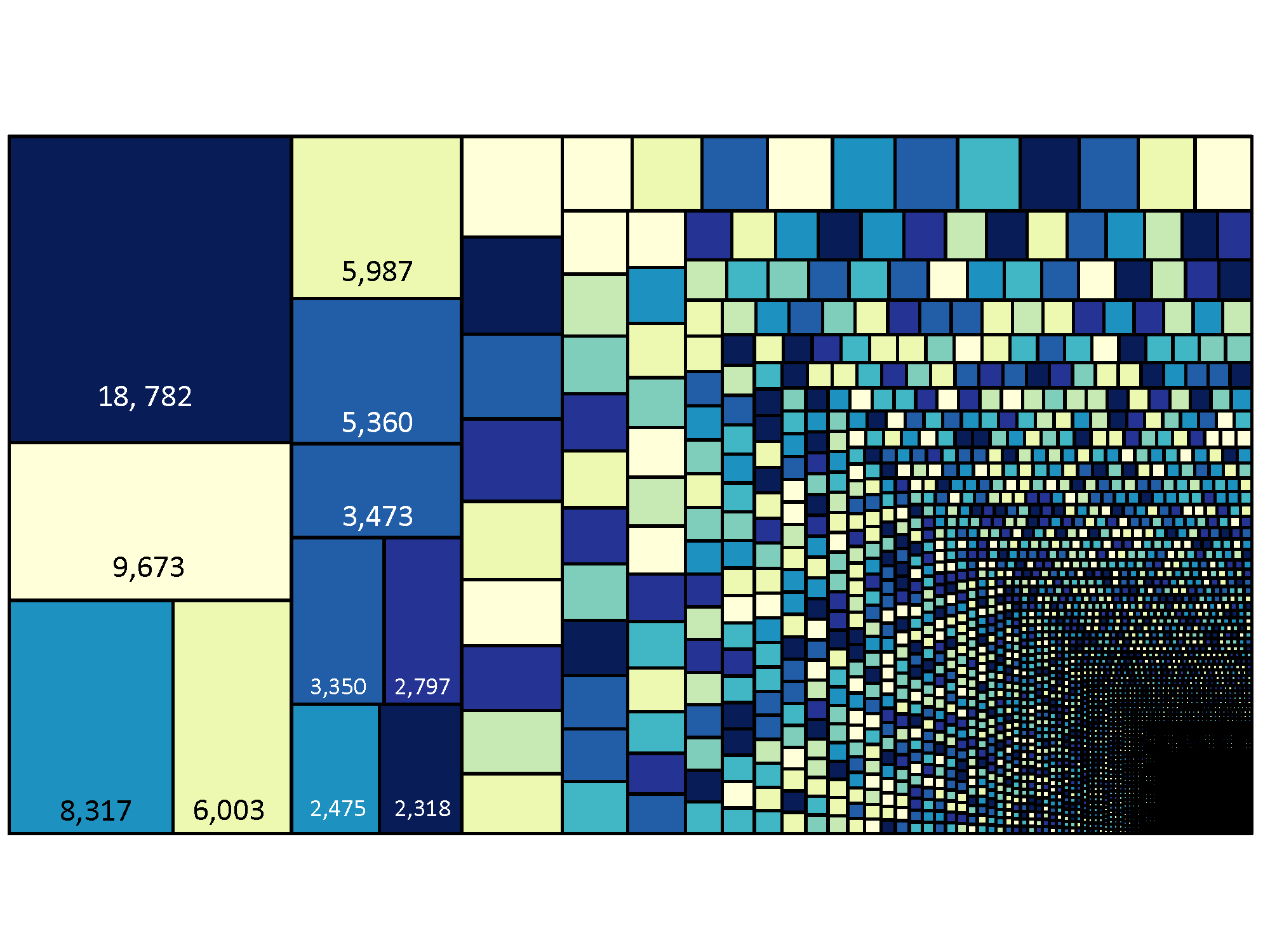
We are very excited to announce our next set of herbarium images!
These specimens come from Southeastern Louisiana University located in the southeastern United States. Wow, that’s really southeastern! Southeastern Louisiana University is a medium sized university which has an herbarium housed in its Biology department. These kinds of small to medium sized collections are fairly common around the southeastern United States. The SERNEC project has estimated there to be over 230 others! We are actively working to get them all digitized so that the data can be made available to anyone that wishes to use it.
One thing that is unique about this set of images is that it contains almost every specimen housed in this collection. That means that once this set of images is transcribed the whole collection will be digitized.
Small collections such as this one play a critical role in the documentation of biodiversity. Most small to medium sized museum collections house specimens primarily from their local area, since this is the most common place that curators and students go to collect. This means that each of these small collections makes a unique contribution to our knowledge of the local biodiversity by filling in important gaps.
The region where this collection is located is also one of the top biodiversity hotspots in the United States and is home to nearly 3,000 species of native plants.
Notes from Nature Profile: New Team Member Raphael LaFrance
Notes from Nature is SUPER EXCITED to introduce Raphael (Rafe) LaFrance, who is working on Notes from Nature in a part time role to help out with some needed improvement to the NFN interfaces and general usability. YAY! More about Rafe below. Also, again, thanks to our volunteers for sticking with Notes from Nature, and hoping that you’ll soon see improvements with Rafe now on board.
_______________________________________________________________________________________
Name: Rafe LaFrance
Title: Informatics Specialist
Where do you work primarily? I work at the University of Florida’s Museum of Natural History (Prof. Guralnick’s lab) in the field of biodiversity informatics. We are currently using computers, field data, and museum data to track where organisms are and have been in the environment. We also track how organisms respond to changes in their environment over time. All of this is done with an eye towards the value of data for decisions in a policy and management framework.
What you do in your day job? I have a few roles. I help design and program a couple of web sites related to the Museum’s research. I also help with the preparation and analysis of research data. And, I also work as a general IT and programming support when that is needed.
What’s your role with NfN and what do you hope to gain from it accomplish? If relevant, how will your research benefit? Notes from Nature is one of the web sites that I help develop. One goal I have for NfN is to continue the tradition of listening to the needs of the citizen and research scientists and make improvements to the Notes from Nature web site based upon those needs. I have already heard several ideas that will make NfN more fun and easier to use. I hope to get them to you ASAP. Another goal is to streamline the process of getting the images and data to the citizen scientists so they can continue to make the highest quality contributions to science at their typical brisk pace. And finally, I want find new and useful ways to present the citizen scientists’ results back to the research scientists. All of which is a long winded way of saying that I want to help push the envelope of what the collaboration between citizen and research scientists can accomplish.
What’s the most exciting aspect of citizen science work from your point-of-view? Like most of us here in the Zooniverse, I have a keen interest in science and would love to help in the research. Well, here it is! Research scientists need this data; it contains vital details needed for their research. Not only are we making real contributions we’re doing it at a rate that couldn’t be done by the researchers alone. We get to — are encouraged to — comb through the hidden archives of museums. We see things that most museum goers don’t get a chance to see and we get to talk with top notch researchers about their data. I started off being curious about biology but doing citizen science has not only increased my enthusiasm for science in general it has sharpened my appreciation for the process of science. I now have a better understanding of what questions research scientists actually ask. How do they go about answering them. What data do they need to arrive at the answers. From my point of view it has made me appreciate science even more than I already did.
A great shout-out to our volunteers!
An article was just published which highlights the wonderful work that our volunteers have been doing.
It is called Citizen Volunteers Pitch in on Digitization Backlog and is in the journal BioScience. Once again a sincere thanks for the enormous efforts of our volunteers!
Updated FAQ and Useful tools: Herbarium Interface
NOTE: This FAQ was updated in January 2018 and can be found here: https://blog.notesfromnature.org/2018/01/26/updated-faq-and-useful-tools-herbarium-interface-version-3/
The following is an updated FAQ that includes the topics covered in our first Notes From Nature FAQ post (https://blog.notesfromnature.org/2014/04/17/faqs-and-useful-tools/). We are most thankful to our dictated volunteers who made great suggestion to improve and clarify some important issues. The discussion and suggestions can be found here: http://talk.notesfromnature.org/#/boards/BNN0000003/discussions/DNN00003mc
Note that this FAQ only covers issues related to the herbarium interface (SERNEC). We will be developing specific FAQs for all the Notes From Nature interfaces over the coming months.
1.) Interpretation: In general, you should minimize interpretation of open-ended fields and enter information verbatim. This way, we can better achieve consensus when checking multiple records against one another (see below, on that process). However, some discretion would be nice. Here are examples:
Interpretation that you should make: Simple spacing errors (e.g. “3miN. of Oakland” should be “3 mi N. of Oakland”)
Interpretation you should leave to us: Don’t interpret abbreviations, we’ll sort that out. (e.g. “Convict Lk.” )
2.) Not in English: Transcribe exactly as written. Match label content to transcription fields as best as you can. Non-English labels should be rarely encountered in the herbarium interface, but may occasionally occur.
3.) Abbreviations: Transcribe exactly as written.
4.) Spelling mistakes: Transcribe exactly as written, unless you have looked it up and are absolutely certain of a simple spelling mistake. In this case, you can enter the correct spelling.
5.) Problem records: If you come across a problem record that may need to be addressed by a scientist, like a faulty image or a record with illegible handwriting, you can flag the record by commenting on it (e.g. with the hashtag #error) and indicate what is in error. Note that the hash tag #scientist is also frequently used for this purpose.
6.) Provinces: Geographic provinces (e.g. Coastal Plain, Piedmont) should go into the Location field.
7.) Capitalization: Sometimes information may be in all capital letters on the labels. Unless this is an abbreviation, you should capitalize only the first letter of every word in your transcription (e.g. “COASTAL PLAIN PROVINCE” should be “Coastal Plain Province”).
8.) Many collectors: In many cases, collectors may be listed on different lines of the label with no punctuation separating them. In your transcription, please separate the collectors with commas.
9.) Missing information: What should you do when there is no information available for a field? When information is not given on the label, you should leave the field blank (in the case of open-ended fields) or select “Unknown” or “Not Shown” in the drop-down lists
10.) Inconsistent collector names: You will often find several variations of the same collector name (e.g. “R. Kral” or “R.Kral”, “RWG” or “R.W.Garrison”). We are asking for the collector names to be typed as written. This is a somewhat complicated issue since same collectors might appear to be very similar but aren’t always the same. It can take know a lot of about the collector and where they deposited specimens to be able to make a definitive decision.
Interpretation that you should make: Simple spacing errors (e.g. “R.Kral” should be “R. Kral”)
Interpretation you should leave to us: Don’t interpret abbreviations, we’ll sort that out. (e.g. “RWG” should remain “RWG”)
11.) Many scientific names: For SERNEC Herbarium specimens, copy only the most recent name. This can be determined based on the date that appears on the ‘annotation label.’ If you do not see a date then enter the name that appears on the primary label.
When the latest determination uses an abbreviation for the genus name, because the genus is the same as the previous/original determination, the genus name should be written out in full. Examples: http://talk.notesfromnature.org/#/subjects/ANN0003mbn , http://talk.notesfromnature.org/#/subjects/ANN0003jz1
The “determination label” or later added determination information should have everything spelled out, however this is not always the case. If the first letter is the same it is safe to assume the same genus is being used. For example, J. marginatus would = Juncus marginatus and “Juncus” would be written out.
12.) Varieties and subspecies: Record the subspecies, but omit the scientific author’s name. So “Cyperus odoratus var. squarrosus (Britton) Jones, Wipff & Carter” becomes “Cyperus odoratus var. squarrosus”. “Echinodorus cordifolius (Linnaeus) Grisebach ssp. cordifolius” becomes “Echinodorus cordifolius ssp. cordifolius”.
13.) Scientific name: Provide the most recent name, whether it is a species name (a two-word combination of the genus and what is called the “specific epithet” in botanical nomenclature) or a one-word name that is at a higher taxonomic rank (e.g., just the genus or family name). Names at higher taxonomic ranks than species are used when a more precise identification has not been made. The species name should typically take the form of a genus name that begins with a capital letter and a specific epithet that begins with a lowercase letter. If any of the names are given in all capitals, such as “CYPERUS ODORATUS”, the name should be entered using the typical convention, “Cyperus odoratus” in this case.
14.) Latitude and Longitude: How do you enter latitude and longitude values, and where do these values go? Enter exactly as written, you can find symbols in Word or by searching online (e.g. 33° 62’ 22” N 116° 41’ 42” W). You can also produce the degree symbol ° using key combinations (alt + 0 on a mac; alt + 0176 on a PC, with the key pad on the right side of your keyboard). This information should go into the “Location” field.
15.) Special Characters: What should you type when there is a special character in a text string, such as a degree symbol or language-specific characters? You can do a google search for the symbol or copy and paste it from Microsoft Word symbols. There are also key combinations for common symbols. As mentioned above, you can produce the degree symbol ° using key combinations (alt + 0 on a mac; alt + 0176 on a PC, with the key pad on the right side of your keyboard).
16.) Elevation: Enter elevation verbatim into the “Habitat and Description” field.
17.) County: If the county is not given on the label, please find the appropriate county using google search or other tools highlighted below. However, if there are multiple potential counties for a locality, please leave the county field blank.
18.) Checking your transcription: You can use the link to the left of the “Finish Record” button (e.g. “1/9” or “9/9”) to check the information that you entered. Just click on any of the fields to make any necessary edits to your transcription.
19.) When is a record finished?: These blog posts describe the data checking process that uses 4 transcriptions of the same record to derive a consensus.
https://blog.notesfromnature.org/2014/01/14/checking-notes-from-nature-data/
http://soyouthinkyoucandigitize.wordpress.com/2014/01/14/412/
20.) Question: Should powerlines go in the location (because it helps you find a place), or habitat (because they imply a more open space and different microclimate)? Example: http://talk.notesfromnature.org/#/subjects/ANN0003qbt
Answer:
This should go in the Habitat field. It could help narrow down a location, but it says more about habitat where the plant was growing.
21.) Question: What do you enter when a record has two different counties? Example: http://talk.notesfromnature.org/#/subjects/ANN000412e
Answer:
This doesn’t happen very often. It usually indicates that the collector wasn’t entirely sure which county they were in e.g. at the boundary between the two. When you encounter this, I would suggest going with the first county listed.
I did do a bit of sleuthing and in this case I think the collectors were trying to indicate that they were on the county line. The Flint River does have a road crossing near the Spalding / Fayette County line.
22.) Question: What do you enter when a record has two different dates?
Answer:
You should enter the first date only. This is also very uncommon on herbarium label so we chose to collect only one date.
23.) Question: On this record, would you rather have the scientific name as ‘unidentified’ or as the supposition? http://talk.notesfromnature.org/#/subjects/ANN0003ynx
Answer:
This is a tough one! I can tell that the original collector (Carter) and the annotator (Kral) agree that it is in the genus Rhynchospora, but they just can’t get any further than that. Ideally you would just enter “Rhynchospora”, but leaving it blank (skipping it) would be acceptable. If the scientific name is blank or can’t be figured out then it should be skipped.
24.) Question: If “s.n.” (sine numerum = no number) is listed as the Collector Number, is it better to leave the field empty or actually put “s.n.” in it?
Answer:
It is recommend to leave it blank, since ideally we would just have actual numbers in that field. Also many people – experts and non-experts – don’t know what s.n. refers to.
25.) Question: Should “floodplain” be in Habitat? I’m inclined to put it there as it describes a growing condition as floodplains are fertilized when flooded, other plants drowned, etc.
Answer:
Yes, please put it into the habitat field.
26.) Question: What is the convention for transcribing a date range as opposed to one specific day? (ie first, last or midway through the range)
Answer:
Enter the first date only. See also #22 above. It is worth noting the conventions in other collecting disciplines is to take a range of dates (e.g. insects and CalBug) but it isn’t for herbarium specimens.
27.) Question: If a specimen is cultivated at one location from cuttings/seeds/rhizomes collected at a second location, which should be the transcribed country/state/county/location, the first or second?
Answer:
Enter the place where it was actually collected. In this case the cultivated place. I haven’t seen the label, but it is likely a good idea to indicate the cultivated information in the habitat field.
28.) Question: Although we transcribe only the latest determination if there are multiple, should we also transcribe multiple synonyms in the same determination if they are listed, or just the first? (ie “Cyperus echinatus [=C. ovularis]”)
Answer:
No. There is no need to add the synonyms, just enter the first or primary name. In this case “Cyperus echinatus.”
29.) Question: Should we also transcribe multiple collector numbers as written? ie “123 & 4567” (Probably an obvious “yes” but isn’t formally in the Standards.)
Answer:
This could indicate that each collector gave the specimen a number in the field. This is an uncommon practice and even when it happens it doesn’t go on the same label. In this case, I suggest entering it exactly as is.
30.) Question: Should we transcribe location information that is printed into the template of the label rather than being added? (such as “Plants of the Great Dismal Swamp” or “Flora of Fort…” etc.)
Answer:
This is a bit of a judgment call, but in general the answer is yes if it is not indicated elsewhere. For example you often see “Plants of North Carolina” and the state is also indicated as North Carolina. In this case, the template really doesn’t give us any new information and it should not be entered. One should also be careful of institutional templates. For example, “Herbarium of Florida State University, Tallahassee.” Labels could have the name of a museum in Florida, but the specimen could be collected in Virginia.
31.) Question: Should we transcribe “Collected as part of a survey…” and other info that doesn’t relate to this specimen per se?
Answer:
No. We do not expect you to transcribe this information. While it is interesting and potentially important we are also interested in keeping the process efficient and not overly time consuming.
32.) Question: Should we transcribe “sheet # of #” or other information indicating that this specimen is part of a set, but again is not just about this one per se?
Answer:
No. We do not expect you to transcribe this information.
33.) Question: Should we transcribe re-examination? ie “This specimen was examined as part of a study of…” that occurs years after the original label.
Answer:
No. This is part of a series of information that relates to annotations of the specimens. It is not considered to be core information that we are trying to collect.
34.) Question: Should we transcribe personal comments that clearly have nothing to do with the specimen? (Thinking Philip E. Hyatt here for some reason).
Answer:
No. See #33 above which covers a similar issue. But if you find something awesome, interesting, etc. please post it in the talk forum!
35.) Question: If a word is hyphenated across two lines, do we remove the hyphen and join it? (Not including hyphenated word pairs of course. This is probably also an obvious “yes” but should be in the Standards formally.)
Answer:
Yes, please remove the hyphen.
36.) Question: Should we transcribe Habitat/Description (or other specimen-relevant) info in later, separate determinations? (sometimes the person who made it adds a comment with further info about the specimen, i.e. its condition or maturity.)
Answer:
Yes. If the annotation clearly contains information added by the collector that fits into one of the fields then add it.
Some Useful Tools (discovered or developed by Notes From Nature users)
Counties and Cities: Good tools for finding counties etc. are lists on wikipedia, there are lists of municipalities in each state of the USA (there are also similar lists for others). For example, https://en.wikipedia.org/wiki/List_of_municipalities_in_Florida (via the linkbox you can also change the state).
Mountains: https://en.wikipedia.org/wiki/Category:Lists_of_mountains_of_the_United_States
Uncertain Localities: Geographic Names Information System, U.S. Geological Survey.
https://geonames.usgs.gov/pls/gnispublic
Mapping tool with topo quads: To find uncertain counties or localitieshttp://mapper.acme.com
Collector Names: Harvard University Herbarium maintains a database of collectors (http://kiki.huh.harvard.edu/databases/botanist_index.html). Note that many collectors that are encountered may not be in this database.
Hard-to-read text: Use “Sheen”, the visual webpage filter, for some hard-to-read handwriting written in pencil. (Tip was from the War Diary Zooniverse project) https://chrome.google.com/webstore/detail/sheen/mopkplcglehjfbedbngcglkmajhflnjk?hl=en-GB
Special symbols: You should be able to find symbols in word or by doing a google search and copy and paste. Here are a few:
– degree symbol for coordinates: °
– plus minus: ±
– fractions: ⅛ ¼ ⅓ ⅜ ½ ⅝ ⅔ ¾ ⅞
– non-English symbols: Ä ä å Å ð ë ğ Ñ ñ õ Ö ö Ü ü Ž ž
The Plant List: Search for scientific names of plants – http://www.theplantlist.org/
List of Trees: https://en.wikipedia.org/wiki/Category:Trees_of_the_United_States
Integrated Taxonomic Information System (ITIS): http://www.itis.gov/
Mr Kevvy’s has generated a very useful set of custom dictionaries. They can be found here:
http://www.baldurdash.org/Herbarium&MacrofungiWordListDictionary5.1.zip
These dictionaries are a wonderful resource. It should be noted that scientific names can have gender based differences. You will see the specific epithet (commonly called the “species name”) with male and female genera spellings. An example albiflora is feminine and albiforus is masculine. The Carolina-poppy is Argemone albiflora (not albiflorus). Both albiflora and albiflorus are correctly spelled, but in this case albiflorus should never be used with the genus Argemone.

