
Another collection complete!
Last week our volunteers completed the University of South Florida herbarium collection. We are excited to see this collection complete and wanted to take this opportunity to thank our awesome volunteers for their effort!
This was a relatively small collection of images (~500). The University of South Florida is similar to many collections in the SERNEC network as it is a small to medium sized collection housed at an academic institution. This collection is somewhat unique in that it has a large collection of cultivated plants.
This collection has been moved to our relatively new completed collections page. Thanks again to all the volunteers that helped with this collection!
Tweaking our transcription numbers (again).
As many of you know, Notes From Nature collects more than one transcription for each image (or subject, in Zooniverse speak). This is not uncommon among Zoonivere projects. This means that we get more than one set of data for each specimen image, making sure that each transcription is done by a different user. In fact, the algorithm does not permit a user to transcribe the same image more than once. This is why it is possible for a collection to be incomplete, but some users are no longer served images to transcribe.
The purpose behind this is to assist with quality assessment of the data. It is not that our volunteers do not provide quality transcriptions! In fact, in many cases Notes From Nature volunteers provide higher quality transcriptions than trained technicians. However, there are various situations where the information on a label can be up to interpretation. This is especially true for handwritten labels and information that goes into our free text fields (e.g. locality). Having more than one transcription helps us come up with the best possible transcription for a given image, using software that analyzes the whole set of transcription.
This is not the first time we have changed the number of transcriptions. When we first started Notes From Nature in 2013 we were collecting 10 transcriptions per image, which we quickly realized was many more than was needed. We reduced the number of transcriptions to 4 per image. We recently reanalyzed this issue again and found that 3 transcriptions per image would be sufficient. This means that we have moved from 4 to 3 transcriptions per image as of this week. So far this has taken place in the CalBug, Herbarium and Macrofungi interfaces.
Some of our volunteers have already noted that our progress bars showed a bit bump this week and this is the reason why. When the algorithm was changed any images with 3 transcriptions were immediately retired from the queue. As always, we greatly appreciate your hard work and are continually looking for ways to make this project more efficient and enjoyable!
Happy New Year to the Notes From Nature Community!
The NFN team wants to wish you all a Happy New Year! We also want to give a brief update about some of the things happening in 2016.
We have a lot of activity going on this year thanks to funding from the U.S. National Science Foundation. We will be posting more information, as new advancements are made and certainly prior to any major site changes. The main activity right now is a transition of NFN to a new platform called Panoptes. The current platform is called Ouroboros and we will be transitioning to the new platform by early summer. A few other Zooniverse project are also making this transition. For example, a new version of Old Weather has already been launched on this platform.
The upside of Panoptes is that it is open source and will allow for addition features to be added and bugs to be fixed much more easily. This will give the research team a lot more flexibility and value over the long haul as NFN continues to evolve. In addition, the new platform includes an improved Talk page. The new Talk is already being used on the main Zooniverse site if you want to see how it works.
The platform upgrade is just the beginning of several changes that will be taking place over the next few years of this grant funded project. There will be additional features that will be of direct benefit to our volunteers, such as improved volunteer profiles. We will also be bringing in biodiversity information from external sources such as Encyclopedia of Life and Map of Life. The goal is to give even more meaning to the specimens and the organisms that are preserved in the specimen images.
As part of the transition to the new NFN we will be pushing to complete the existing sets of images before any new interfaces are launched. Since the herbarium (SERNEC) interface will be the first project to launch on the new platform, we will be focusing on completion of those image sets in the coming months. There will be more information about our strategy for doing that very soon.
Notes From Nature Restored!
Hi All,
Notes From Nature was down for most of the last two days. The problem was fixed late last night and all the interfaces should be working now.
Thanks to our dedicated volunteers for pointing this out and for providing details of the issues you were encountering. I want to give a shout out in particular to the users am.zooni, maggiej, Bonnie123 and HelenBennett57!
Please post in the Talk post here if you see any other issues over the next few days.
Happy Winter Solstice and Happy New Year!
Who loves statistics? We do!
Crab Shack Complete!
The Crab Shack at Notes From Nature has temporarily shut its doors, for the best possible reason: we’re done! In barely over a month, an amazing group of transcribers has completed data transcription from nearly 1,000 samples (upwards of 4,000 transcriptions, since each sample is transcribed four times). That’s the complete collection of crabs in the family Cancridae that we have here at the Natural History Museum of Los Angeles County.
This was a particularly challenging transcription project. There were over a dozen data fields, and a truly ambiguous mapping of text on labels to database fields. This was really a stretch for the Notes From Nature team, and we’re extremely grateful! Deep thanks to Rob Guralnick, Rafe LaFrance, Libby Ellwood and Michael Denslow for putting it all together in time for the WeDigBio blitz.
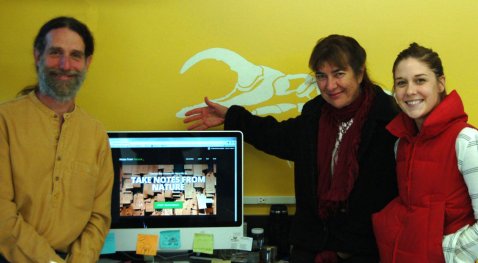
Are we happy about how it went? Extremely! Here’s a snapshot of a few of the Happy Crab Shack Biologists here at the Museum right after we learned of the completion. From left to right, that’s Dean Pentcheff, Regina Wetzer, and Jenessa Wall. Not shown are Kathy Omura, Adam Wall, and a crew of interns, volunteers, and work-study students from the University of Southern California (who did the specimen and label photography).
But of course, the core contribution came from the many transcribers out in Internet-land. To all of you — thank you so much! This project happened and succeeded because of your persistence on this (admittedly ambiguous) project.
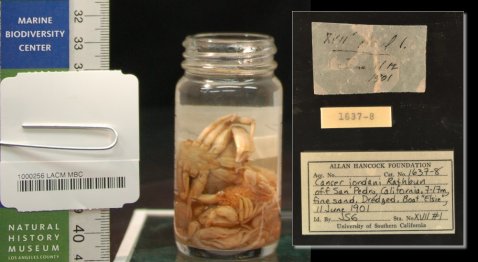
Even without looking at the data in detail, some gems have emerged. One example is a sample that, from its label data, we now know was collected in 1901 at an early marine laboratory near us in San Pedro. The photo shows the crabs and the labels that were transcribed. The boat “Elsie” was used by researchers at the lab before the operation moved to the San Diego area, where it became the Scripps Institution of Oceanography. At the time, San Pedro was a pretty rough place, but was home to (among other characters) an eccentric group of women pursuing marine biology. We had no idea that we had any specimens from that era.
While the Crab Shack is currently not serving any entrées, we’re not closing shop for good. First, we need to analyze and ingest the amazing dataset we now have. Based on what we learn from the data and the feedback from this expedition, we’ll be moving forward (again, teamed with the great Notes From Nature crew) to open a newly refurbished Shack, journeying on to a new group of animals (still to be determined).
We look forward to having you on board again!
WeDigBio: Closing thoughts and appreciation
It was a very exciting past few days as Notes From Nature participated in WeDigBio. The event was a great success and you can see lots of photos and reports from the event on Twitter and Facebook. The WeDigBio site also has some really nice visualizations showing where people were working during the event and the overall transcription progress.
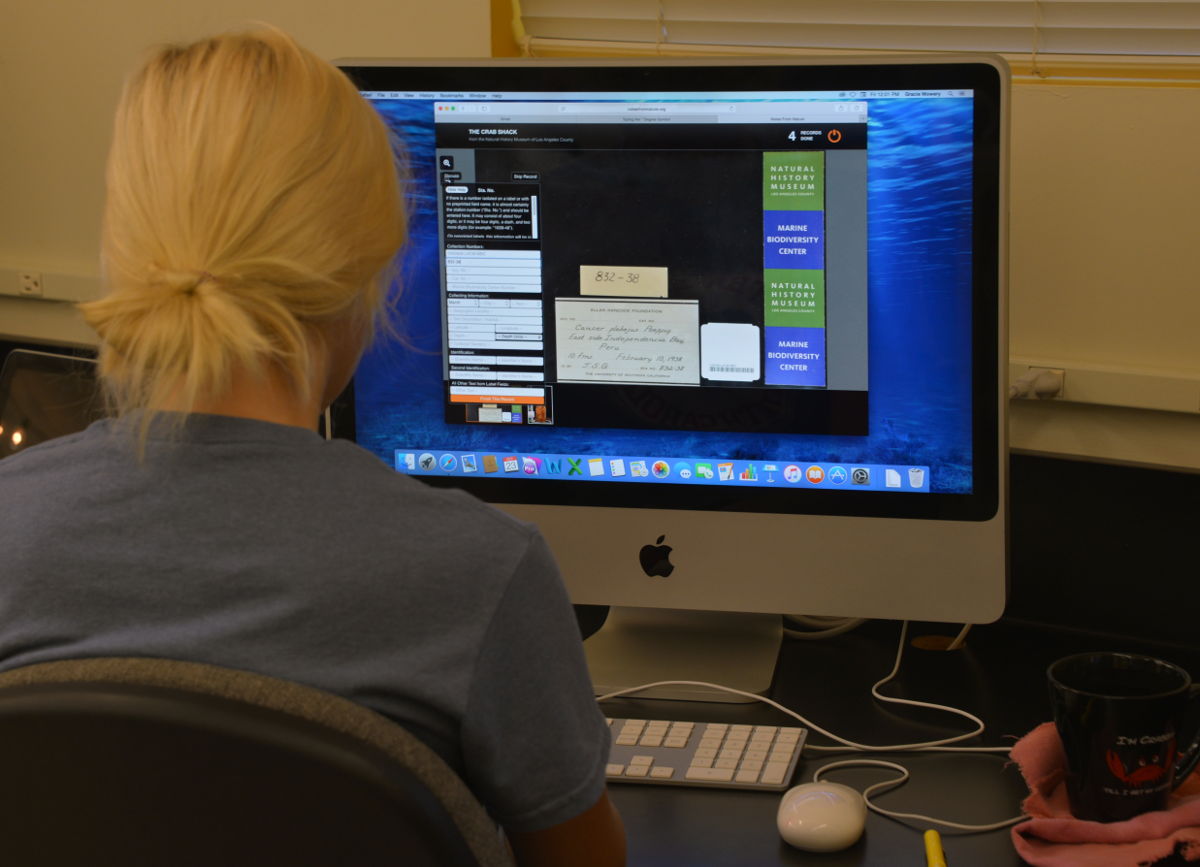
A Crab Shack participant’s eye view of digitizing a crab specimen, one of dozens of digitized at the Marine Biodiversity Center of the Natural History Museum of Los Angeles County’s event for the WeDigBio digitizing blitz.
We want to offer our sincere appreciation for all those that made this event possible and especially to the volunteers who stepped up and helped us meet not one, but two challenge goals for the event! The WeDigBio team started out with a goal of completing 25,000 transcriptions for the entire event using all the transcription platforms. After that milestone was met the goal was raised to 30,000 transcriptions. The event ended with well over 34,000 transcriptions!
The official count for transcriptions completed using Notes From Nature was 9,980! This is simply incredible and the Notes From Nature team is so very thankful for these efforts. The number could actually be as many as 1,500 transcriptions higher since there were some glitches that prevented some transcriptions from getting counted on the first day. The transcriptions themselves are saved, it was a glitch with the visualizations on the WeDigBio page.
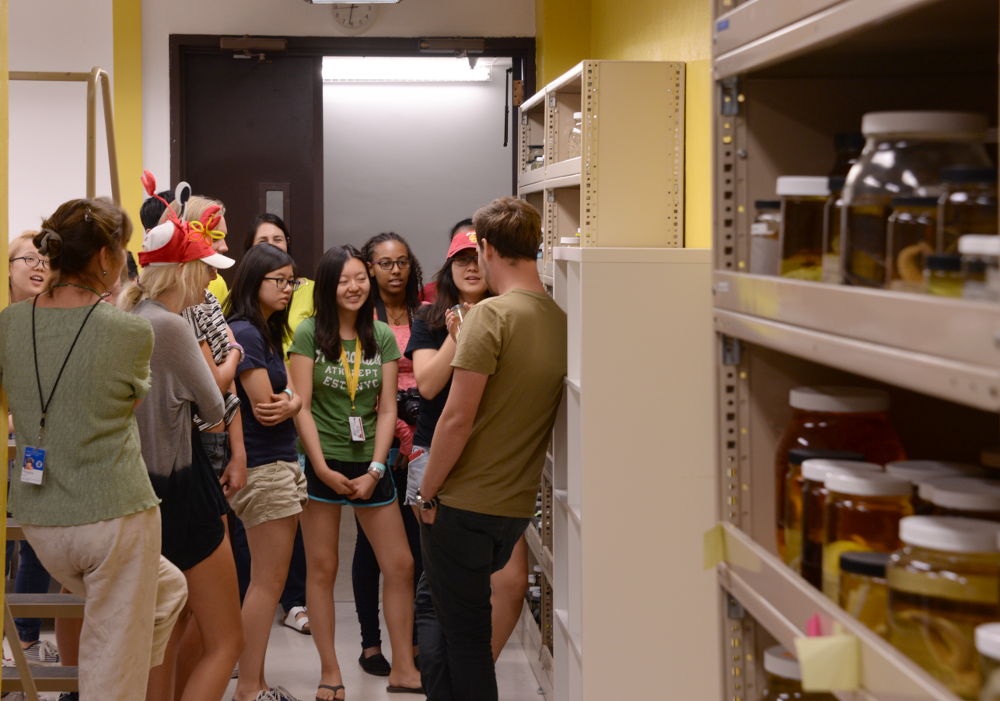
Adam Wall, of the Crustacea Section at the Natural History Museum of Los Angeles County, orients participants in the Crab Shack digitizing event on what they’ll see inside the research storage facility.
While these numbers are amazing, we are also thrilled with many of the less tangible aspects of the event such the interactions between the museum curators and citizen scientists that occurring during the onsite gatherings. We hope to see you all for the second annual WeDigBio event in 2016!
UC Berkeley Museum and WeDigBio
For centuries, scientists have explored and documented the natural world, collecting the billions of specimens housed in museums, universities, and field stations worldwide. And now, UC Berkeley and other institutions across the globe want to help make that information available to the general public.
But they need your help.
UC Berkeley’s Essig Museum of Entomology invites members of the public to one of the many transcription parties that will be held this week during the Worldwide Engagement for Digitizing Biocollections (WeDigBio) Event. The WeDigBio event will transform the cryptic data sequestered on the labels of plant, insect, fish, and fossil specimens into an open, globally accessible, digital resource with the help of the public.
“Between California’s extended drought, extensive wildfires, and other assaults on our environment, it is now more important than ever to understand how these pressures are changing insect communities and the ecosystem services they provide,” says local event organizer and collections manager, Dr. Peter Oboyski. “There is no better way to convey this message than by inviting the public behind the curtain to help us collect the data we need to document these patterns.”
The Essig Museum contains nearly 6 million specimens of insects, spiders, and their relatives, representing over 35,000 species. These specimens also represent the past 100 years of California’s climate, terrestrial habitats, and waterways in the form of distribution records of native and invasive species. “California is a biodiversity hotspot and a world leader in conservation, research conducted at the University of California over this time span allows us to map the past and give us a glimpse of our environmental future,” says Oboyski.
The WeDigBio event emerged within the museum community to accelerate the rate of digital data creation about the historical what, when, and where of the perhaps 9 million species on Earth. The major online transcription platforms include the U.S.-based Notes from Nature, Smithsonian Transcription Center, and Symbiota; the Australia-based DigiVol; the UK-based Herbaria@Home; and the France-based Les Herbonautes.
This one-of-a-kind event will be held from October 22-25 at 30 locations across the globe. While the local event at UC Berkeley offers a social setting where people can contribute and learn about the entomology museum and local insect diversity, members of the public can contribute at anytime from anywhere during the event at one of the participating online transcription platforms.
Essig Museum ”CalBug” specimens will be available for transcriptions at www.notesfromnature.org. More information about the WeDigBio event can be found at https://www.wedigbio.org.
The UC Berkeley transcription blitz will take place from 9 a.m. to 2 p.m. on Saturday, October 24th, in the BioScience Library of the Valley Life Science Building. More information is available at http://essig.berkeley.edu/activities/wedigbio.shtml. RSVP to essig.museum@gmail.com
Student feedback from Day 1 of WeDigBio
The following is a collection of comments and reactions from students that used Notes From Nature as part of their classroom activities on the first day of WeDigBio. The is an innovative example of service learning and community engagement being used in the classroom. The NFN team is always excited to see these kinds of activities being integrated into the classroom setting!
“I really enjoyed the WeDigBio Blitz; there is something about contributing to digitizing important records that are so vital to botanists and other researchers that is satisfying. Of interest: I found two plants of the twenty-five I did that were collected on the day of my dad’s birth!”
“This Notes from Nature transcription activity was quite valuable. I felt like I was legitimately helping and contributing to the scientific community; the WeDigBio experience is super important.”
“This morning we contributed to science in wedigbio. I enjoyed converting the old data sheets into a database and felt good that I contributed to humanity.”
“Wedigbio is a very well designed website. It was easy to use and I felt like I accomplished something for the greater good of our world. The blitz itself was cool to think about when looking at it from an outside point of view. There are thousands of people around the world working together to transcribe the world’s flora! That is amazing to think about.”
“The experience of transcribing for Notes from Nature was very rewarding. The idea that I am contributing to the study of scientific specimens from around the world is very exciting and I was happy to be a part of it. “
“Notes From Nature is a fun and easy way to transcribe plants into the online system. I didn’t experience any glitches with the system. Some of the plants are difficult to transcribe because the herbarium notes aren’t very detailed, especially those from out of the country.“
“My experience today with transcribing for Notes From Nature was fulfilling in that I felt like I was contributing to a bigger picture for further discoveries and enabling those in the field to continue to collect and document specimens.”
“I really enjoyed this assignment and the idea that all of us could make an impact in the scientific community. My favorite discovery was hearing that each label/specimen is transcribed four times in an attempt to minimize errors. While I think more activity on the site might get rid of transcribing jobs, this is a really innovative project. I liked being able to see how botany is transitioning into the modern age with everything at our finger tips.”
“This morning’s Notes from Nature experience was fun and informative especially hearing more information about how it works behind the scenes. It also gave a different perspective of how this work is done, I work in the herbarium on campus where digitization is being done and it is not greatly different which was curious. I wish there was a bit more time to go in depth and discuss and reinforce the importance of digitizing plant collections.”
“I found it very helpful to move from material data to technological data since we are in the era of technology. Making this ability to help out public is a very good idea and motivated students will be sure to help out, I know I will. The experience overall was hit or miss with the transcribing, some handwriting is hard to read and some information is omitted, regardless, this is a great idea to make available to the public.”
“I really enjoyed being able to transcribe for the Notes From Nature. It is very easy to access and fun to see different types of plants that are found in different areas of the world. I also felt like I was doing my part by being able to transcribe something so important that a computer could not. Overall it was a wonderful experience.”
“It was an interesting experience for the limited amount of time that I was in class. This is something that I would probably do for fun on my spare time.”
“The blitz was really fun, I was more into it than I thought I was going to be. I think the fact that the whole class was doing it at the same time made it much more exciting. “
“I transcribed 9 specimens. I chose to do them from the University of South Florida Herbarium. I liked that I was already familiar with most of the plants I had the chance to look at. Most of them where approximately 40 years old. However the oldest specimen was from1959 and the newest was collected in 2012. Very interesting to look at specimens that old.”
“When transcribing the labels on WeDigBio, I realized for the first time how unstandardized the labeling system is. Some collectors put all necessary information with plant facts, others put the bare minimum and didn’t do a very good job on describing the location of the specimen.”
“Transcribing for Notes from Nature was simple and interesting and certainly a productive experience. Even doing something as easy as typing the records of a particular plant specimen feels like a significant contribution to the scientific community. It also provides an example of what details should be recorded about plants for other scientists and helps users take one more step on the road to becoming a botanist.”
“WeDigBio was a good way to spend my class time. I was able to learn how to digitize records really easily. The entire process was quick, painless and very straightforward.”
“This was a fun experience, and I felt like I was making a positive contribution to science. Fortunately my specimens were very clear, and easy to decipher the information. It made me confident in my submission and that I was able to supply accurate information. I also noticed there were different types of specimens such as crabs to be transcribed, and I would like to do those as well.”
“It was hard to read a lot of the labeling. Also, I noticed that for the SLU records, if a record from found on campus, it just said “on campus” and didn’t say the county. So this part I’m sure will be missing for a lot of their records. The activity went more or less smoothly, although I am not a huge plant person, so I didn’t personally enjoy the activity very much, although I understand the scientific value in it.”
“Learning about how the notes from nature website was developed was interesting. Doing more label identifications were helpful to learn how the pressed plant labels should be. Doing the label identification is also fun to do, and a great citizen science website that is user friendly.”
“Transcribing Notes from Nature was cool because we got to help science as citizens by helping create an online database for plants. We viewed pictures of plants and labels and transferred the information to the online database by filling out the proper information. I think it would be interesting to see how many people participated so far and I will definitely participate in the future.”
“One of my specimens had an incorrect scientific name. Thankfully we had a subtle pencil correction on the specimen to go off of. All of my specimens were collected by Olga Lakela, who evidently was an influential female botanist in the 60’s. “
“I really enjoyed the concept of the transcription event. Being a little competitive myself, I viewed it as a challenge to get as many done in the time we had. I do actually feel like I am providing a valuable service by transcribing for Notes From Nature. Learning that what I transcribe will be transcribed by 3 other people removed any stress that I might get something wrong and prevent me from wanting to participate. I would participate in a future transcription event if I found out about it.”
“It was a really interesting event to take part of (WeDigBio). Notes From Nature was an easy site to do this through, as it walked you through what to look for in separate steps and provided examples. However, the specimen navigation (zooming in and moving to different areas) was a little difficult. Additionally, the specimen label was missing information sometimes, such as county or habitat.”
“Transcribing through Notes From Nature was a interesting experience. It was neat to see such a variety of specimens, some that were many decades old. I liked being able to do something that benefits the scientific community. WeDigBio seems like it is and will continue to be a huge event.”
“I think that notes from nature is a great way to start developing museums labels for herbariums. I sometimes could not find all the information and some of the labels were a bit hard to read but that comes with the territory I suppose. The site was nicely made and easy to navigate. I would definitely use it again!”
“I think the Notes From Nature activity was a really cool activity we did in class today because it was a world-wide effort. There were a few issues I found with using the website that were kind of confusing when it came to transcribing. Some specimens had more than one label with different information on each, two specimens popped up at once a few times, and not all the information needed to transcribe was given for each specimen. Overall fun and cool class activity!”
“My experience transcribing for Notes from Nature was quite interesting. For the most part I had species that were found in Florida except for one that was a herbarium sheet from Finland. It was interesting to transcribe for a species from a different country. I was also thankful that all the herbarium sheets I transcribed had typed information rather than handwritten information.”
“My experience transcribing for Notes from Nature was quite interesting. For the most part I had species that were found in Florida except for one that was a herbarium sheet from Finland. It was interesting to transcribe for a species from a different country. I was also thankful that all the herbarium sheets I transcribed had typed information rather than handwritten information.”
“I enjoyed the class this morning, I transcribed around 10 plants. The website itself runs great, although I had a few problems throughout with the picture freezing when trying to zoom in or out but refreshing the page seemed to be a quick fix. Hearing the guest speakers side of the story to the beginning of the site gave me more respect for the site and for the cause. I now see why the website is necessary to preserve herbarium specimens because some I transcribed were beginning to fade and wrinkle (granted they were added to the collection during 1968).”
Slicing up SERNEC
As many of you may already know, the herbarium interface (or collection as its called on NFN) is comprised of images related to the SERNEC initiative. This is a very large consortium of herbaria that is interested in bringing more data about plants online for everyone to use. When I say more, I mean a lot more – millions of records! The geographic focus of these efforts is the southeastern United States, which is an extremely rich and unique global biodiversity hotspot.
Since NFN began, volunteers were only able select one set of herbarium images to work on. These have been preselected by the science team for a variety of different reasons. We have realized that there are limitation of this approach and have wanted to make these sets of images even more meaningful to everyone involved, especially our volunteers.
We have taken a step in this direction this week, by offering up four different collections to work on. These sets of images were selected and separated because they are from museums that are hosting onsite events this week as part of WeDigBio. The thought is that people have come to these events, in order to specifically help the museum that they are visiting. The new page allows volunteers to do just that.
This is a great test for the NFN team to see how this works out and will inform our plans for the future. For example, we are planning to allow for the subsetting of images by geography (e.g., North Carolina) and taxon (e.g., sunflower family). This has not been possible in the past mostly because this kind of information was not being collected when the specimens were imaged. The SERNEC group has changed it’s imaging protocol to allow for these kinds of selections to be made in the future. We are also interested in exploring other methods such as creating word clouds by using OCR methods to automatically extract all the words from the image and allow users to select them. After all, one of our main goals is to make coming to NFN a valuable experience for our volunteers.

Newfound Gap Rd near Clingman’s Dome Rd – Great Smoky Mountains National Park. Photo by Timothy Wildey

