
The Macrofungi Collection – Some Background
The Macrofungi project on Notes from Nature is off to a great start!!! Thank so much to all who have contributed so far.
Some transcribers have been a bit confused when there are several different bits of paper presented for transcribing. Usually there is one “official” label with the basic collection information, e.g., the name of the specimen, where it was collected, when and by whom. There may be a second label that just repeats some of the official label information. Occasionally there is even a third label, often handwritten, and sometimes quite lengthy, that is filled with unfamiliar terminology. Learning a bit more about how macrofungi collections are documented may help you to understand what is going on here.
Macrofungi are usually short-lived. As soon as you pick one, it begins to change, and if left alone after picking, may become a slimy mess in an astonishingly short time. So if a mycologist (that is, someone who studies fungi) plans to make a scientifically useful specimen from a macrofungus he or she collects, there is a work that has to be done right away.
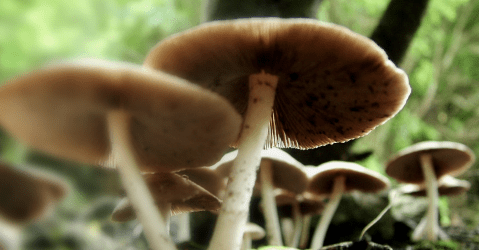
First, the mycologist will take habitat photographs as shown here, sometimes picking a few individuals and arranging them so all the important parts are showing.

Habitat photograph
Then he or she will make written notes about the features of the fungus that are going to disappear once it is dried, namely the odor, the color, the taste (yes, all mushrooms are tasted, even poisonous ones, but of course they aren’t swallowed!) and whether or not the fungus is dry, sticky, or slippery to the touch. These characteristics, as well as measurements of size and descriptions of shapes are important for identifying the fungus, and must be recorded before the specimen is put on the drier.
These days mycologists record these field notes on computers, but before this was possible, the information was often recorded in cramped handwriting on small bits of paper, as shown here, that could be folded up and would follow the fungus on the its journey to becoming a permanent collection.

Handwritten fieldnotes
At the end of a collecting trip, the mycologist has to prepare the specimen for permanent storage in an herbarium (or fungarium, as some mycologists like to call these collections). This involves making the official label and placing the specimen and the field notes in a cardboard box.

Dried macrofungi collections
Placement of the official label varies between and even within collections – it is very convenient for future users if the label is glued to the box top where it is easily seen, but to save space and money, we use the smallest possible box for each the collection, and this often means that the label won’t fit on the box top. In such cases, the label is put inside the box, and some of the label information, usually the name of the specimen and the collector name and number, sometimes the state or country, are written or printed on the box top. The picture below shows a collection with all three label types. Hopefully, armed with the information presented here, you will now be able to tell which is the official label, which is the box label, and which are field notes when Notes from Nature Macrofungi presents you with multiple pieces of paper to transcribe. You should always transcribe from the official label, but sometimes looking at the box top label can be helpful in interpreting handwriting or abbreviations. If not, please keep posting comments!

A macrofungi image in Notes from Nature with three labels
If you would like to learn more about how mycologists make collection of macrofungi, you can download a document called “Recommendations for Collecting Mushrooms for Scientific Study” that explain the process in more detail: (http://sweetgum.nybg.org/boletineae/collecting_illustrated.pdf).
If you would like collect macrofungi yourself, contact a mushroom club in your area – you can find a complete listing at the North American Mycological Association website (http://namyco.org)
Macrofungi Added to Notes from Nature!
 The Notes from Nature team is excited to announce the addition of content from the Macrofungi Collection Consortium! This collection is a partnership of 35 institutions across the U.S that collectively will digitize about 1.5 million specimens that have been collected the past 150 years. Macrofungi are important to humans in many ways – many people like to eat them, but some species are also deadly poisonous. Macrofungi are also key to the health of our forests – indeed, most forest trees could not survive if their roots did not form a relationship with a macrofungus (called mycorrhizae) that helps tree roots absorb water and minerals from the soil. Macrofungi are also an important source of food for forest animals and they serve as homes for many soil insects and other small organisms that are also part of a healthy forest ecosystem. Many macrofungi are very beautiful, and are the subject of nature photographers. Their pigments may be used for dyeing wool or cotton, and for paper-making. Macrofungi are important religious symbols in some cultures. Recently it has been discovered that macrofungi can play a role in the cleanup of environmental disasters. Through a process called “mycoremediation” macrofungi are able to break down or remove contaminants such as pesticides and fuel oils.
The Macrofungi Collection comprises mushrooms and related fungi. After collection, specimens of macrofungi are dried on a vegetable dehydrator or similar type of dryer, and then are placed in a box or packet with a specimen label that gives the name of the fungus, when, where, and and by whom the specimen was collected. Because macrofungi are often very short-lived, documenting their occurrence with specimens is critically important for knowing which macrofungi grow where.
To help scientists answer the many remaining questions about these foundational organisms, they need access to data from collections. Our project is to digitize these specimens and make the data available in a standardized, searchable form through the MycoPortal.
Although macrofungi (mushrooms and mushroom-like organisms) are not plants, they are still stored as dried specimens in herbaria. The dried mushroom (which often looks nothing like the fresh mushroom!) is stored in a box or paper packet and is accompanied by a label that that gives the name of mushroom, where it was collected, when, and by whom.
You can contribute to a better understanding about these environmentally critical organisms by helping to transcribe data from the specimen labels into a structured format. The folks who are capturing the images of these specimens have already recorded the name of the fungus, so what we need your help with is transcribing the collection locality and date, as well as the collector’s name and number.
If you want to learn more about macrofungi, there are many sources of information. Online, Encyclopedia of Life, which is also linked to the macrofungi collections in Notes from Nature, is a reference for images and descriptions of many of these fungi. Mushroom Observer is a site where citizen scientists and professional mycologists meet to discuss macrofungi of interest. There are also many clubs around the country where participants go on mushroom collecting trips, host lectures for members and teach the general public about these organisms. You can learn about clubs in your area through the North American Mycological Association website.
Seeking participants for December hackathon!
iDigBio and Zooniverse’s Notes from Nature Project are pleased to invite you to participate in a hackathon to further enable public participation in online transcription of biodiversity specimen labels. The event will occur from December 16-20, 2013, at iDigBio in Gainesville, FL, though you may choose to participate in a subset of the days based upon the schedule. We are especially looking for participation from the most enthusiastic and committed citizen science transcribers! This is a great opportunity to have a direct influence on expanding this tool in the directions you would like to see it go.
The hackathon will produce new functionality and interoperability for Zooniverse’s Notes from Nature and similar transcription tools. There are four areas of development that will be progressively addressed throughout the week.
- Linking images registered to the iDigBio Cloud with transcription tools in order to alleviate storage issues. (Monday)
- Transcription QA/QC and the reconciliation of replicate transcriptions. (Remainder of week)
- Integration of OCR into the transcription workflow. (Remainder of week)
- New UI features and novel incentive approaches for public engagement. (Remainder of week)
There will be opportunities to narrow the focus in each category of activity in a teleconference tentatively scheduled for early in the week of November 25 (and also at the TDWG meeting and the iDigBio Summit, if you are attending either of those events).
If you are interested, please get in touch with Austin Mast (amast@bio.fsu.edu) by Wednesday, Nov 1. iDigBio has budgeted some funds to support travel costs.
With best regards,
Austin and Rob Guralnick (UC-Boulder), co-organizers
On television!
Check-out a recent feature on Notes from Nature on the local NBC29 news station in Charlottesville, Virginia. Two billion specimens!
http://www.nbc29.com/story/23757819/uva-researchers-seek-publics-help-classifying-species
A new milestone!
The Notes from Nature team is proud to report reaching the new milestone of 300,000 transcriptions completed! This has been made possible by the generous and committed efforts of nearly 4,000 citizen scientists from around the globe. We look forward to continuing the project and sharing more biological collections with you in the near future. Thank you citizen scientists!
To continue growing and expanding, we are interested in your feedback. What excites you the most from Notes from Nature so far? How would you like to see it evolve? Leave a comment and let us know!
On the radio!
This morning I had the opportunity to join WTJU’s Robert Packard on the Soundboard program to talk about Notes from Nature. Click here to listen to the clip!
Are you a teacher?
One thing the Notes from Nature team has been interested in doing from the start, but hasn’t yet found the time to squeeze in, is to develop educational materials utilizing the Notes from Nature content and release it via the Zooniverse ZooTeach site. For those who have never heard of ZooTeach, it is described as a place “where educators can share high quality lesson plans & resources that compliment the Zooniverse citizen science projects.”
 Are you a teacher? Do you love Notes from Nature? Would you like to integrate it into your curriculum? If yes, please reply to this post with a comment to begin a conversation about how to do this. We’re eager to reach a broader audience and partner with you!
Where Our Crowd Funders Come From
Notes from Nature is a project that spans the United States, and in the future, will hopefully span the globe. Our citizen scientists certainly come from around the world. I’ve put together a map to look at where our crowd funders come from thus far. How far can we reach in getting support and expanding this project?
Take a look at where our current crowd funders come from and click on the map to go to our campaign page.

A Case for Conservation
Here’s an interesting article entitled “Vanishing act: Conservationists make the case for saving Albemarle County’s rare and threatened habitats” from the C-Ville Weekly, one of the local news sources in Charlottesville, VA. Have you found any specimen in Notes from Nature that come from habitats like the rock outcrop discussed in this article? Some of the specimen in the Mountain Lake Biological Station collection were even collected right in this area!

