
Help us transcribe fossil collections
Join paleontologists of all ages in looking at images of fossil specimens and contribute to our understanding of Earth’s past life.
Notes from Nature is pleased to announce that we’re unveiling our fossil label transcription service in honor of National Fossil Day and WeDigBio. Log in or sign up now to begin looking at fossil specimens from around the world in various museum collections.
Our first transcription expedition consists of a significant collection of Cambrian trilobites casted by Charles Deiss, of Indiana University. Dr. Deiss visited many world-class institutions to make these plaster molds as perfect replicas of the fossils contained in the original museums for his research. Plaster molds were used by Dr. Deiss and other scientists in the early part of the 20th century because 3D scanning and printing didn’t exist yet! Fortunately, sharing research data is considerably easier with new technology AND helpers like YOU! Thanks for enabling others to find out more about this world-class collection of fossils and molds by transcribing labels from this unique collection!
Get Back, to where you once transcribed
National Fossil Day (and a special announcement)!
Every year, October 12th marks a special day in which we celebrate the history of life on earth with the best record we have available…fossils!
On this day we are very pleased to announce that we will be launching a new interface for fossil transcription just in time for WeDigBio. We are collaborating with Indiana University and the first expedition will consists of a significant collection of Cambrian trilobites.
Please keep an eye out over the coming days for this new set of specimen images and consider helping out with this unique collection.
— The Notes From Nature Team
SERNEC WeDigBio events
A big event is around the corner for herbaria worldwide. WeDigBio, a worldwide digitizing event, is happening October 20-23, that’s just 8 days away! Many herbaria are planning events for students and citizen scientists to gather online or onsite for talks, workshops, and more. This is all in an effort to encourage the digitizing of collections. SERNEC is planning to have 9 collections represented. You can see if there is one happening near you on the WeDigBio event list.
This is not just limited though to large herbaria but also smaller universities collections. This event will give people an opportunity to learn what is going on in the natural history collection world and they can help mobilize critical biodiversity data for public use. Please consider joining us onsite or online next week.
Jordan Willet — Graduate Student at Appalachian State University
Insulting and/or Naughty Place Names
Recently an undergraduate student was transcribing herbarium labels using Notes From Nature as part of “The Physician’s Garden,” a course at the University of North Carolina at Chapel Hill that combines botany, chemistry, gardening, history, and citizen science.
Herbarium staff were helping the student learn how to read herbarium labels – how to enter collector name, where to enter the date the plant was collected, how to tease apart location and habitat – when a specimen with an insulting place name came up on the screen. Ahhhh… yes… a Curatorial Cringe Moment. From time to time, we come across labels that contain insulting or otherwise unfortunate place names. I had failed to even think about a specimen such as this popping up on Notes From Nature. For those interested, you can look up Mt. Jefferson in western North Carolina, U.S.A. to see the name that is used to be called. [https://en.wikipedia.org/wiki/Mount_Jefferson_(North_Carolina)] This happens to be a well collected area with lots of interesting plants, so we have many specimens from this area.
Fortunately, the student was gracious about it, “Hey, history is history,” was his comment and it prompted a discussion about how the mountain got its name, what the mountain is called now, and how to deal with cringeworthy herbarium labels on Notes From Nature in the future.
One source on Wikipedia claims that the mountain got its name from the many African Americans who lived on the mountain to escape slavery. More likely the name actually comes from the dark coloration of amphibolite and metagraywacke rocks of the mountain. Dr. Asa Gray called it by such name in his notes from his trip to the mountains of North Carolina in 1841 because of the coloration of the rocks. When the peak became a State Natural Area in 1956, the name was changed to Mount Jefferson in honor of Thomas Jefferson, principal author of the Declaration of Independence and third President of the United States.
Nearby Mulatto Mountain, with its somewhat lighter rock hues, is further from the beaten path and has not been renamed. If we were to re-name Mulatto Mountain, my personal choice would be Mount Hemings, a nod to the complexity of race, love, property, freedom and history in the life-long relationship between Thomas Jefferson (1743-1826) and Sally Hemings (c. 1773-1835).
Lest one think that a reference like this is associated only with places in The Land of Dixie, a quick perusal of herbarium specimens on sernecportal.org yields Creeks/Mountains/Heads/Points/Islands etc. from Idaho, Pennsylvania, Wisconsin, Michigan, Nevada, Washington and California with the same unfortunate use.
So, what is a Curator to do with offensive or insulting place names? First of all, take a deep breath and like my undergraduate, concede that “history is history.” Second, pick up and read From Squaw Tit to Whorehouse Meadow: How Maps Name, Claim and Inflame by Mark Monmonier, published in 2006 by University of Chicago Press. “Offensive toponyms fall into two categories. One type…denigrates racial and ethnic groups. The other variety…offends folks bothered by rude or otherwise impolite references to body parts, sex, excrement, and other no-no’s.”
So, armed with Tolerance for History and Appreciation of Anatomy, the University of North Carolina Chapel Hill Herbarium has resolved to Keep Calm & Continue Databasing old specimens from now-Mount Jefferson (North Carolina), “Dildo Cove” (Newfoundland, Canada), “Shitten Creek” (Oregon), “Jap Valley” (California) or, going for the double bonus of derogatory and anatomical, “Squaw Tit” (Arizona).
We welcome your thoughts on this issue and also end by reminding everyone that our social mores and values change, usually for the better, and what was seen as acceptable in in the 1800’s is not so in 2016.
Carol Ann McCormick, Curator, University of North Carolina Chapel Hill Herbarium
Come visit Notes from Nature at ‘Science Uncovered’ at the Natural History Museum
On Friday the 30th of September, from 16.00 – 22.00, the Natural History Museum in South Kensington London will be hosting our annual festival of science as part of European Researchers’ Night. The theme is Uncovering the hidden worlds of nature – from the depths of the oceans to planets beyond our own – and the Miniature Lives Magnified team at the museum will be showing off our Chalcids!
“Beyond our sight: using the latest technology, scientists can reveal the natural world in more detail than ever before. From bacteria to bioacoustics, learn how microscopic details are helping us understand our future challenges.”
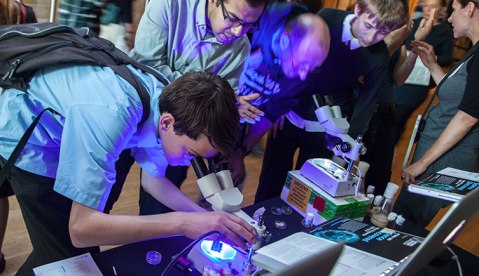
The event is free to attend, and is a wonderful chance to discover rare items from the Museum’s collections, meet hundreds of experts, and take part in interactive science stations, debates and behind-the-scenes tours. You can find out more about the event on the Museum Website.
The team will have a range of slides from our Collection that are being used in our The Killer Within Expedition, which focuses on a group of wasps called chalcids (pronounced ‘cal-sids’). These tiny wasps are parasitoids, meaning they lay their eggs inside other insects. When chalcid eggs hatch the emerging larvae eat the inside of their host. They then grow and pupate until mature enough to burst out as adults, finally killing the host.

Almost invisible to the naked eye the insects in this project inhabit a little known world we rarely notice, but their lifestyles have a huge impact on nature and our human lives. Whilst some insects are vital for pollinating our crops or providing food to higher levels of the food chain, the insects in this project are terrors, either as pests causing destruction to our crop plants through their feeding, or as parasitoids killing these pest species by hatching out of their bodies.
By helping us to transcribe some of the 6286 microscope slides we have in the collection, you are making data and information available to scientists worldwide that can help address some of the key environmental issues we are facing right now, such as sustainable agriculture, the impacts of climate change, and how diseases affect wildlife and humans.
All data transcribed by the expedition will be made freely available for anyone to use on the Museum’s open Data Portal (http://data.nhm.ac.uk).
Come meet the Notes from Nature team at Science Uncovered in the Birds Gallery (Green Zone) of the Natural History Museum:

New Expedition from the Ouachita Mountains
Just released is Arkansas’s largest transcription project to date: Herbaceous Plants of the Ouachita Mountains. Please help us transcribe these specimens in the next few weeks. The expedition is being released just in time for the Fall meeting of the Arkansas Native Plant Society in Mena, Arkansas, U.S.A. (Sept. 23-25, 2016, https://anps.org/) , which is being held in the heart of the Ouachita Mountains. Researcher @tmarsico is giving a tutorial to this group about how they can become involved in the state’s herbarium specimen data transcriptions using Notes from Nature. The beautiful and chlorophyll-less Indian pipe (cover photo for this expedition) was just photographed in flower last weekend in the Ouachita Mountains. It is a great time of year to be exploring the outdoors and transcribing historical label data. The Ouachita Mountains are an east-west running range of compressed, folded rock dominated by sandstone and shale. The region is predominately pine-hardwood mixed forests, with mesic forests on the northern slopes of the mountains. Rich seeps, shale glades, barrens, and scour-prairies also occur in this area that make botanical exploration a treat.
Thanks! And a new approach for using NfN in the classroom
Again, we are so thrilled to have completed another Arkansas transcription project (now our third). The Delta and Crowley’s Ridge project is particularly meaningful to Researcher @tmarsico, as he has a graduate student working on assessing collection bias in this region in Arkansas. The data from other institutions will help answer these research questions. In other BIG news, @tmarsico was recently just awarded two National Science Foundation grants to improve the collections at Arkansas State University and to mentor scholarship students in a biodiversity program. Press releases and video.
These new grant projects will be huge for regional biodiversity research, student education, broadening participation, and outreach to the public. Affiliation with projects like this one on Notes from Nature helps to get the important data that will be used by these students.
Thanks again for all your help.
Also, be on the lookout for new Arkansas expeditions coming online as of today. There will be a new one each week for a while. In the name of the expedition there will be a date as we are testing out some new educational approach with these new expeditions. Please feel free to check out these expeditions, but if you are planning to do lots of transcriptions over the next week, it might best to try one of the other herbarium expeditions so that the Arkansas State University students will be able to complete their assignments. The goal here is for the students to study the specimens of the species they are seeing each week and learning something about their distribution and ecology as they transcribe labels. In other words, Notes from Nature is being set up as a targeted study tool for the students in his class.
Completed Expedition: Tiger Beetles 2
Once again, thank you to all the NfN volunteers out there that contributed to our Tiger Beetles 2 expedition. Although, it was a small expedition, it has allowed us to complete the digitization of all our Tiger Beetle specimens for which we have images.
We’ll now shift focus to other groups within the Carabidae (Ground beetles), beginning with the subfamily Trechinae, which includes the hyper diverse ground beetle genus called Bembidion.
Keep an eye out for these new expeditions the first of which will be posted in the next few days.
–Bryan Brunet, PhD
Collections Management Advisor (Natural Sciences), University of Alberta Museums, Edmonton, Alberta, Canada
Burn through Elderberry and ViBurnUm
The University of North Carolina at Chapel Hill Herbarium once again seeks the aid of Citizen Scientists. We’d like you to join us for an Expedition through the Adoxaceae (moschatel) family .
While the Adoxaceae has around five genera within its family worldwide, only two – Sambucus and Viburnum — are native to the Southeastern United States.
The genus Sambucus, commonly known as Elderberry, are shrubs that have beautiful, deep colored berries ranging from the rare white and yellow to the more common red, black and blue black. These berries are preceded in the spring by small, dainty flowers. Not only is Elderberry lovely in appearance, but it is also used in wines, jams and syrups!
The genus Viburnum, like Sambucus, has berries, but most species are not edible by people. Viburnum is a garden favorite for its spring blooming flowers, vibrant fall foliage, and fruits relished by wildlife. The coolness factor for Viburnum is elevated when one realizes that one common name, Arrowwood, is not a fiction. Viburnum twigs make very sturdy arrow shafts!
Please help us map these shrubs across the Southeastern United States, and thank you for your company on our Expedition.
 Notes from Nature