
WeDigBio 2019 Day 2 summary
WeDigBio day 2 was another huge success! NfN received over 9,000 transcriptions (9,105 to be exact). That is our second most productive day ever. We are excited to see how the next two days unfold.
It’s not all about the numbers though. We’d love to hear about everyone’s experience at at an onsite event or participating online. Feel free to check in on NfN Talk.
We are so grateful to each and everyone who participated. Remember to check #WeDigBio on Twitter through out the event for more exciting developments!
— The Notes from Nature Team
How Weird is That?
Specimen collectors often have deep experience with the natural world, and occasionally they notice things that aren’t as they expected. In a recent survey of over 220 collectors from across taxonomic disciplines (botanists, ornithologists, entomologists, etc.), over half (59%) reported documenting the anomalies that they observe on their specimen labels, which is great. However, there is a huge diversity of ways in which they do this, which makes it hard to find their observations. When asked to provide words that they use in those descriptions, survey respondents gave 170 unique words and phrases. Most of these words and phrases can be used in ways that might not communicate an anomaly. For example, “early” is a frequently cited word to describe a phenological anomaly (i.e., an anomaly related to the timing of life history events). “Flowering early” is an observation of an anomaly; “specimen collected in early morning” is not. Even words that might be thought straightforward, like “Strange”, appear in ways that are not documenting an anomaly (e.g., “Strange Road” as a place name).
With this new project, “How Weird is That?”, we are seeking help to classify specimen records as including an observation of an anomaly or not. These classifications will then be used to train machines to differentiate between the two cases. To ensure that some of the records being considered include observations of anomalies, we’ve searched the 120 million specimen records at iDigBio for each of 25 terms cited by collectors as useful in describing them. In the project’s first Notes from Nature Expedition, we included all of the records that have images associated with them and that contain the terms “early”, “earlier”, or “earliest”. The second expedition includes records that use the terms “late”, “later”, or “latest”. After that, we will do a second late-later-latest set of specimens, then move on to other terms like “weird”, “abnormal”, and “odd”. The further classification of statements of anomalies as being about phenology, distribution, or other things will be used in to refine the machine learning step. Once the machines have been taught to flag assertions of an anomaly, it can be a much faster hand-off of that information to those who could use the information, such as those studying invasive species or mismatches in the arrival of migratory birds and emergence of the insects that they eat.
Finally, a few things to note. We have the expectation that most images that are associated with specimen records will contain the specimen labels, but that is not always the case. So as not to bias the sampling and diminish the utility of the machine learning rules that we arrive at, we have not removed any records from the datasets by acting on potentially faulty assumptions, such as “images of fossils don’t ever contain labels” or “bird images are only ever made in the field and not after specimen preparation is complete.” This leads us to an important point: specimens are preserved plants, insects, birds, fish, etc. If you think that viewing dead organisms, whether in the field (e.g., a photo of a beached whale) or after preservation (e.g., an insect on a pin), will trigger unpleasant reactions for you, we encourage you to contribute to science in a different Notes from Nature project. Also, please note that some handwriting on labels is hard to read. If that’s the case for something you see, use “Uncertain” as a response, and we will check it later. Finally, please be assured that classifications of specimen records as not containing an observation of an anomaly are as valuable to our process as finding those that do. The machines need both to learn how to differentiate.
We are tremendously grateful to participants in this activity and hope to keep things interesting throughout this data creation campaign by remaining engaged in Talk and providing occasional blog updates. Thank you and enjoy!
— Austin Mast, Florida State University
A new record and WeDigBio 2019 Day 1 summary!
WeDigBio 2019 got off to an amazing start! NfN received 9,865 transcriptions on day 1 of the 4 day event. That is our most productive day ever! This broke our previous record set back in 2017. We are beyond thrilled and can’t wait to see what happens with day 2.
Remember to check #WeDigBio on Twitter through out the event for more exciting developments!
— The Notes from Nature Team
Here we go!
WeDigBio 2019 is just starting to kick off around the world. Here at Notes from Nature we have lots of great content. There are over 20 expeditions in 9 different projects.
We hope everyone has an enjoyable event and that we see lots of transcription activity and chatter on Talk. Please take a moment to connect on the chat board to tell us about your event or anything else you want to share.
— The Notes from Nature Team
Introduction to the Notes from Nature Orange County Expedition
Orange County is a small, densely populated county in coastal Southern California. At around 800 square miles, it is home to nearly 3.2 million people. Over half of the land area, and thus vegetation, of Orange County has been transformed by human use. However, good examples of almost every vegetation community that historically existed still exist today due to the county’s network of public and private protected areas. Old herbarium specimens can help us get a more complete picture of the historic vegetation of Orange County.
In terms of plant diversity, 1431 species and 1525 taxa, 953 of which are native, are recorded for the county (Roberts Jr, 2008). Dudleya stolonifera and Pentachaeta aurea subsp. allenii are the only county endemics, that is, plants that are limited in range solely to Orange County. The taxonomic focus of our first expedition are the plant families Adoxaceae (elderberries), Aizoaceae (carpet-weeds), Apiacae (carrots), Asteraceae (sunflowers/daisies), and Brassicaceae (mustards).
The end of an era
Notes from Nature made a big transition back in May. Even though NfN 3.0 has been up and running we still had some unfinished business in terms of expeditions that weren’t completed on the old system. A few days ago we completed our last expedition from the “old” platform. This also means that this particular project on Notes from Nature will be retired for good.
Not to worry though we have lots of fun and exciting expeditions on our current platform! NfN is now organized around Projects so look around and explore expeditions that are available within each one. Remember that these Projects can be filtered by tags such as Plants, Bugs, Butterflies and so on.
We have some mixed feelings about all these changes. We are thrilled to move forward and continue to make improvements to NfN 3.0 (our current platform), but we had so many great expeditions, events and memories over the time that NfN 2.0 was running. The amazing Notes from Nature community completed over 1 million transcriptions and was visited by over 8,000 volunteers. We are so happy that the community is continuing to help us build this resource. Thanks as well to our network of providers and our hope is that 3.0 is ultimately an easier and better experience for all involved.
With all that said remember that we still have some more upgrades to complete on NfN 3.0. For example, this includes a unified Statistics page, improvements to Talk, etc.
— With gratitude the Notes from Nature Team
Cracking Nitrogen Fixation – New expeditions and update!
The NitFix team is ready to make it to the finish line with herbarium transcriptions! Sequencing efforts are nearly complete and exciting results are on the horizon. Already our work is providing glimpses into how plants form root nodules—uncovering key differences and similarities across millions of years of evolution of this important symbiosis between plants and microbes. More than ever, establishing links specimens between genetic data and specimen collection information is critical as we move into new work assessing the evolutionary and climatic context of today’s nitrogen-fixing species — work in which your transcription efforts will have a direct impact! We really appreciate your help getting us to completion.
-Ryan Folk and Rob Guralnick
 [Above Figure – Cercis glabra, an Asian species and one of the few legumes with no root nodules that lacks the nitrogen-fixing symbiosis. Understanding groups like these is a major goal of the NitFix project as we seek to understand the earliest origins of nodules and shed light on engineering them into today’s crops]
WeDigBio 2019!
The Notes from Nature team is very excited about WeDigBio 2019. The event will take place October 17 – 20.
To our amazing volunteers:
We hope you’ll save the dates and join us online or in person at one of the many events happening at that time.
To our collaborators and data providers:
It’s always a fun and exciting time for us as we get to work with lots of new and existing colleagues! If you plan to host an expedition this year let us know as soon as possible.
Note that Notes from Nature has recently gone through an upgrade. Previous data providers that we have worked with will utilize their existing Projects on our site. Other providers expeditions will go into a WeDigBio themed Project that we’ll start building very soon. We will plan to have all expeditions within the WeDigBio project complete within a month of the end of the event. We have lots of activity on the site and we always aim to keep our content fresh and have expeditions complete in a timely fashion.
— The Notes from Nature Team
Where the butterflies roam
Monarch butterflies (Danaus plexippus) are well-known for their long-distance migrations. Monarchs east of the Rocky Mountains spend their winters in Mexico, while those west of the Rockies head for the California coast. But there are others, like the painted lady (Vanessa cardui) and the California tortoiseshell (Nymphalis californica) that also make annual treks over hundreds of miles in response to the changing seasons.
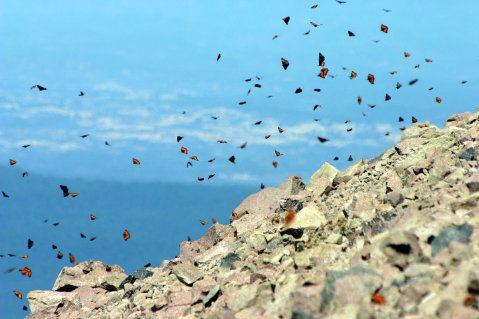
Tortoiseshell migration at Lassen Volcanic National Park, 2005. By DotPolka CC BY-NC-ND 2.0
But other butterflies, like blues, coppers, hairstreaks, and metalmarks, hardly move at all. Individuals and their offspring may never leave a single meadow or dune for many generations. Their caterpillars often feed on a single species of plant found in a particular habitat many miles from other similar habitats. Some even have intimate relationships with ants, whereby the ants take the larvae into their nests and care for them. Because of these particular (and peculiar) life histories, many species and subspecies of butterflies in the family Lycaenidae have very restricted distributions and are listed as either threatened or endangered. One subspecies, the Xerces blue (Glaucopsyche lygdamus xerces) that once lived in the coastal dunes of California, went extinct in the 1940s. Even the once common and widespread monarch has suffered massive population declines in the past two decades.
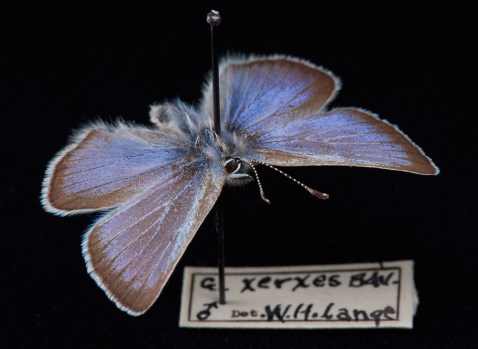
Xerces blue butterfly. By Lucas Foglia
New conservation efforts, however, are turning the tides for these imperiled imps of the sky. Captive rearing and release of threatened species of blues and checkerspots are establishing new populations to protect against local extirpation. Neighborhood programs to propagate native host plants have connected populations of green hairstreaks that were once isolated from each other. And concerned citizens across the country are planting milkweed to feed hungry monarch caterpillars.
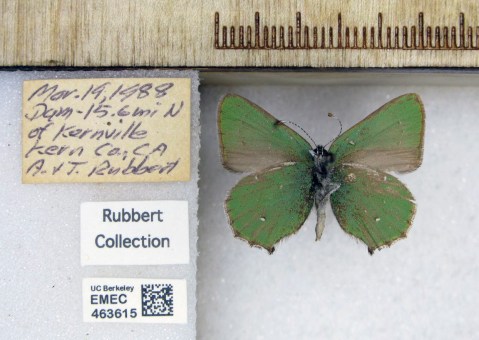
Green hairstreak, Callophrys dumetorum
To aid this cause, our team at CalBug has been busy photographing butterflies in our collection. These historical records tell us how butterflies have responded to climate, land use, and other environmental changes over the past 100 years. With your help, we can map these changes over time and better focus our restoration efforts. And since we include the name of each species in the corner of each photo, and photos pop up in a random order, each new image is like a flashcard to help you learn to identify butterflies!
by Peter Oboyski
Images:
dotpolka https://www.flickr.com/photos/dotpolka/34311984/in/photostream/
Lucas Foglia, c/o Essig Museum
Specimen images, c/o Essig Museum
Notes from Nature – NYBG: New expeditions to uncover global plant biodiversity!

For over 125 years, the William and Lynda Steere Herbarium at the New York Botanical Garden (NYBG) has served as a crucial resource for researchers around the world seeking to study and conserve plant biodiversity. Through projects dedicated to discovering new species, documenting regional floras, and deciphering complex evolutionary relationships within the plant kingdom, thousands of scientists have helped build our collection of 7.8 million specimens — representing the largest natural history archive of plants in the westen hemisphere. Now, plant lovers everywhere can support future scientific exploration at our institution by helping to document our specimens!
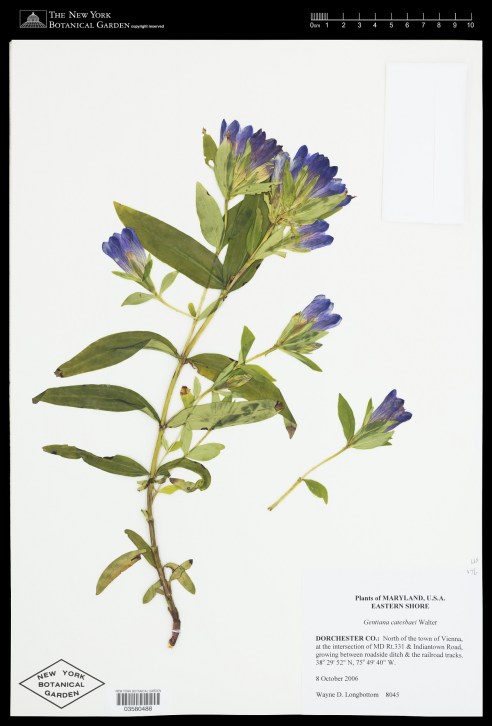
This specimen of Gentiana catesbaei “Elliott’s Gentian” was collected in 2016 by Wayne Longbottom, a former amateur naturalist turned active contributor to the NYBG herbarium.
Each NYBG “virtual expedition” will target a subset of our extraordinary collection to accomplish unique research objectives. Some projects will be dedicated to exploring particular geographic regions or specialized habitat types (such as alpine areas), and documenting plants that have been discovered there. Other projects may follow along on the expeditions of notable plant collectors in order to chronicle significant historical specimens. Lastly, we’ll aim to investigate evolutionary relationships and biogeography by cataloging all the occurrences of specific groups of plants scientists know are closely related. All the extraordinary new digital-datasets that citizen scientists help create will contribute profoundly to our understanding of the living planet and open new avenues for investigating long-term patterns in biodiversity change.
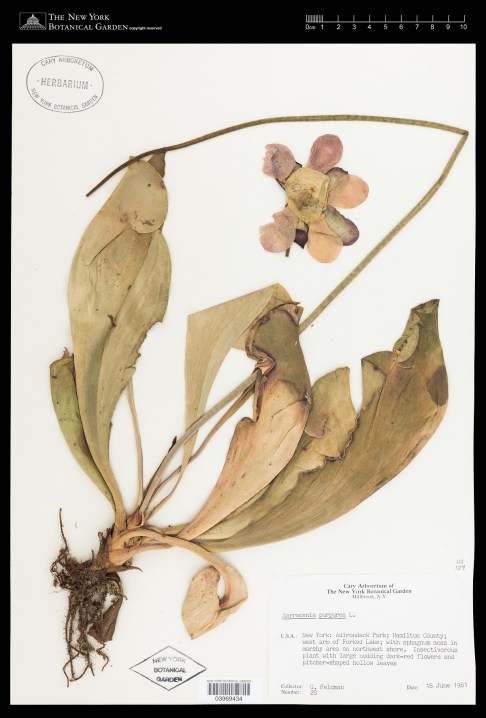
NYBG specimens frequently document occurrences of rare native species, like this carnivorous “pitcher-plant” Saracenia purpurea, collected in 1981 from Adirondack Park in New York State.
Citizen scientists who participate in Notes from Nature – NYBG will learn how to interpret natural history specimens and gather research using a variety of online tools to overcome challenges with deciphering historic collection labels. One of the most important resources for puzzle-solving will be the very database we are working to create, the C. V. Starr Virtual Herbarium, where we openly share all currently available data about our specimens. Your mission will be to help fill the gaps in our knowledge using the collections we have already digitized as a guide!

NYBG’s collections are not limited to land plants! This specimen of marine algae represents a separate branch of the tree-of-life, and demonstrates a more challenging hand-written collection label.
Most NYBG expeditions feature a comprehensive workflow designed to capture every essential detail which scientists routinely use: including precise geographic location, date, and collector information. For newcomers to natural history specimens and participants who are looking for a faster-paced activity, Notes from Nature – NYBG will also host “US State Spotter” expeditions, featuring a simplified workflow intended to efficiently capture basic geographic data about our specimens. Keep a lookout for other project types in the future as we experiment with new approaches for including the public in gathering scientifically relevant information from our renowned botanical collection!
Click to join our virtual expeditions today!
Then discover The Hand Lens to learn more about the fascinating stories told by NYBG specimens.
–Charles Zimmerman, William and Lynda Steere Herbarium, New York Botanical Garden
 Notes from Nature