
More progress
Last week another herbarium collection reached 100%! As always we want to thank all the volunteers that helped make this possible. The NFN team is thrilled to see this progress as we move towards launching a new version of NFN this coming spring. Our goal is complete all the current collections before this time.
The collection that was just completed is from the Botanical Research Institute of Texas, however the specimens in these images were originally from the Vanderbilt University herbarium. This collection was housed on the Vanderbilt University campus until it transferred to Texas in 1997. These kinds of transfers between museums happen from time to time, but this one is notable for it’s size (over 350,000 specimens) and historical importance. The Vanderbilt collection is mostly comprised of specimens collected by R. Kral who was a very important collector in the southeastern United States. We will have more specimens from this collection coming in the future.
For those looking for more herbarium specimens, we still have two active collections where you can contribute today.
CalBug complete (again)!
Earlier this week the NFN team realized that we had retired an earlier CalBug collection a bit too early. There were 530 images that still needed to be transcribed. For this reason, this collection was put back up live on the NFN site earlier this week. Late yesterday our volunteers completed this collection. We are really excited to see two collections complete in one week!
The NFN team once again wants to sincerely thank our amazing volunteers (new and veteran!) for their effort!!
Still hungry for more CalBug images to transcribe?! CalBug Expeditions is still active and is 63% complete at the time of this posting.
Another collection complete!
Last week our volunteers completed the University of South Florida herbarium collection. We are excited to see this collection complete and wanted to take this opportunity to thank our awesome volunteers for their effort!
This was a relatively small collection of images (~500). The University of South Florida is similar to many collections in the SERNEC network as it is a small to medium sized collection housed at an academic institution. This collection is somewhat unique in that it has a large collection of cultivated plants.
This collection has been moved to our relatively new completed collections page. Thanks again to all the volunteers that helped with this collection!
Tweaking our transcription numbers (again).
As many of you know, Notes From Nature collects more than one transcription for each image (or subject, in Zooniverse speak). This is not uncommon among Zoonivere projects. This means that we get more than one set of data for each specimen image, making sure that each transcription is done by a different user. In fact, the algorithm does not permit a user to transcribe the same image more than once. This is why it is possible for a collection to be incomplete, but some users are no longer served images to transcribe.
The purpose behind this is to assist with quality assessment of the data. It is not that our volunteers do not provide quality transcriptions! In fact, in many cases Notes From Nature volunteers provide higher quality transcriptions than trained technicians. However, there are various situations where the information on a label can be up to interpretation. This is especially true for handwritten labels and information that goes into our free text fields (e.g. locality). Having more than one transcription helps us come up with the best possible transcription for a given image, using software that analyzes the whole set of transcription.
This is not the first time we have changed the number of transcriptions. When we first started Notes From Nature in 2013 we were collecting 10 transcriptions per image, which we quickly realized was many more than was needed. We reduced the number of transcriptions to 4 per image. We recently reanalyzed this issue again and found that 3 transcriptions per image would be sufficient. This means that we have moved from 4 to 3 transcriptions per image as of this week. So far this has taken place in the CalBug, Herbarium and Macrofungi interfaces.
Some of our volunteers have already noted that our progress bars showed a bit bump this week and this is the reason why. When the algorithm was changed any images with 3 transcriptions were immediately retired from the queue. As always, we greatly appreciate your hard work and are continually looking for ways to make this project more efficient and enjoyable!
Happy New Year to the Notes From Nature Community!
The NFN team wants to wish you all a Happy New Year! We also want to give a brief update about some of the things happening in 2016.
We have a lot of activity going on this year thanks to funding from the U.S. National Science Foundation. We will be posting more information, as new advancements are made and certainly prior to any major site changes. The main activity right now is a transition of NFN to a new platform called Panoptes. The current platform is called Ouroboros and we will be transitioning to the new platform by early summer. A few other Zooniverse project are also making this transition. For example, a new version of Old Weather has already been launched on this platform.
The upside of Panoptes is that it is open source and will allow for addition features to be added and bugs to be fixed much more easily. This will give the research team a lot more flexibility and value over the long haul as NFN continues to evolve. In addition, the new platform includes an improved Talk page. The new Talk is already being used on the main Zooniverse site if you want to see how it works.
The platform upgrade is just the beginning of several changes that will be taking place over the next few years of this grant funded project. There will be additional features that will be of direct benefit to our volunteers, such as improved volunteer profiles. We will also be bringing in biodiversity information from external sources such as Encyclopedia of Life and Map of Life. The goal is to give even more meaning to the specimens and the organisms that are preserved in the specimen images.
As part of the transition to the new NFN we will be pushing to complete the existing sets of images before any new interfaces are launched. Since the herbarium (SERNEC) interface will be the first project to launch on the new platform, we will be focusing on completion of those image sets in the coming months. There will be more information about our strategy for doing that very soon.
Notes From Nature Restored!
Hi All,
Notes From Nature was down for most of the last two days. The problem was fixed late last night and all the interfaces should be working now.
Thanks to our dedicated volunteers for pointing this out and for providing details of the issues you were encountering. I want to give a shout out in particular to the users am.zooni, maggiej, Bonnie123 and HelenBennett57!
Please post in the Talk post here if you see any other issues over the next few days.
Happy Winter Solstice and Happy New Year!
Who loves statistics? We do!
Crab Shack Complete!
The Crab Shack at Notes From Nature has temporarily shut its doors, for the best possible reason: we’re done! In barely over a month, an amazing group of transcribers has completed data transcription from nearly 1,000 samples (upwards of 4,000 transcriptions, since each sample is transcribed four times). That’s the complete collection of crabs in the family Cancridae that we have here at the Natural History Museum of Los Angeles County.
This was a particularly challenging transcription project. There were over a dozen data fields, and a truly ambiguous mapping of text on labels to database fields. This was really a stretch for the Notes From Nature team, and we’re extremely grateful! Deep thanks to Rob Guralnick, Rafe LaFrance, Libby Ellwood and Michael Denslow for putting it all together in time for the WeDigBio blitz.
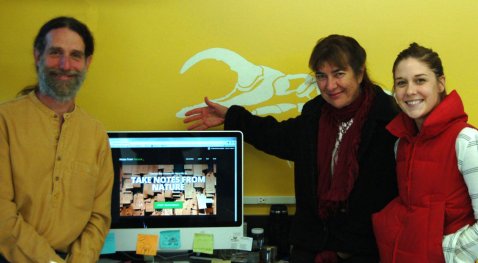
Are we happy about how it went? Extremely! Here’s a snapshot of a few of the Happy Crab Shack Biologists here at the Museum right after we learned of the completion. From left to right, that’s Dean Pentcheff, Regina Wetzer, and Jenessa Wall. Not shown are Kathy Omura, Adam Wall, and a crew of interns, volunteers, and work-study students from the University of Southern California (who did the specimen and label photography).
But of course, the core contribution came from the many transcribers out in Internet-land. To all of you — thank you so much! This project happened and succeeded because of your persistence on this (admittedly ambiguous) project.
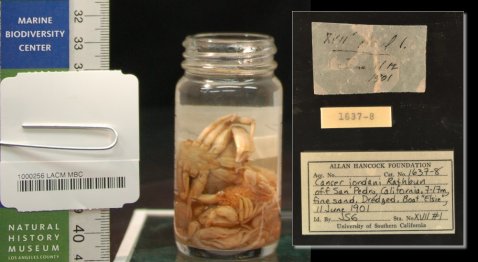
Even without looking at the data in detail, some gems have emerged. One example is a sample that, from its label data, we now know was collected in 1901 at an early marine laboratory near us in San Pedro. The photo shows the crabs and the labels that were transcribed. The boat “Elsie” was used by researchers at the lab before the operation moved to the San Diego area, where it became the Scripps Institution of Oceanography. At the time, San Pedro was a pretty rough place, but was home to (among other characters) an eccentric group of women pursuing marine biology. We had no idea that we had any specimens from that era.
While the Crab Shack is currently not serving any entrées, we’re not closing shop for good. First, we need to analyze and ingest the amazing dataset we now have. Based on what we learn from the data and the feedback from this expedition, we’ll be moving forward (again, teamed with the great Notes From Nature crew) to open a newly refurbished Shack, journeying on to a new group of animals (still to be determined).
We look forward to having you on board again!
WeDigBio: Closing thoughts and appreciation
It was a very exciting past few days as Notes From Nature participated in WeDigBio. The event was a great success and you can see lots of photos and reports from the event on Twitter and Facebook. The WeDigBio site also has some really nice visualizations showing where people were working during the event and the overall transcription progress.
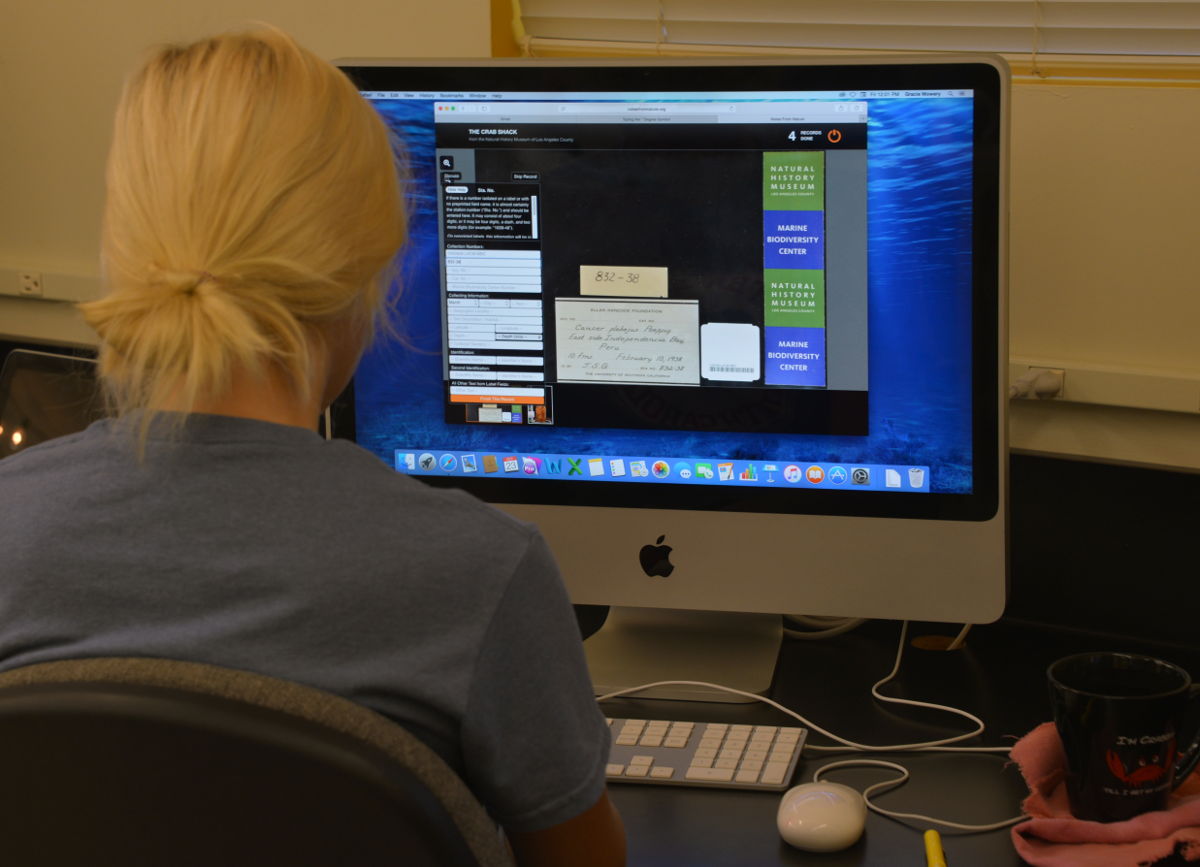
A Crab Shack participant’s eye view of digitizing a crab specimen, one of dozens of digitized at the Marine Biodiversity Center of the Natural History Museum of Los Angeles County’s event for the WeDigBio digitizing blitz.
We want to offer our sincere appreciation for all those that made this event possible and especially to the volunteers who stepped up and helped us meet not one, but two challenge goals for the event! The WeDigBio team started out with a goal of completing 25,000 transcriptions for the entire event using all the transcription platforms. After that milestone was met the goal was raised to 30,000 transcriptions. The event ended with well over 34,000 transcriptions!
The official count for transcriptions completed using Notes From Nature was 9,980! This is simply incredible and the Notes From Nature team is so very thankful for these efforts. The number could actually be as many as 1,500 transcriptions higher since there were some glitches that prevented some transcriptions from getting counted on the first day. The transcriptions themselves are saved, it was a glitch with the visualizations on the WeDigBio page.
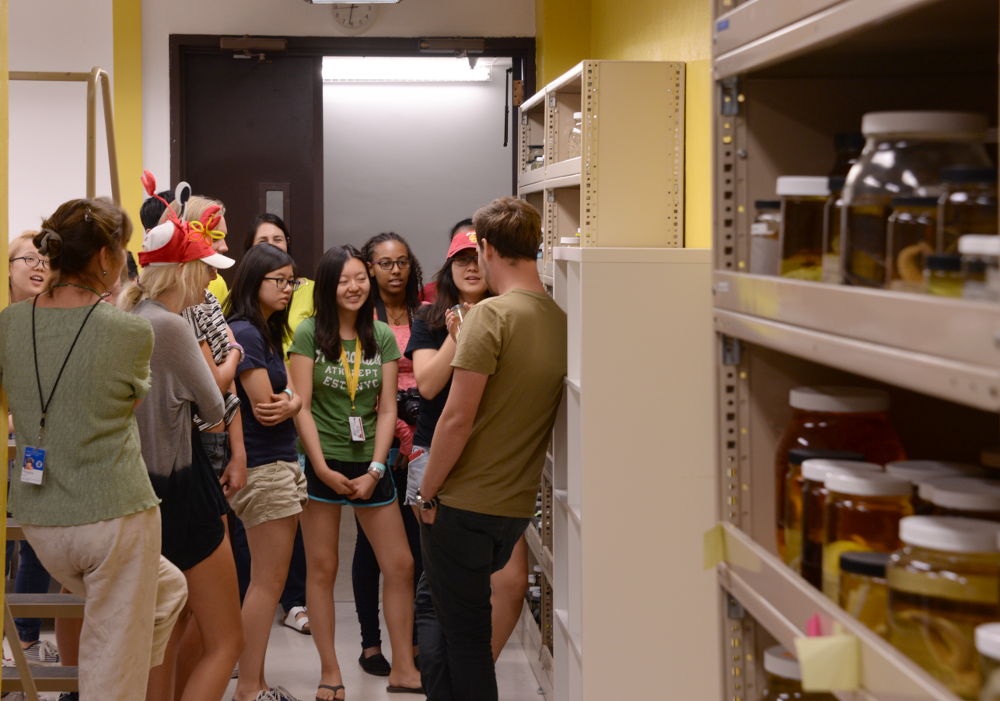
Adam Wall, of the Crustacea Section at the Natural History Museum of Los Angeles County, orients participants in the Crab Shack digitizing event on what they’ll see inside the research storage facility.
While these numbers are amazing, we are also thrilled with many of the less tangible aspects of the event such the interactions between the museum curators and citizen scientists that occurring during the onsite gatherings. We hope to see you all for the second annual WeDigBio event in 2016!
UC Berkeley Museum and WeDigBio
For centuries, scientists have explored and documented the natural world, collecting the billions of specimens housed in museums, universities, and field stations worldwide. And now, UC Berkeley and other institutions across the globe want to help make that information available to the general public.
But they need your help.
UC Berkeley’s Essig Museum of Entomology invites members of the public to one of the many transcription parties that will be held this week during the Worldwide Engagement for Digitizing Biocollections (WeDigBio) Event. The WeDigBio event will transform the cryptic data sequestered on the labels of plant, insect, fish, and fossil specimens into an open, globally accessible, digital resource with the help of the public.
“Between California’s extended drought, extensive wildfires, and other assaults on our environment, it is now more important than ever to understand how these pressures are changing insect communities and the ecosystem services they provide,” says local event organizer and collections manager, Dr. Peter Oboyski. “There is no better way to convey this message than by inviting the public behind the curtain to help us collect the data we need to document these patterns.”
The Essig Museum contains nearly 6 million specimens of insects, spiders, and their relatives, representing over 35,000 species. These specimens also represent the past 100 years of California’s climate, terrestrial habitats, and waterways in the form of distribution records of native and invasive species. “California is a biodiversity hotspot and a world leader in conservation, research conducted at the University of California over this time span allows us to map the past and give us a glimpse of our environmental future,” says Oboyski.
The WeDigBio event emerged within the museum community to accelerate the rate of digital data creation about the historical what, when, and where of the perhaps 9 million species on Earth. The major online transcription platforms include the U.S.-based Notes from Nature, Smithsonian Transcription Center, and Symbiota; the Australia-based DigiVol; the UK-based Herbaria@Home; and the France-based Les Herbonautes.
This one-of-a-kind event will be held from October 22-25 at 30 locations across the globe. While the local event at UC Berkeley offers a social setting where people can contribute and learn about the entomology museum and local insect diversity, members of the public can contribute at anytime from anywhere during the event at one of the participating online transcription platforms.
Essig Museum ”CalBug” specimens will be available for transcriptions at www.notesfromnature.org. More information about the WeDigBio event can be found at https://www.wedigbio.org.
The UC Berkeley transcription blitz will take place from 9 a.m. to 2 p.m. on Saturday, October 24th, in the BioScience Library of the Valley Life Science Building. More information is available at http://essig.berkeley.edu/activities/wedigbio.shtml. RSVP to essig.museum@gmail.com
 Notes from Nature