
Thanks! And a new approach for using NfN in the classroom
Again, we are so thrilled to have completed another Arkansas transcription project (now our third). The Delta and Crowley’s Ridge project is particularly meaningful to Researcher @tmarsico, as he has a graduate student working on assessing collection bias in this region in Arkansas. The data from other institutions will help answer these research questions. In other BIG news, @tmarsico was recently just awarded two National Science Foundation grants to improve the collections at Arkansas State University and to mentor scholarship students in a biodiversity program. Press releases and video.
These new grant projects will be huge for regional biodiversity research, student education, broadening participation, and outreach to the public. Affiliation with projects like this one on Notes from Nature helps to get the important data that will be used by these students.
Thanks again for all your help.
Also, be on the lookout for new Arkansas expeditions coming online as of today. There will be a new one each week for a while. In the name of the expedition there will be a date as we are testing out some new educational approach with these new expeditions. Please feel free to check out these expeditions, but if you are planning to do lots of transcriptions over the next week, it might best to try one of the other herbarium expeditions so that the Arkansas State University students will be able to complete their assignments. The goal here is for the students to study the specimens of the species they are seeing each week and learning something about their distribution and ecology as they transcribe labels. In other words, Notes from Nature is being set up as a targeted study tool for the students in his class.
Completed Expedition: Tiger Beetles 2
Once again, thank you to all the NfN volunteers out there that contributed to our Tiger Beetles 2 expedition. Although, it was a small expedition, it has allowed us to complete the digitization of all our Tiger Beetle specimens for which we have images.
We’ll now shift focus to other groups within the Carabidae (Ground beetles), beginning with the subfamily Trechinae, which includes the hyper diverse ground beetle genus called Bembidion.
Keep an eye out for these new expeditions the first of which will be posted in the next few days.
–Bryan Brunet, PhD
Collections Management Advisor (Natural Sciences), University of Alberta Museums, Edmonton, Alberta, Canada
Burn through Elderberry and ViBurnUm
The University of North Carolina at Chapel Hill Herbarium once again seeks the aid of Citizen Scientists. We’d like you to join us for an Expedition through the Adoxaceae (moschatel) family .
While the Adoxaceae has around five genera within its family worldwide, only two – Sambucus and Viburnum — are native to the Southeastern United States.
The genus Sambucus, commonly known as Elderberry, are shrubs that have beautiful, deep colored berries ranging from the rare white and yellow to the more common red, black and blue black. These berries are preceded in the spring by small, dainty flowers. Not only is Elderberry lovely in appearance, but it is also used in wines, jams and syrups!
The genus Viburnum, like Sambucus, has berries, but most species are not edible by people. Viburnum is a garden favorite for its spring blooming flowers, vibrant fall foliage, and fruits relished by wildlife. The coolness factor for Viburnum is elevated when one realizes that one common name, Arrowwood, is not a fiction. Viburnum twigs make very sturdy arrow shafts!
Please help us map these shrubs across the Southeastern United States, and thank you for your company on our Expedition.
New Badges: Miniature Lives Magnified
To go alongside the launch of the new expedition group Miniature Lives Magnified, we have a whole new set of badges for you to collect.
Transcribe 5 microscope slides and earn the ‘5x zoom’ badge.

Transcribe 50 microscope slides for the ‘50x zoom’ badge.

And become a microscopy master by transcribing 150 microscope slides for the ‘150x zoom’ badge.

A big thanks to Jordan, from Zooniverse, for the artwork. We hope you love them as much as we do.
Don’t forget to check your Field Book, to see what progress your making on collecting badges and transcribing specimens.
I’m challenging myself to get to the ’50x zoom’ badge today.
Jade (Natural History Museum, London).
New herbarium expedition: Pollinator Plants of Virginia, U.S.A.
Welcome to a new Notes from Nature Project and a series of upcoming Expeditions: Pollinator Plants of Virginia. Pollinator populations and their overall health have declined in recent decades. While much current research is necessarily focused on the health of non-native, domesticated honey-bees and agricultural productivity, thousands of other invertebrate pollinators such as bumble-bees, small solitary bees, butterflies and moths are in need of help, too. In order for researchers to find these small creatures in the wild to monitor their population sizes or to test them for diseases, they must first locate the food plants that are preferred by each pollinator and wait for their research subjects to appear. Many native pollinator species will consume the pollen or nectar of very few plant species; this very choosy feeding behavior is called oligolecty. It also means that these species can die out if their food plants disappear. In this project, we have assembled herbarium specimens from over 100 plant genera that are identified by The Xerces Society as the most important pollinator host-plants in the mid-Atlantic region of the United States. By transcribing these herbarium records, you help us develop very fine scale maps of the plants’ locations and flowering times, which can be used by pollinator researchers to find their quarry.
Ant plants II complete
Thanks again, fellow natural historians! You digitized nearly 1,400 specimens of Virginian ant-dispersed plant species between Expedition I and II and closed out the relevant holdings from the Ted R. Bradley Herbarium at George Mason University The Ant Plants theme is going to rest for a bit as we assemble more ant plant sheets from other herbaria. But, please do not despair. Other herbarium specimens from Virginia will be debuting under a new and different theme – Native Plants for Native Pollinators – stay tuned!
Another one done (Bellflowers of Arkansas)
Another expedition is complete for the Plants of Arkansas. Thanks again to all who worked on the Bellflowers (Campanulaceae). Another critical milestone has been met!
We now have only the Delta and Crowley’s Ridge Flora as an active expedition from Arkansas U.S.A. The Delta Region is greatly under-explored and under-appreciated area. This particular project is helping to fill in knowledge gaps at a time when additional field exploration is underway. Because conversion from natural habitat to row-crop agriculture has been so extensive in this area, finding those places that retain natural vegetation is really important for conservation efforts. In addition to the Delta Region expedition, expect a series of new expeditions in the coming weeks targeted to @tmarsico’s Dendrology class being taught at Arkansas State University. For the first time, Notes from Nature will be implemented as a formal study tool for coursework. Stay tuned for updates on how this aspect of Notes from Nature unfolds.
New Expedition Group: Miniature Lives Magnified
Welcome to Miniature Lives Magnified!
Here at the Natural History Museum, London, we are so excited to bring you a brand new expedition group focusing on the transcription of microscope slides.
We have taken images of 100,000 microscope slides of a variety of insects, many of which are invisible to the naked eye. We’ll be releasing the images of these insects in small batches.
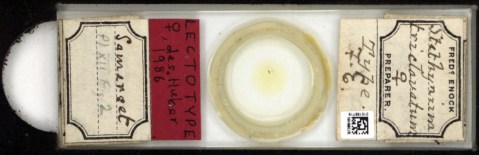
Our first expedition is called ‘The Killer Within: Wasps but not as you know them’ and focuses on a group of tiny wasps called Chalcids, pronounced ‘kal-cids’. Just millimetres in length these wasps are parasitoids; they lay their eggs inside other insects and the emerging larvae eat their host inside out, growing and pupating until they are mature enough to burst out as adults.
But the gruesome killing habits of Chalcids have an advantageous role in our food production systems. Many of the host species of Chalcids are plant pests that have devastating impacts on agricultural and so Chalcids are used commercially as a biological control agent.
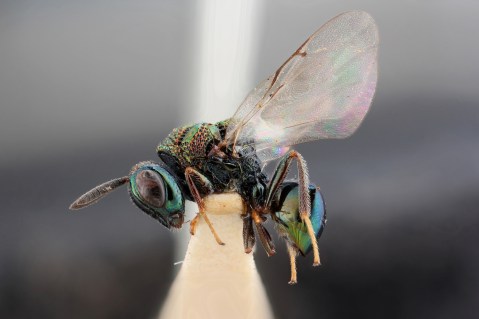
Perilampus aeneus
Being sooooo tiny Chalcids are really hard to study, which means there are huge gaps in our knowledge about their ecology and behaviour. We want to start unlocking some of that knowledge from our collections, which is why we have brought the slides to you the Notes from Nature community.
To get stuck into our first batch of microscope slides visit the ‘Magnified’ group, indicated by the microscope icon.
And do let us know what you think of the project in the ‘Magnified Help’ talk group.
We hope you enjoy the slides and we’ll see you in Talk.
Best wishes from Jade and the Natural History Museum team.
New Expedition—Thistle be fun!
UASM Tiger Beetles 1 – Complete
Thank you to all Notes from Nature contributors that helped with the 1st Tiger Beetle expedition of the University of Alberta’s E.H. Strickland Entomological Museum. Thanks to your hard work, we now have data for 1000 more specimens digitized! We are all very excited to see that there is such a lively and active group of natural history enthusiasts willing to help make our data available to the world.
This was our first foray into citizen science data transcriptions via Notes from Nature, but there are many more still to come. We have 41000 ground beetle specimens that have yet to be digitized. About 7000 of these are from locations in Canada, 1000 are from the United States, 4000 are from Mexico, 4000 are from Central America and 25000 are from South America. About half of these (mostly those collected north of South America) have been imaged and are waiting to be uploaded to Notes from Nature expeditions. These represent about 1200 species of ground beetles from about 180 different genera.
Stay tuned for our next expedition “UASM Tiger Beetles 2”!
Thanks again,
–Bryan Brunet, PhD
Collections Management Advisor (Natural Sciences), University of Alberta Museums, Edmonton, Alberta, Canada
 Notes from Nature