
New expedition: Ant plants!
image: http://www.alexanderwild.com/keyword/bloodroot;elaiosome/i-CGtKkgt/A
Afterwards, ants discard the undamaged seeds in underground waste-pits or by their nest’s entrance, where germination conditions are ideal. Consequently, distributions of many native plant species, including some of Virginia’s most recognizable wildflowers such as bloodroot, trout lily and spring beauty, are governed by ants.
Help us learn more about the diversity and distribution of this remarkable ecological interaction while expanding your knowledge of the many ant-plants that call Virginia home.
First butterfly expedition complete!
Thanks to all the volunteers who contributed to the freshly-completed transcription of images from the first batch of butterfly specimens from the Florida Museum of Natural History. This collection of images presented a unique set of challenges, since they represent material that originated in several smaller collections which were then united under one roof at the FLMNH’s McGuire Center for Lepidoptera and Biodiversity. This means the tags and data associated with specimens are not standardized, and in some cases, there is data written on both sides of tags, requiring us to provide two images of each specimen. However, despite all of these challenges, data associated with these 468 specimens was transcribed in 13 days!
The first thing to which these data will be applied is developing better distribution maps of swallowtail butterflies. These specimens provide a vouchered record of where and when species can be found, and provide an especially valuable record of rare species that are not easily encountered by casual hobbyists, especially in remote areas of Southeast Asia and South America. We are interested in comparing closely-related species from these two regions to determine what role the pressures of paleoclimatic change may have played in determining their current distributions. This may offer clues to how future climate changes may affect these species, which have important roles as pollinators and as links in the food chain.
Thank you again, and be sure to check back soon for more FLMNH butterflies—our dedicated team of imaging volunteers is working hard to image more swallowtails and other groups, which we hope to post in a few months.
The first week
We relaunched Notes From Nature a week ago. We are really excited about the response that we have gotten in that time. In the first week we have had over 600 registered volunteers and close to 9,000 transcriptions. Thanks so much to all who contributed to make for such a great first week!
The relaunch also marked our new approach of providing smaller and hopefully more meaningful sets of images. We are calling these expeditions. We are thrilled that three have been completed in less than a week! They were Florida Mints, Florida Laurels, and a set of CalBug Bee Fly images, which was the first to be completed. This is a new approach for us as well and we would love to hear what you think of the expeditions we have put up or the approach overall. Leave a note in the Talk forum and let us know what you think!
We are also experimenting with collecting different sets of fields. For example, the current Florida St. John’s Wort expedition does not ask for the geography (country, state, country) to be transcribed, because we already have this information in our SERNEC database. This should make each specimen even quicker to transcribe.
We are working on ideas for new expeditions and content that will be of interest to our users, so please let us know what you think so far.
In appreciation,
The Notes From Nature team
Badges in Notes from Nature V2
For those of you new to Notes from Nature or who have been long-time transcribers and want to know about badges in the relaunched version, just a quick overview. First, badges are part of a bigger overhaul of what we are calling your “Field Book”, which is customized for each user who has a Zooniverse account. The field book is going to be a lot more interesting in the coming months, but for right now it contains information on the last set of expeditions you’ve been involved in, and the specimens and labels that you have just transcribed. Check it out! The link to your personalized field book is accessible on the Notes from Nature homepage!
As for badges, we have some plans for better notifying you when you earn a badge, but for the moment you’ll need to check your field book every so often to see the new badges as they happen.
For any insect expeditions you take part in (including the current bee fly and butterfly expeditions), the badges are:

These first three (egg, catepillar, and butterfly) are earned when you transcribe 1,25, and 100 records. We also have a fourth badge for the heroic:

that you earn when you transcribe 500 records.
For any plant expeditions, we have six badges! Here are the first five, (representing seed, sprouts at three stages, and a young tree), earned when you transcribe 1,10,25,75,and 250 records.
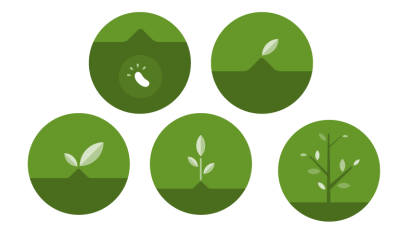
For the transcriber extraordinaire, true stalwarts, and to whom we will all bow to in amazement, there is the “mature tree” badge, which is earned when you transcribe 1000 records:

We hope you want to collect them all, and we’ll be announcing more badges soon. We hope you love the new Notes from Nature as much as we do, and keep helping to increase our knowledge of biodiversity, one record at a time!
Butterflies on Notes From Nature
The McGuire Center for Lepidoptera and Biodiversity at the University of Florida houses a large, diverse collection of pinned butterflies and moths. As a National Science Foundation-funded research fellow at the University of Florida, I am working to collect standardized images of the hundreds, if not thousands, of New World swallowtail butterflies housed at the McGuire Center for Lepidoptera and Biodiversity. These large, colorful butterflies can be found from Canada to Argentina in the New World, and the northern Mediterranean, India, and Southeast Asia in the Old World. One species is endangered, and another six species are considered vulnerable to becoming endangered by the International Union for Conservation of Nature.
Each of the butterfly specimens in this collection is pinned with a number of descriptive labels, containing valuable information on the species and sex of the specimen and where and when it was collected. By transcribing these labels, you are helping me to collect information that I can use to determine the broad-scale ecological patterns of diversity in this group of butterflies. These data can be combined with color and shape measurements collected from specimen images in order to understand how morphological and broad-scale ecological patterns relate.
Additionally, transcribed label data and their associated images will be made available to other researchers for future work utilizing these specimens.
This new interface on Notes From Nature is a little different from the others for two primary reasons. First is that you are required to look at two images in order to capture all the information being asked for. Second is that there is a lot of variability among the labels making the task a bit more difficult. Thanks for giving them a try and please remember to take a close look at the amazing organisms contained in the images.
— Hannah Owens
In case you haven’t noticed…
Notes from Nature (NFN) just relaunched and we are hoping folks will give our new site a whirl, and tell us what you think! As with the previous version of Notes From Nature, we will feature a variety of natural history museum specimens types such as plants, insects, crabs, butterflies, birds and so on. Your efforts help unlock the vast treasure trove of data that is contained within the 2 billion specimens housed in museums around the world!
Why the relaunch, and why now? Short answer: While the original was a huge success, we saw a real need to refresh NFN, and overcome some limitations of the former platform. After months of planning and great work by a lot of folks who we’ll acknowledge more in later posts, we are ready!
The new version of Notes From Nature that is being launched today makes use of the ZooniversePanoptes platform and will provide lots of benefits to both the researchers and the volunteers. This is just the beginning of what will be lots of exciting new features on the site. One big change will be lots of smaller expeditions that will target a specific group and location, with more direct ties to research needs.
Before going any further though, a huge shout out to the over 9,200 volunteers from around the world who put their time, energy, enthusiasm, knowledge and hearts into helping Notes from Nature share over 1.3 million transcriptions. We are truly humbled by the response since we started in 2013. For those who have taken part in the past, we welcome you back to take part in the new and improved Notes from Nature.
Please help out by Taking Notes From Nature! And your feedback is of course much appreciated, especially since we know that there are always some kinks to work out whenever launching a new resource. We’ll also quickly note that we do have some priority fixes we want to get live, including increasing the size of the photo window and storing content so that you can go back to previously entered information.
There are a lot of features we want to share with you about the new NFN and we’ll blog about them in the coming days and weeks. If any of you reading this are digitizing collections and want to take part in Notes from Nature, a huge advantage of the new system is that it is MUCH easier to build expeditions and get them to be part of NFN. Please feel free to contact the NFN team, especially Michael Denslow (michael.denslow@gmail.com) and Rob Guralnick (robgur@gmail.com) and we’ll explain the process.
We are excited to hear from you and look forward to seeing you on Facebook, Twitter and our blog.
Update on our new version
Dear NFN Volunteers,
As we have previously announced we are very close to launching the new version of Notes From Nature. Our planned launch date is June 16th. At this time we are writing to update you on that progress and tell you about some the things we are doing to make this happen.
Why are we relaunching? Over the three years of working on the Notes from Nature project, some things we wanted to make easier and better just couldn’t happen using the platform on which Notes from Nature was originally developed. We are now going to leverage some really neat new features to make it easier to get new expeditions launched, and new ways to track progress, etc. We’ll fill you in on all the neat thing very soon. In the meantime…
We are working diligently to meet our deadline and have a lot of work to do in the next few days. We received some very useful feedback from over 50 different individuals as part of our beta launch. Feedback like this is so critical to the process of launching new software and we are extremely thankful to all those that participated. We are working to address as many of these changes as we can before the launch, but some things may take more time to complete.
In addition to the interface changes, we are in the process of preparing more datasets and working on an exciting new type of interface that will feature specimens that we have not featured before. Lastly is the very important task of writing up press releases and social media content to accompany the release.
We still have our sites on June 16th, but in all honesty we may have to delay a day or two depending on how much we can accomplish in the next few days. More details as we get closer and hoping you’ll join in and bring friends when we go live in just a few days.
The last set of herbarium images…
A very large set of herbarium images was just completed on Notes From Nature. It was over 15,000 images from the Southeast Louisiana State University herbarium. One important aspect of this set of images is that it contained all the specimens from this museum collection. This means that after the data is processed the entire collection will be digitally available to public. Small university collections like this benefit greatly from Notes From Nature transcribers. Without your efforts this data would not be mobilized for scientific and educational use.
This also means that there are no longer any herbarium related images on the current Notes From Nature site. Given that we plan to launch the new version of Notes From Nature next week (around June 15th), it is unlikely that we will post any new herbarium images until that time. We hope that all our dedicated herbarium transcribers will come back when the new site launches next week.
We are really excited for the launch of the new Notes From Nature site and are actively working to launch the new site very soon. We will update you all more about those efforts and what you can expect from the new site in the coming days.
— The Notes From Nature team
Volunteers visit Museum to participate in Notes from Nature
As we approach the transition to the new Notes from Nature platform, we are preparing to retire the ornithological registers from the project. But before we do we are keen to get as much of the register transcribed as we can, so we have invited volunteers to the Natural History Museum, London, to give us a hand.
A day at the Museum Visiteering

Visiteering is the newest strand to the volunteer programme at the Natural History Museum, and offers one day volunteering opportunities. Especially appropriate for people who can’t commit to volunteering over a longer period of time or who may only be in London for a couple of days, it provides the opportunity to make a meaningful contribution to the Museum’s work through participating in a digital challenge.
Monday 16th May was our first Visiteering day transcribing the Hume collection. 6 volunteers joined myself and Ali Thomas (Volunteers Project Manager) for a day in our Specimen Preparation Area and were presented with the challenge of collectively transcribing 48 pages of the Hume bird register. After an introduction about Hume and how to complete the transcription task, we all worked together to decipher the handwriting, using online tools to check the species and location names we were struggling to work out. The volunteers joined us for lunch in the staff restaurant and got a chance to visit our British collections in the Angela Marmont Centre for UK Biodiversity.
![Visiteers[1]160516](https://blog.notesfromnature.org/wp-content/uploads/2016/05/visiteers1160516.jpg?w=479)
Six volunteers joined Jade Lauren Cawthray at the Natural History Museum, to help transcribe the Hume ornithological registers.

Hume’s ornithological register is a record of specimens collected by Allan Octavian Hume in the 1800s, and now housed at the Natural History Museum’s site at Tring.
Despite the difficulty of the challenge the volunteers reported that they enjoyed…
‘Investigating and decoding the handwriting and working as a team to transcribe the register.’
‘Researching something new and discovering a variety of bird species.’
‘Understanding the way the museum works.’
A meaningful contribution to science
Unlocking the data from these registers is of huge value to the Natural History Museum, as it increases scientists’ access to the ornithological data.
We currently have three registers on the Notes from Nature platform, each containing records of the ornithological collection of a man called Allan Octavian Hume. Hume lived and worked in British India during the 1800s working in a number of senior government positions and having a significant impact on the judicial system, on reforming agriculture across India and founding the Indian National Congress, which played a key part in India gaining independence. In his spare time Hume made an incredible contribution to the ornithology of the South Asian region, amassing a personal collection of 63,000 bird skins, 500 nests and 18,500 eggs. These were donated to the British Museum of Natural History (now the Natural History Museum) in 1885. (For a more detailed account on Hume see our blog A Special Collection of Bird Ledgers’ by Birds Collections Manager, Robert Prys-Jones.)

Pericrocotus brevirostris, Short-billed Minivets, shot by Hume in 1865.
For the past 130 years Hume’s collection has been an essential resource for all research into the taxonomy and distribution of birds across South Asia. The Museum receives requests for data from this collection on a regular basis, but we are unable to answer some of these queries because we are unable to conduct data searches by location, date, or species. By digitising the data from these registers, we will be able to respond to many more of these research queries and therefore better support international research into the birds of this region.
A big thank you to Emma, Mitra, Fjolla, Mersije, Sarah and Xiaoyue who gave their time on Monday and made a valuable contribution to the Museum. We look forward to welcoming our next visiteers on Friday.
There are just a couple more weeks left for you to help us transcribe this important data. Spare an hour and see what bird species you can find amongst the pages of the Hume register.
Many thanks, Jade (Natural History Museum, London) and NFN team.
Macrofungi complete!
Thanks so much to all Notes from Nature contributors to the Macrofungi interface! We are so very grateful for your work and we hope that doing these transcriptions has piqued your interest about these amazing organisms and maybe you even want to get out in the field and look for some yourself. If so, there is probably a mushroom club in your area where you could learn more about them through walks in the woods or seasonal displays. Our volunteers from North America can check the website of the North American Mycology Association for more information about local clubs and events.
This set of Macrofungi images dates back to 2013. It was a very large set of images and t is wonderful to have them completed. We are unlikely to post image sets like this in the future. With the launch of the new Notes from Nature, we intend to focus on smaller theme based image sets or expeditions. For example, a new Notes from Nature expedition could represent fungal specimens from a specific geographic area. Our goal is the make the content more meaningful and to complete image sets more quickly.
Thanks again from the NFN team.
 Notes from Nature