
Featured Collection: FSU’s Robert K. Godfrey Herbarium
As you may have noticed, many of the herbarium images currently featured in Notes from Nature come from FSU’s Robert K. Godfrey Herbarium. To peak your interest, we are happy to share this guest post from the herbarium’s director, Austin Mast. Enjoy! – Andrew Sallans
Florida State University’s Robert K. Godfrey Herbarium is a biodiversity research collection of about 210,000 plant and microalgae specimens. These primarily document the distribution and natural variation of the roughly 2,800 species of flowering plants, ferns, conifers, and cycads found in the East Gulf Coastal Plain (EGCP) ecoregion—a North American biotic hotspot—and the microalgae of Florida’s Gulf and Atlantic coasts. A secondary strength of the collection is tropical Central America. The herbarium grows at a rate of about 2,000 specimens each year.
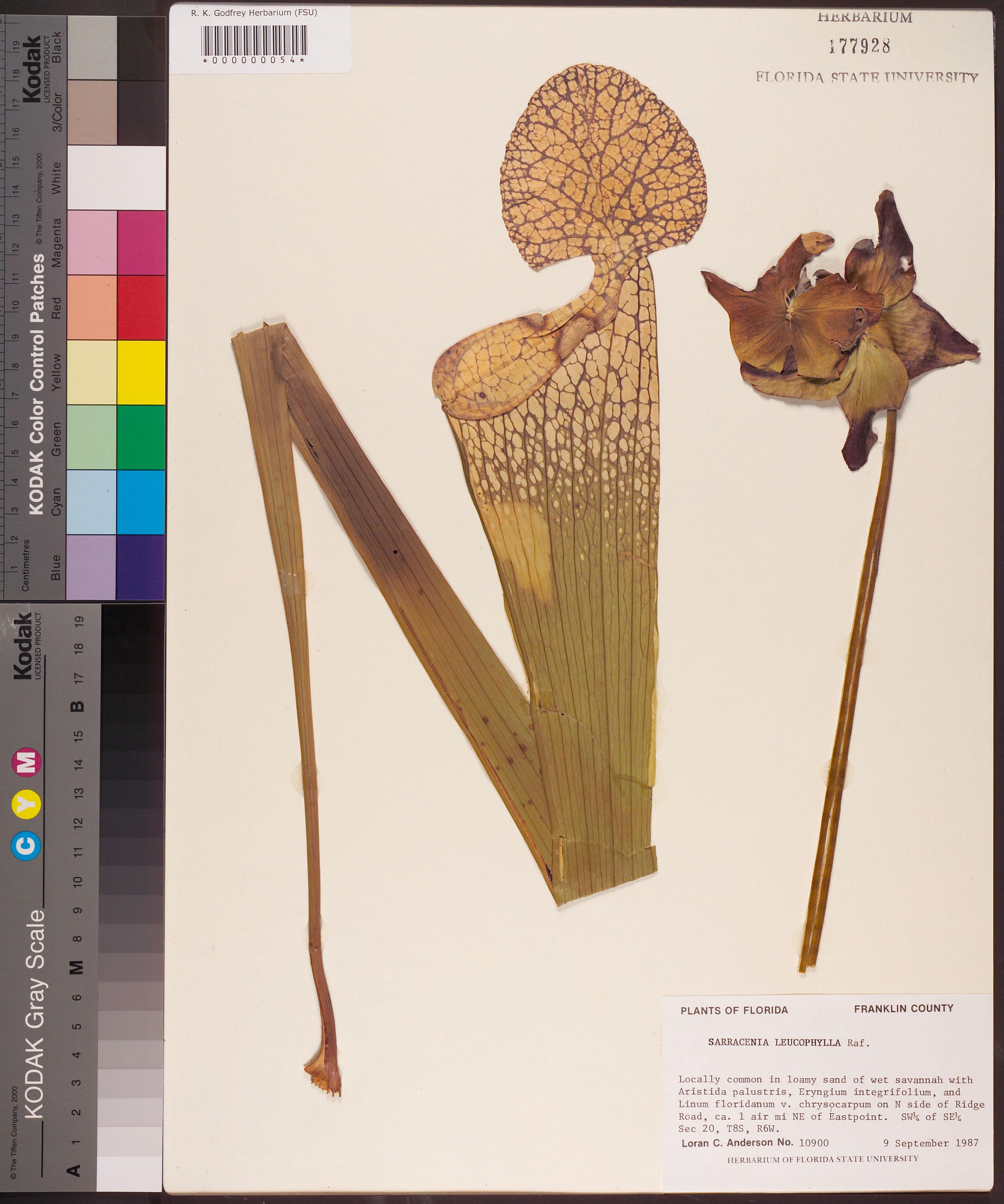
White-top Pitcher Plant
Stretching across the Florida panhandle to eastern Louisiana along the coast, the EGCP is home to 125 endemic plant taxa (species and varieties found nowhere else), including the White-top Pitcher Plant (left). A large number of the regional endemics are restricted to pine-dominated wetlands and uplands, two communities that have dwindled to less than 5% of their original extent and are now considered among the most endangered ecosystems in North America. Loss of longleaf pine-dominated communities and fire suppression has left many endemics critically imperiled, and the EGCP is also considered a “species endangerment hotspot,” with many of its counties within the top 95th percentile of US counties when ranked by the number of threatened and endangered species in each. The Robert K. Godfrey Herbarium is the most extensive collection of plants from the eastern part of the EGCP.
The herbarium was established in 1940 by Herman Kurz (1886–1966), a professor of botany at what was then the Florida State College for Women. It is named for Kurz’s successor, Robert K. Godfrey (1911–2000), who collected about one-third of the specimens currently in the collection, named many plant species himself, and had 12 plant species or varieties named for him (such as Hymenocallis godfreyi, an endangered spiderlily restricted to one county in Florida; below right). The FSU botanists Loran Anderson, Gil Nelson, and Austin Mast (the herbarium director) currently use the specimens onsite for research and education, as do Florida’s natural resource managers. Through an active loan program, biologists from around the world borrow specimens from the Robert K. Godfrey Herbarium for studies of plant and microalgae systematics, ecology, evolution, biogeography, conservation biology, anatomy, and morphology.
About a third of the Robert K. Godfrey Herbarium’s specimens have been digitally imaged, databased, and georeferenced since 2003, thanks to support from the National Science Foundation, the Florida Department of Environmental Protection, and the Florida Fish and Wildlife Conservation Commission and the (typically) short-term efforts of about 75 students and staff members. This third of the collection is searchable at http://herbarium.bio.fsu.edu/search-specimens.php, allowing anyone with access to the web to sort result tables, browse through images, and generate distribution maps.
The Robert K. Godfrey Herbarium would like to complete the digitization of the remaining two-thirds of the collection in the next 10 years. This parallels the broader goal of the US biodiversity research community to digitize the roughly 90% of the 1 billion biodiversity research specimens yet to be digitized in US collections in the next decade. This ambitious community goal can be reached with greater coordination and standardization within the digitization community, more efficient workflows, technological innovation, and broader participation—ESPECIALLY public participation. For more information on how the public can contribute, see the report on iDigBio’s Public Participation in Digitization of Biodiversity Specimens Workshop organized by the Robert K. Godfrey Herbarium’s director, Austin Mast.
The Robert K. Godfrey Herbarium (and all of the world’s biodiversity research collections) need your help to make our specimens broadly discoverable and potentially useful to everyone. Thank you, Notes from Nature community members!
-Austin R. Mast, Director of FSU Robert K. Godfrey Herbarium
Profile of Notes from Nature Team Member: Peter Oboyski
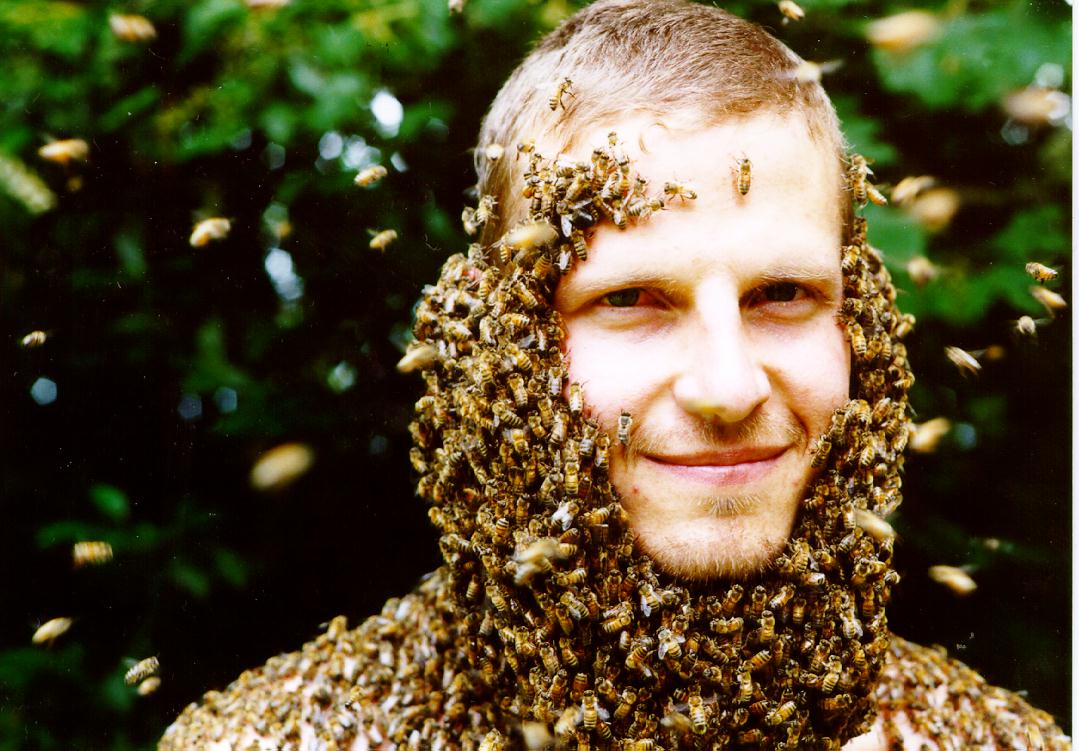 Where do you work primarily? Essig Museum of Entomology, University of California, Berkeley, and field work in California, Hawaii, French Polynesia
Calbug’s Entomology Collections and Arthropod* Diversity
Tens of millions of insect and spider specimens lie pinned into drawers, folded in envelopes, or are floating in jars of alcohol within the major entomology collections of California.** Each specimen’s tiny labels, usually about the size of a honeybee, hold information on who collected it, where and when it was found, what species it is and who identified it. Until now, this information was locked in the drawers and cabinets of eight museums, scattered throughout the state. Calbug is a collaborative effort to begin unlocking this data by digitizing information for over one million specimens and publishing it online.

Inside the Essig Museum of Entomology at UC Berkeley. Photo by Marek Jakubowski, 2010.
The rich history of arthropod collecting in the state kicked into high gear with the California Insect Survey, which launched in 1939 to document the diversity and composition of insects and arachnids. A major goal was (and is) to provide practical information about insects, primarily for agriculture. Crops, for example, rely on pollinating insects (like bees and butterflies) and are plagued by pests (like aphids), while other insects (such as ladybugs and parasitic wasps) can help control the pests. Bugs provide a variety of benefits and detriments to other organisms—some assist in decomposing dead matter or provide food for birds and other vertebrates, while others may be vectors of disease or pests. Entomologists have been busy collecting as many of them as possible. While a majority of our collections are from California and the western United States, we have specimens from all over the world.
Besides being key components of agriculture and other ecosystems, insects are the most diverse animal group on the planet, with over one million described species. This accounts for 80% of all known animal diversity. Studies estimate that there are likely five to ten million extant arthropod species in total, including those that have not been discovered yet. Such large diversity, and the small size of individuals, means that a single museum may house millions of specimens. For example, the Essig Museum of Entomology at UC Berkeley has an estimated six million specimens and the California Academy of Science has about ten million. In fact, we have so many specimens, that we can only estimate how many there actually are!
Click here for some great arthropod photos.

Western Branded Skipper (Hesperia colorado), on a flower. Photo by Ray Bruun, 2011.
Because the databasing task is so large, we are first focusing on specific localities that have been sampled more consistently through time, and on groups that address important environmental issues (such as the pollinators and pests mentioned above) and charismatic species (like colorful dragonflies, butterflies and beetles) that have been well-collected over time. The end result will be a specimen database of geographically referenced specimens, and analyses of how changes in species distribution relate to land use and climate.
In addition to learning about the distribution of individual species, we can use insects and spiders as indicators of environmental change. These diverse creatures have relatively short life spans, limited distributions, and a wide range of tolerances to habitat alterations. They can therefore provide fine-scale information on habitat change that we use to better understand how ecological communities are changing over time, and make predictions about the future.
In future posts we will discuss some of these groups in more detail, so stay tuned!

Ohlone Tiger Beetles (Cicindela ohlone), mating. Photo by Joyce Gross, 2010.
For the launch of Notes from Nature, the CalBug team chose to share some of our charismatic species like Tiger Beetles, Bombardier Beetles, and Skipper Butterflies. These insects are striking in appearance, but also have fascinating behaviors—check out the links below to get a glimpse. We hope you enjoy these insects as much as we do, and thank you for your help!
*An arthropod is an invertebrate with an exoskeleton, a segmented body, and jointed appendages. This includes insects, spiders, crustaceans, and more.
**Calbug institutions include: The California Academy of Sciences, Essig Museum at UC Berkeley, Bohart Museum at UC Davis, Entomology Research Museum at UC Riverside, California State Collection of Arthropods, San Diego Natural History Museum, LA County Museum, and Santa Barbara Museum of Natural History.
-Joanie Ball
Additional Links:
Bombardier Beetles:
http://www.wimp.com/bombardierbeetle/
http://ncse.com/cej/2/1/bombardier-beetle-myth-exploded
Ground Beetles:
http://carabidae.org/carabidae/brachinini.html
http://carabidae.org/carabidae/cicindelinae.html
Tiger Beetles:
Why do we need so many collections of the same plant?!
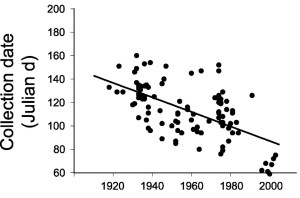
Figure from a paper by C. Lavoie and D. Lachance showing a shift toward earlier flowering time for coltsfoot (Tussilago farfara). Image used by permission of the Botanical Society of America.
When people first get a look inside of a herbarium cabinet they often ask: “why do you need so many specimens of the same plant species?” Well there are a few reasons for this. People who study plants don’t just want to see one example of a species. They may want to see multiple collections so that they can understand the variation in characters for the species. For example, the leaf shape may be highly variable so we would need to see different specimens to understand this. It may also be important to get an idea of all the places where a certain plant can be found. We would need several specimens from different locations to understand the geography. We may also want to know how characteristics of a plant, or its geographic distribution, might be changing over time. In this case, we would need collections from multiple years.
The change in when plants bloom (aka phenological shift) has received a lot of attention over the past few years. It is now well established that changes in the climate have caused many species to shift the timing of when the leaves emerge in the spring (leaf out) and when the flowers open. This shift has major implications. One example is that a plant might bloom before its pollinators are available. If pollination does not occur, this could result in the plant not being able to produce fruits and seeds, which are important for the future success of the species.
Herbarium specimens can be used in a relatively simple way to study phenological shifts.
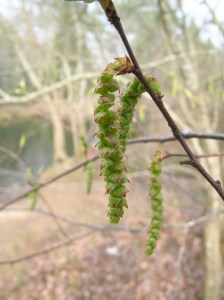
American Hornbeam (Carpinus caroliniana) flowering in March 2007.
Using the date information provided on the specimen label, we can record the day of the year that different plant collections were made (e.g., collections showing flowers in bloom) and graph these values against the year. What is commonly found is that plants are blooming earlier as a response to a warmer climate. For example, the graphic at the right shows how a plant is blooming earlier. The collections made in the year 2000 bloomed several days earlier than the ones collected in 1920. The full article can be read here.
I am interested in knowing the date that plants were collected for a different reason.
For exotic species, or species that are relatively newly introduced into an area, it is valuable to know when they first arrived in a new place and how fast they are spreading. If we can locate the earliest museum records of a species in the United States for example, we can then trace its expansion to new areas over time using additional museum records (subsequent collections). We can then examine where the exotic species has spread and how fast. There are many factors that influence the spread of exotic species, but describing the basic aspects of their spread in space and time is a first important step in our efforts to understand this process.
The Notes From Nature projects asks citizen scientists to transcribe specimen labels in order to help record this kind of information that is important in ecological research. The date is a simple but extremely important piece of information. Phenological shifts and the spread of exotic species are two important issues that can be addressed using this information.
-Michael Denslow
Profile of Notes from Nature Team Member: Joan Ball
Name: Joan Ball
Title: Ph.D. Student
Where do you work primarily? UC Berkeley, Essig Museum of Entomology
What you do in your day job? I study aquatic insects as indicators of freshwater ecosystem health.
What’s your role with NfN and what do you hope to gain from it? If relevant, how will your research benefit? I work on the Science team for Calbug and I’m compiling data from dragonfly and damselfly specimens for my dissertation research. Notes from Nature will provide historical records of species occurrences throughout California that I am using to study changes in dragonfly communities and species distribution over the past century.
What’s the most exciting aspect of citizen science work from your point-of-view? I’m excited for online volunteers to see our insect specimens from wherever they are in the world, and to learn how we use specimen data in research.
What is an herbarium?
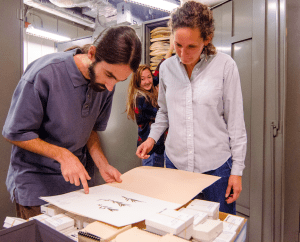
Researchers working in the herbarium at Appalachian State University
An herbarium is a place that houses plant specimens. Many people expect that an herbarium will be filled with living plants. However, these plant specimens are pressed, dried and glued to sheets of paper. They are dead. The sheets of paper are typically stored inside of cabinets for safekeeping and organizational purposes. An herbarium is similar to a library in that both house artifacts (specimens or books) in a safe and organized way that allows them to be found and used by researchers. If plant specimens are stored properly they will last hundreds of years with little sign of degradation.
If you think about it, it makes sense to store plant specimens in this way (as dead samples). Logistically you can fit and care for many more pressed specimens than living plants in the collection. In addition, an herbarium often contains plants from all over the world including plants from diverse habitats such as deserts and alpine tundra. It would be tough to grow all of these different plants in one place.
Herbaria are sometimes part of natural history museums, associated with botanic gardens or academic institutions. The largest herbarium collections in the world are housed in Paris and New York. These large collections contain millions of specimens. However most herbarium collections are much smaller. There are more than 3500 herbaria scattered across the world. In fact, you likely have a local herbarium that contains specimens of the plants that occur in your area. To learn more about the herbaria in your area you can search Index Herbariorum, a global directory of herbaria.
-Michael Denslow
Introduction to Notes From Nature
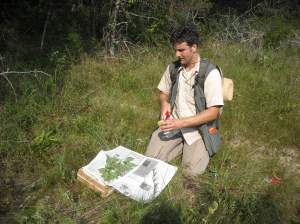
Michael Denslow collecting plants in central Tennessee, USA.
Humans have been collecting specimens from the natural world for centuries. These specimens include samples of rocks, minerals, plants, fungi and animals. In fact, a lot of the knowledge that we have about the earth’s plants and animals is based on specimens that were collected in nature. These specimens are now housed in natural history museums. The world’s great exploration expeditions often included teams of scientists that documented the things that they saw along the way. For example, Lewis and Clark’s expedition of the western United States resulted in the discovery of hundreds of plants and animals that were new to science.
Today, there are an estimated 2 billion specimens housed in natural history collections around the world. This incredible resource provides us with baseline information about the biodiversity of the earth. In addition, the data resulting from these specimens has been used to address a wide range of society’s pressing issues such as public health and environmental change.
However, for this resource to be used to it full potential there must be better digital access to the collections. Most natural history collections are housed in museum cabinets, where they are not easily available to citizens and researchers. It is estimated that only about 1/3 of all natural history specimens are available digitally over the Internet! In effect, the other 2/3 of this biodiversity information is locked away from view. This is despite the fact that the natural history museum community is committed to providing access to this data.
The Notes from Nature project is about digitally unlocking this treasure trove of biodiversity data. Contributions from the public or informally trained people have always played an important role in the field of natural history. These citizen scientists, as they are now called, have made many important contributions, including collecting specimens and even describe new species. Today’s technology provides us with new ways for people to engage with natural history collections, and to help promote access to this biodiversity resource.
The Notes from Nature project has built a tool that enables citizen scientists to make a scientifically relevant contribution though the transcription of specimen label information. Please consider helping us unlock this important information by taking some notes from nature. Every transcription that is completed brings us closer to the goal of providing access to this critical resource.
Take Notes From Nature!
 Notes from Nature