
Arctics – Oeneis butterflies on Notes from Nature
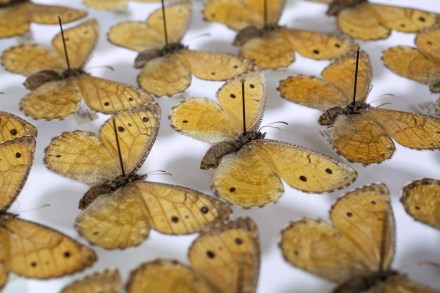
In 2015 the Triplehorn Insect Collection at The Ohio State University received a beautiful donation of more than 50,000 butterfly specimens. This gift came from a local teacher and butterfly enthusiast, David Parshall. It dramatically increased the depth and the breadth of our holdings of Lepidoptera – the moths and butterflies – including representatives of all the butterfly and skipper species found in the state of Ohio. The collection also includes many specimens of butterflies and skippers from Alaska and the Canadian Arctic regions.
A real highlight of the collection are specimens of the genus Oeneis. One of the common names of this group of butterflies is, appropriately enough, “Arctics.” They are found along rocky, mountainous terrain in alpine and sub-alpine habitats. The upper surface of the wings of these butterflies ranges from dull orange to delicate shades of brown and gray. The underside of the wings is beautifully mottled to appear like the rocky terrain and tree bark upon which the butterflies rest. Arctics are strong, fast fliers that are difficult to collect. As just one measure of the value of these donated specimens, they were part of the discovery and description of a species new to science, the Tanana Arctic, Oeneis tanana in 2016. This was the first new butterfly described from Alaska in 28 years.
Oeneis butterflies are adapted to living in the harsh Arctic conditions. They overwinter as caterpillars, and in those cold temperatures, it can take two years to grow from egg to adult. In the North the climate has a strong impact on survival, and so the distribution and flight periods of these butterflies are excellent indicators of environmental change.
Let’s not shy away from the elephant in the room: climate change. According to NASA the extent of sea ice on the Arctic Ocean is declining at a rate of 13.2% per decade. Researchers at the University of Colorado and the University of Wisconsin have concluded that average summer temperatures are now higher than they have been in more than 40,000 years. What will be the impacts of this warming trend? How has this trend already affected plants and animals of the Far North?
The Parshall butterfly collection can help provide some of the answers to these questions. There is evidence that butterflies living in the Arctic are already showing differences in size from the past. By documenting the distribution and flight times of these butterflies in past years, we can then compare the data with modern observations and better assess the impacts of climate change, human population growth, land use changes, etc. It can be difficult to tease apart the importance of each of these influences, but a comparison of similar changes in the distributions of other plants and animals can help to highlight possible common causes.
The first step, though, is the most important: where and when were specimens of these butterflies seen and collected over the past many years. By making the images and specimen data quickly and freely available online we hope to contribute to the investigation of the effects of global climate change on these butterflies. As part of the LepNet Project we at the Triplehorn Insect Collection have already digitized our entire holdings of skipper butterflies and made it fully available online. But there’s a lot of other butterflies still to go and we welcome all the help we can get from the vast community of citizen scientists interested in insect biodiversity.
One of the exciting things about science is that in trying to get an answer to one question, we always come across new discoveries which lead to even more questions. What amazing new knowledge will we gain from accessing all those specimen data? Where will that understanding lead us next? No one knows… yet. Come and embark on this adventure with us!
Find out more about our Arctic Oeneis databasing effort, see the people behind the images, and check out our data transcription tutorial on our project page.
— Norman F. Johnson & Luciana Musetti
Leaves have beards!

Photo by am.zooni
While classifying at NfN, do you sometimes see a specimen that is particularly beautiful, or one that looks odd, and wonder what the living plant looks like? Or perhaps your curiosity is roused when you transcribe a label for a familiar species or location. Take hold of that thought and build on it.
There are many excellent sources of photos and information about plants online: use them. But add depth, and literally, add life, to your “book learning”, by going outdoors to observe nearby plants. You may discover a wealth of awesome things all around you, which previously escaped your notice.
Take a close look at a flower, a bud, a fruit, a leaf. A very close look. Use the zoom on your phone camera as a magnifying glass to get an even closer view. You’ll see all sorts of patterns and textures. For example, many plant are hairy creatures: fine hair, thick hair, short hair, long hair, surfaces with an even coat of hair, or a clumpy one, or with a fringe of hair at the margin. Turn a leaf over and look at the underside. Even a plant with a smooth, hairless leaf surface may have “beards” where the veins join the main rib, or at the base. Leaves have beards! Who knew? (See some examples.)
There are endless fascinating things to learn, once you begin paying close attention to plants. If you can, revisit the same plant every week or two, and observe buds as they develop into flowers or leaves, and flowers as they develop into ripe fruits. It’s exciting to see how the parts of a plant look and grow and change, through all four seasons. (Yes, even in the depth of winter, there is much you can learn.) It takes patience, but the rewards are rich.
It isn’t necessary to have studied botany, or to visit a natural, undisturbed environment. Finding a variety of plants to observe is more convenient if you have easy access to a “leafy” park or neighborhood, but plants are everywhere, even in a dense urban environment. The flower at the top of this post (Cichorium intybus, or chicory) was found on a plant growing in a crack between a paved road and its curbstone.
Give plant observation a try! You will see your surroundings with a fresh perspective, and learn a lot along the way. There are things to surprise and delight you at every turn.
— Ann (am.zooni)
[This is guest post from a NfN volunteer. We are always open to blog contributions from the NfN community. If you have a blog idea please reach out to Michael on Talk (md68135).]
ICEDIG – glimpse on the diversity of European collections

Take part in a European-wide experiment and help us discover the best methods to unlock the information stored within herbarium cupboards.
The ICEDIG project, “innovation and consolidation for large scale digitisation of natural heritage”, is funded by the European Union and aims to address many of the challenges that lie ahead to enable the mass digitisation of more than one billion specimens of natural history collections across Europe (https://icedig.eu/).
We need your help! We are experimenting with transcription on different crowdsourcing platforms using specimens from different herbaria, from many countries. Within this expedition you will find specimens from Botanic Garden Meise (BR), Botanischer Garten und Botanisches Museum Berlin-Dahlem (B), The Natural History Museum London (BM), Royal Botanic Gardens, Kew (K), Royal Botanic Gardens Edinburgh (E) and Muséum National d’Histoire Naturelle (P). The goal was to create an expedition with a good cross section of specimen characteristics, typed and handwritten labels, covering a wide range of collection dates, different countries and families. The aim is to try and discover if and why some specimens are harder to transcribe than others. We will share our findings with you.
Exceptionally, you will see the same specimens have been put up on several other crowdsourcing platforms. This is to allow us to analyse and compare transcriptions from different platforms.
If you like variety in your transcriptions, then this is the challenge for you. Thanks to all in advance from the ICEDIG team for trying the expedition. Happy transcribing!
— Sarah Phillips, Royal Botanic Gardens, Kew
Calling all young people taking part in Notes from Nature!
Dear NfN Community,
You might notice an email coming from the Zooniverse team in the coming days, calling for young people to join a new research study, and we wanted to share a little more about this with you.
The Notes from Nature platform supports the transcription of data form many different Museum collections, including those from the Natural History Museum in London. Alongside participating in Notes form Nature, the Museum is responsible for a number of other citizen science projects relating to its collections and research and is taking part in an international collaboration to better understand how young people engage with projects of this nature.
The study is being carried out by researchers at the Open University and University of Oxford in collaboration with a range of other museums and academic institutions in the USA, funded by the National Science Foundation, Wellcome Trust & ESRC. The team aims to gain a better understanding of the experiences of people between the ages of 5-19 when taking part in Zooniverse projects, with the ultimate goal of designing better projects and tailoring learning experiences specifically for this age range.
As you might have guessed, Notes from Nature has been selected as one of the citizen science projects to be used in the study. The site and the classification process will remain exactly the same, however, if you’re one of our younger online-volunteers and would like to take part in the study you can find out more and sign up to be a part of it here [https://openuniversity.onlinesurveys.ac.uk/zooniverse].
Wading through Water Plants in Virginia
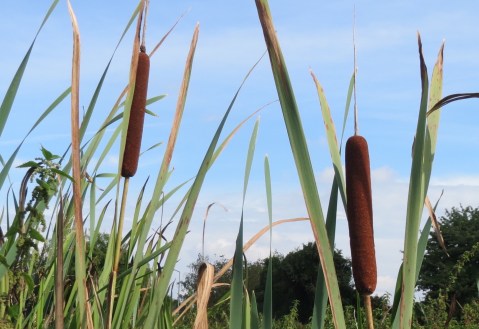
Water plants are a diverse group of species that can be found in a number of unrelated families. We’re focusing on aquatic flowering plants in this expedition, although they can be found in other groups. Even ferns have aquatic members, like the nitrogen-fixing mosquito fern (Azolla).
Some aquatic plants can be large, showy, and easy to identify. Big, bright water lilies (Nymphaceae) are certainly hard to miss! Many of these water plants have converged on a similar morphology for ecological and evolutionary success. These plants frequently have very narrow (cattails; Typhaceae) or finely dissected leaves (water-nymphs; Najas) for life in the water.
These plants can often be quite common but they often pass under our radar. Sometimes we can’t access them out in a lake or in a mucky pond. And sometimes we might just pass them by without even noticing the smaller, less conspicuous species.
We would love to fully digitize our aquatic plants and make their collecting data available to students, researchers, artists, and others world-wide. So please help us with this expedition! You will get a chance to hone your ID skills for these diverse plants found across Virginia, U.S.A. Thank you!
— Jordan Metzgar, Virginia Polytechnic Institute and State University
Happy 2nd Anniversary!
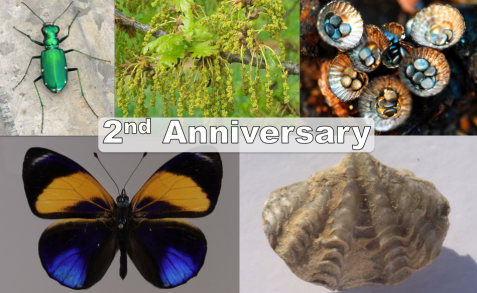
It has been two years since we launched the new version of Notes from Nature or what we sometimes call “NfN 2.0.” We wanted to take a moment to thank everyone and reflect on some events.
In the past two years, over 666,000 images have been transcribed by over 6,000 amazing volunteers. We have completed 124 expeditions from a variety of plant and animal groups. We have launched some mobile app based expeditions, and have been featuring more simple expeditions such as State Spotter and lots related to phenology. Our goal is to both facilitate science and provide a variety of rewarding volunteer experiences on the site.
There have been some milestones as well such as setting a new record of over 8,000 transcriptions in a single day!
Notes from Nature has also continued to have onsite events such as the one we organized on Earth Day this year called Take a Note. WeDigBio continues to be major yearly event for Notes from Nature and some of the team recently published a paper about it. Let’s not forget about museum kiosk event called Phenomuse!
We would like to take this opportunity to thank the Zooniverse team and all of the specimen image providers that we work with, but most of all the site wouldn’t be a success without a dedicated group of volunteers. We sincerely hope that you all find value in working with us and we remained committed to providing a valuable experience for you. We have some neat, new additions planned for Notes from Nature in the coming year, and can’t wait to share some of those soon.
Sincerely,
The NfN Team
NitFix Appreciation and Update
We wanted to take a moment to thank all that have helped with the NitFix expeditions. There has been a fantastic response to this project on Notes from Nature. The 5th expedition is currently at 17% complete and four expeditions have finished so far with over 15,000 transcriptions already completed!
Today there are researchers from the NitFix team collecting more samples at the Missouri Botanical Garden herbarium for analysis. This is one of the largest herbaria in the world with over 6.6 million specimens. To date the NitFix team has had 90% sequencing success meaning that they have been able to get genetic sequences from 90% of the samples collected. That is a really good considering that all of these samples have come from herbarium specimens as opposed to fresh plant tissue.
We expect about 6 more expeditions to come in the future as the NitFix team continues this ambitions project. You can continue to follow progress at the NitFix website and on Twitter @Nit_Fix
East Coast Versus West Coast Transcription Battle
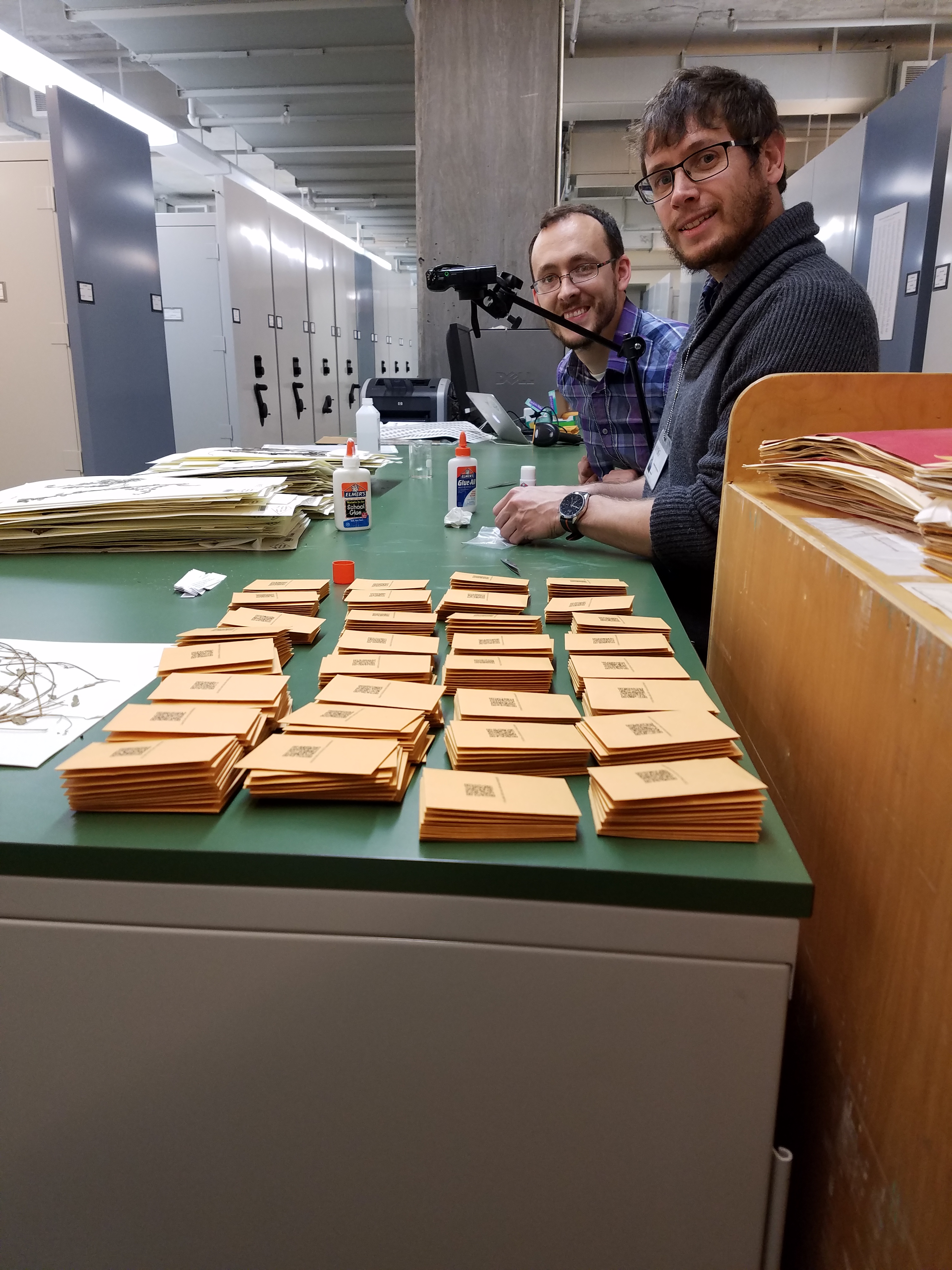
Our West Coast entrant is the California Academy of Sciences herbarium, who were kind enough to host us for three weeks in January for a marathon effort to sample herbarium sheets. Our worked focused on the very strong collections of nitrogen fixers from Mexico and Central America.
So its East Versus West in an epic transcription battle! We’ll update how each expedition is doing in terms of weekly effort and see who will get the crown.
Finally a very quick update that we are motoring through extracting DNA from all our samples, and have had excellent success so far getting DNA from most of our samples. We’ll have more to report about sequencing efforts, which are now underway, in a follow-up post.
Rob Guralnick and Ryan Folk, Florida Museum of Natural History
Notes from Nature and the Florida Museum Launch the ‘Take a Note for Earth Day’ campaign
It’s Earth Day again! To celebrate, we are launching “Take a Note for Earth Day” in collaboration with the Florida Museum of Natural History.

From April 20 – 22, we are encouraging people to do one transcription and post about it on social media using the hashtag #TakeANote. In the time it takes to order a cup of coffee, you can help scientists document life on our planet!
We will be releasing a few expeditions leading up to the weekend, and on Sunday, there will be a special expedition available to people who drop by the Florida Museum between 1 and 5 p.m. Participants will have an opportunity to talk to botanists, see museum specimens and get a Notes from Nature sticker for helping out.
So, order a cup of coffee and do one transcription, and don’t forget to post about it on social media! #TakeANote
Thank You! Meet Our (MGCL) Sack-bearer Moths, aka Poop-house Caterpillars!
Thank you for your work on the Mixed Bag of Specimens from the McGuire Center! It was amazing to see this expedition finish in a short amount of time. We have another grab bag of specimens for you to transcribe. But before transcribing read about some of the moths you will be transcribing, thanks to graduate student Ryan St. Laurent.

Throughout the Americas, but especially in the rainforests and savannahs of Latin America, live a peculiar family of moths called Mimallonidae. These moths are colloquially known as “Sack-bearers,” a name derived from their strange caterpillars which make open-ended shelters that are unlike any other constructed by butterflies and moths. These shelters are made of frass (poop), silk, and plant material; the caterpillars drag around their funny houses much like a hermit crab carries its shell. Sack-bearer caterpillars have evolved specialized bodies adapted to living inside these shelters, their heads and butts are tough and shield-like, so they can stuff either end of their bodies in either opening of their house, preventing unwanted intruders from entering. While these shelters usually appear mostly to be made of leaves and silk, the frass is interwoven into the shelter, providing structure and rigidity. The frass pellets are actually used much like little bricks. Maybe these moths are more accurately called Poop-house Caterpillars, rather than Sack-bearers? Relative to many other moth families, the Poop-house caterpillar family is not particularly diverse, with only about 300 species total. Despite the low number of species, and restricted distribution, Mimallonidae are an interesting piece of the overall evolutionary puzzle of Lepidoptera (butterflies and moths). From recent studies that examined the DNA of many families of Lepidoptera, it has become increasingly clear that Mimallonidae share a common ancestor with a globally distributed group of moths that also happens to be the most diverse in terms of number of species. Does this mean that the ancestor of most moths that are alive today was like a Poop-house caterpillar, and not like a typical caterpillar that you might find in your garden? Therefore, it seems that studying Mimallonidae will help researchers unravel the evolutionary history of butterflies and moths more broadly. This Notes from Nature expedition, which includes moths of this fascinating family, will be the first attempt to digitize and transcribe labels of an entire Mimallonidae collection, setting the stage for countless studies on Mimallonidae and Lepidoptera more broadly, by making images and data of hundreds of these specimens available to researchers around the world.
— Stacey L. Huber, Digitization Coordinator, McGuire Center for Lepidoptera & Biodiversity, Florida Museum of Natural History
 Notes from Nature