
Thank you and more about spectacular underwings moths

Photo by Lary Reeves
Once again, thank you NfN community for helping complete the fourth expedition digitizing the spectacular underwings moths! With this data, researchers can begin to examine the moths’ distribution changes, changes in host plants, and impacts of climate change during the last century. As we take a break from spectacular underwing moths, Lary Reeves (a photographer and PhD candidate at the University of Florida in the Entomology Department), has provided more information and photos of the Catocala moth.

Photo by Lary Reeve
The Catocala moths have been popular among moth collectors for more than a century, in part, because they are both diverse and charismatic. Each of the world’s ~230 Catocala species is a unique variation of a repeated theme: cryptically patterned forewings coupled with striking, often colorful hindwings. This theme earns Catocala the common name of underwing moths. In North America, there are at least 110 species with more than 100 named color forms within the species. New species are described with regularity. The Catocala species are made to be even more charming by their romanticized, and sometimes sorrowful, names, e.g., C. amatrix (sweetheart underwing), C. amica (girlfriend underwing), C. insolabilis (inconsolable underwing), C. lacrymosa (tearful underwing), C. piatrix (penitent underwing), C. muliercula (little wife underwing), C. nuptialis (married underwing), C. neogama (bride underwing), C. vidua (widow underwing), among many others.
During the day, Catocala moths rest on tree trunks or dark, sheltered locations such as underneath bridges, in tree cavities, on the root masses of overturned trees, or in caves, giving them a mysterious countenance. They rest with their gaudy underwings covered by cryptic forewings, camouflaging the moth against the substrate. If approached too closely, the unseen moth, sometimes surprisingly, explodes from its resting site in a flurry of striking colors as the hindwings flash into view. At night, Catocala become active and seek out mates and sugar, feeding from flowers, tree sap or rotting fruit.

Photo by Lary Reeves
There are a variety of ways to collect Catocala that have been practiced and refined for more than a century. Like many other moths, Catocala can be attracted to lights, particularly those towards the ultra violet end of the spectrum. They are occasional visitors to porch lights, even in relatively developed areas. Most nocturnal moth taxa are attracted to lights. Light trapping is an effective and common method for collecting moths in general, but for Catocala, there are more productive, targeted methods.

Light trapping
As the sun sets, Catocala moths become active and begin their nightly search for sugar. Catocala and many other erebine moths are highly attracted to rotting, fermenting fruit and tree sap. One of the targeted methods of collecting Catocala is baiting or sugaring. As fruit rots and ferments, sugars are converted to alcohol which may provide an olfactory cue for hungry moths. To concoct a bait for Catocala, the two required ingredients are sugar and alcohol. Many collectors have their own, sometimes complex bait recipes. The most basic of these rely simply on white or brown sugar mixed with beer or wine. This bait can be augmented with rotting fruit (bananas, apples, mangoes, peaches, pineapple, watermelon, berries, etc.) or yeast. One useful and relatively affordable recipe is 1.8 kg brown sugar, 1.5 L Carlo Rossi red wine, 2-3 kg overripe bananas and a couple of packets of yeast. This recipe can be mixed in a large bucket. Baits that include fruit should be given at least 24 hours to ferment before use. Failure to provide time for adequate fermentation may result in an ineffective bait.

Ingredients for bait
Once the bait is ready for use, it can be applied in several ways. One of the common methods is to apply the bait to the trunks of trees with a large paintbrush. Ideally, this is done along a trail that traverses suitable habitat. (In Florida, the greatest Catocala diversity and abundance is found in habitats that contain high densities of hardwood trees.) Catocala moths are wary and startle easily. They are particularly sensitive to sound. Using trails reduces the likelihood that moths will fly off in response to the vibration of footsteps or crunching of leaves. Bait-feeding Catocala moths should always be approached as stealthily as possible. Another method of applying bait is ropes. Rope can be soaked in the bait and hung from trees or other conspicuous locations. Catocala are readily attracted to these baits. Once it has been applied, moths usually begin to arrive within 30 minutes. Baited trees and ropes can be checked and revisited at 30-60 minute intervals, usually with new arrivals on each pass. While the moths are easily startled by sound, they are somewhat distracted by feeding and can be cautiously approached to be photographed or collected. Catocala are strong fliers, and once they have been disturbed from feeding, may be difficult to collect without a net. However, if a headlamp or flashlight is used, a startled Catocala often makes several circles around the light source before flying off into the darkness, offering a frantic, last ditch opportunity to collect.
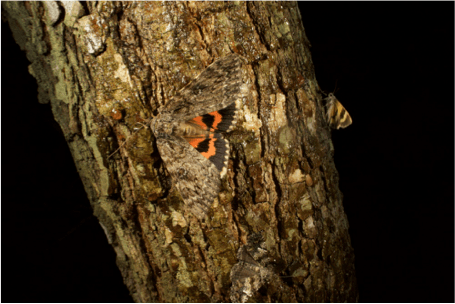
Moth feeding on bait
Another method for collecting Catocala is to locate them at their diurnal roosting sites. Against many substrates, Catocala are well camouflaged. Unless their position is given away by movement, they are likely to go unnoticed. However, because they startle easily, inducing a roosting moth to flight is easy. Catocala spend the daylight hours perched against tree trunks, or hidden in the shadows of tree cavities, stumps, the roots of fallen trees, caves or underneath bridges. With some practice, it becomes easy to identify sites that are likely used by roosting Catocala. Knocking on tree trunks, especially those of shagbark hickory, with a hammer or baseball bat will induce any resting moths to fly. Larger trees with a DBH of >30 cm should be targeted. Once flushed, the moth flies, often erratically, just a short distance to a new perch on another tree. If visually tracked, the new position can be located allowing the moth to be quietly approached and netted. This method is somewhat less productive, and requires more effort (and often agility) than baiting.
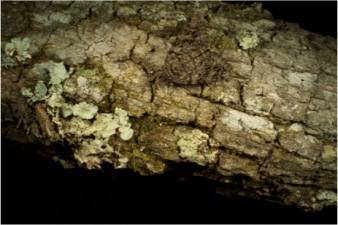
Camouflaged moth
In Florida, Catocala moths become active as adults in late April and are abundant through June. Elsewhere in the U.S., Catocala fly through much of the summer until early autumn. During these times, collecting Catocala can be very productive. For experienced collectors, general naturalists, and those with budding interest in moth collecting, collecting Catocala is an enjoyable and enriching experience. Some species are particularly challenging to collect, either because their populations are very localized or sparse, or for the simple fact that Catocala are wary and easily startled. Catocala are also very diverse, with around 70 species in the eastern U.S. For these reasons, collecting Catocala is a favorite pastime of lepidopterists and naturalists.
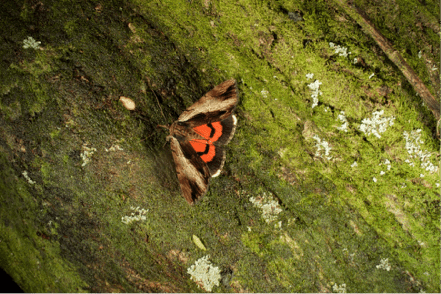
Photo Lary Reeves
— Lary Reeves, PhD candidate, University of Florida
Instagram: biodiversilary
Sea-rocket Phenology
Our next NfN Labs expedition focuses on the phenology of species of Cakile (sea-rockets), a group of wildflowers in the mustard family (Brassicaceae). These species are called sea-rockets because they often grow close to the coast, often in sand and near the water’s edge, and it has fruits that look like rocket ships. As you can see from the drawing, they have flowers that are characteristic of the mustard family (4 petals). What you can’t see is that if you bit into one of these flowers, they would have a spicy, mustard-like flavor. The fruits (#4 in the drawing) are unusual among mustards in that the top of the fruit breaks off and can disperse away in water, while the remaining half releases the seed near the mother plant. This makes them great colonizers of beaches. The plants are commonly fleshy, which is common for halophytes (plants growing in salty environments).
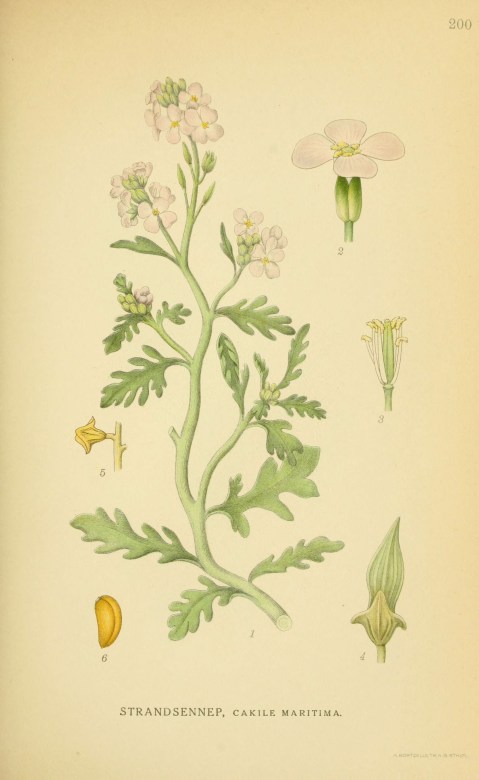
Photo Credit: Biodiversity Heritage Library https://flic.kr/p/abNcGy
We chose to focus on Cakile because these plants are widely distributed across North America. In the case of Cakile edentula (American sea-rocket) and Cakile maritima (European sea-rocket), they are found along both the Atlantic and Pacific coasts. Having phenological data for these sea-rockets will help us look at their responses to changing climate. We are very pleased to be collaborating with Susan Mazer, at the University of California at Santa Barbara, and Jenn Yost, at Cal Poly State University, San Luis Obispo. This expedition is the first of many we hope to launch with them, and all of the efforts are strongly tied to their long-term work to look at historical phenology patterns and to detect the climatic factors that influence these patterns. Our plans are to have them guest blog more about their work and about how this expedition fits in.
The phenological tasks for this expedition are challenging. We are asking you to count buds, open flowers, and fruits. This is an expedition where it pays to pay close attention to the tutorials. These tasks are typically done with specimens in hand. However, we are confident that they can also be done from images and we plan to compare the results using different methods. In addition, we are excited to engage with a much broader community to help us with these tasks and to participate in this valuable research. We encourage you to give these tasks a try, and to do the best you can. For example, counting of buds can be particularly challenging given that they frequently overlap, making them hard to count precisely. For this reason, we are likely to use the averages of the counts provided by participants rather than a consensus for these fields. Please have fun and know that we are especially interested in feedback on how much you like this expedition, how hard you find the tasks, and how we can improve this type of expedition.
All the best from the NfN Team
FERNTASIA!
I hope everyone is having a ferntastic summer so far! We have just released a new expedition “Plants have all the anthers: FERNTASIA” from the BOON Herbarium at Appalachian State University focusing on our fern collection, along with some of our smaller family collections. We promise you will have a sporrific time transcribing our collection!
Thanks again for everyone who helped with completing “Plants have all the anthers: Pt1”! Look forward to the completion of this fun little expedition.
— Jordan Willett, BOON Herbarium, Appalachian State University
New phenology themed badges
The NfN team is excited to announce that we have a new set of badges. As many of you have likely noticed we have been experimenting in our Labs group with some new kinds of expeditions. So far these have all been related to Phenology. For this reason, we thought it would be fun to have a set of phenology themed badges. These badges can be earned by scoring 2, 10 and 100 specimens. Here is the first one called the Blossoming Badge.

The Blossom Badge
Instead of showing you all the badges here, we thought we would create some suspense (and maybe motivation!) by letting you see the rest of them once you reach each threshold. Score 10 specimens for the Multi-blossoming badge and 100 for the Fruiting Badge.
Please take a look at the phenology themed expeditions and let us know what you think. We have one running now and expect to launch another very soon.
The NfN Team
Danke schön
The Botanic Garden and Botanical Museum Berlin says “Danke schön” – “Thank you”

Herbarium and the biodiversity informatics staff at the Botanischer Garten und Botanisches Museum Berlin
Thanks a lot to the Notes from Nature Community for completing the Amaranthaceae expedition. Your transcriptions are very helpful for the Caryophyllales (an order of flowering plants that includes the cacti, carnations, amaranths, etc.) research group at the Berlin Botanical Museum. We’ll include the results into information systems to make them available for further research queries. You classified 444 specimens which is great! Many labels on these specimens were handwritten and not easy to read. All the more we appreciate your enthusiasm and endurance!
The results of the Amaranthaceae Expedition help our team to track back distribution patterns of this plant family and are important for biogeographical analyses and dynamic monographs of the group.
Dr. Sabine von Mering, Coordinator, Caryophyllales Research Group
Kind regards,
Agnes Kirchoff, Botanischer Garten und Botanisches Museum Berlin
New expedition: Microbe Mutualists!
Introducing a new ecologically-themed expedition from Plants of Virginia: Microbe Mutualists! An overwhelming number of plants rely on beneficial microbes – microscopic fungal mycorrhizae and bacteria – to improve their access to mineral nutrients, such as nitrogen, phosphorous and potassium, in the soil.
Jump into the expedition to learn more about the taxonomic breadth of these interactions, which are occurring under our feet in our backyards every day. In this edition, over fifty of the most common microbe mutualistic genera residing in the state of Virginia are highlighted.
Introducing WeDigFlowering
When do plants flower across time and space, and how does this change with temperature, precipitation, and species? These are the questions that inspired me to work with biodiversity informatics: using the “big data” of herbarium specimen records to answer pertinent ecological and evolutionary questions. Herbarium specimens are like time capsules, capturing a snapshot of the phenological (i.e., reproductive) status of a plant at a particular point in time and space. From these aggregated data, we can discover patterns that help us explain the natural world.
Herbarium specimens have already helped us discover that many plants flower early in response to warmer temperatures, but some phenological responses are not so predictable (Willis et al. 2017). The U.S. Southeastern Gulf Coastal Plain is a particularly interesting place to further study this phenomenon because of its unique biodiversity and warm, humid climate. The many different species could be responding to different cues, and understanding these cues could help us predict future shifts with climate change.
The WeDigFlowering project provides a unique opportunity for interested volunteers, students, and citizen scientists to contribute to the study of phenological shifts. In it, participants estimate the percentage of buds, flowers, and fruits on an herbarium sheet, and these data help determine the approximate “phenophase” of the specimen. I hope you join us for this exciting, new project, and that you enjoy the flowers as you go!
Katie Pearson, Graduate Student and Curator, R. K. Godfrey Herbarium, Florida State University
http://mastlab.org/people/katelin-d-pearson
Cited study: Willis CW, Ellwood ER, Gallinat A, Mazer S, Nelson G, Pearson K, Primack R, Rossington N, Sparks T, Yost J. Old plants, new tricks: phenological research using herbarium specimens. Trends in Ecology and Evolution. 32(7):531-546.
Happy Anniversary

It has been a year since we launched the new version of Notes from Nature or what we sometimes call “NfN 2.0.” The new platform has been a big improvement for us, providing the opportunity to really bring a range of new expeditions up and online, and to connect to more people than ever before. We hope NFN2.0 has been something in which you’ve been excited to take part!
In the past year, over 281,000 images have been transcribed by 3,641 registered volunteers. We have completed 64 expedition from a variety of expeditions groups. We added fossils, butterflies, aquatic insects and even brought back fungi to the site. We hope to have new and exciting expeditions to bring forward in the next year, including more phenology exhibits and new groups. There are some exciting new developments on transcription improvements, field book contents, and how we organize our expeditions, that should also come online in the next year. We can’t wait for Y2 for NFN2.
We would like to take this opportunity to thank the Zooniverse team and all of the specimen image providers that we work with, but most of all the site wouldn’t be a success without a dedicated group of volunteers. We sincerely hope that you all find value in working with us and we remained committed to providing a valuable experience for you.
Sincerely,
The NfN Team
BOON herbarium thanks you!
Our “Plants have all the anthers! Pt 1” was a great success! We appreciate everyone’s hard work. This first expedition contained over 780 specimens, which is no small feat. As the title suggests, this was is just the beginning! Soon our new expedition will launch so keep an eye out for “Plants have all the anthers! Pt 2”. Feel free to follow the BOON Herbarium on Facebook or Twitter to keep track of all the exciting discoveries and events we have going on. The BOON Herbarium thanks everyone for their time and effort for making Notes from Nature such a success for all herbaria!
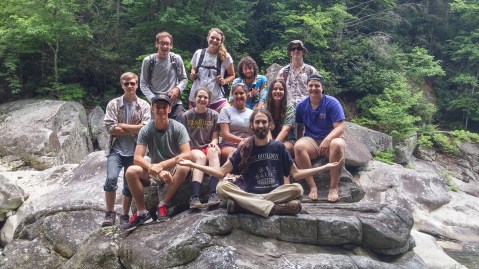
A botany class out exploring at Appalachian State University
— Jordan Willet, Appalachian State University, Boone, North Carolina, U.S.A.
Editor’s Note: BOON is the official acronym for the herbarium at Appalachian State University. A resource called Index Herbariorum compiles the acronyms for the over 3,000 herbaria around the world.
 Notes from Nature